How to Keep Aluminium Extrusion Press Alignment Accurate: A Comprehensive Maintenance Guide

The Critical Importance of Alignment in Aluminium Extrusion
In the world of metal fabrication, precision is not just a goal; it is a requirement for survival. When discussing how to keep aluminium extrusion press alignment accurate, we are addressing the fundamental heartbeat of the production line. An aluminium extrusion press is a massive piece of industrial machinery designed to force heated aluminium billets through a die to create complex profiles. However, the sheer force involved—often thousands of tons—means that even a microscopic deviation in alignment can lead to catastrophic failures, poor product quality, and excessive wear on expensive components.
Maintaining accurate alignment ensures that the main ram, the container, and the die are all perfectly centered along a single longitudinal axis. If this axis is compromised, the resulting lateral forces can cause the extrusion stem to bend, the container to wear unevenly, and the final aluminium profiles to exhibit wall thickness variations or structural defects. For operators using HARSLE equipment, understanding the nuances of alignment is the difference between a high-yield operation and one plagued by frequent downtime and scrap material.
Furthermore, the financial implications of misalignment are staggering. Beyond the immediate cost of rejected profiles, misalignment accelerates the fatigue of tie rods and main cylinders. Replacing these components involves significant capital expenditure and weeks of lost production. Therefore, establishing a rigorous protocol to keep aluminium extrusion press alignment accurate is the most effective way to protect your investment and ensure long-term profitability in the competitive aluminium market.
Why Maintenance is the Foundation of Precision
Maintenance is often viewed as a reactive necessity, but in the context of extrusion press alignment, it must be a proactive strategy. The environment of an extrusion plant is harsh, characterized by extreme heat, high pressures, and fine metallic dust. These factors constantly work against the mechanical stability of the press. To keep aluminium extrusion press alignment accurate, maintenance teams must transition from a ‘fix-it-when-it-breaks’ mentality to a predictive maintenance framework.
The foundation of this framework is the understanding of thermal expansion. As the press heats up during operation, the metal components expand. A press that is perfectly aligned when cold may shift significantly once it reaches its operating temperature of 400°C to 500°C. Maintenance routines must account for these thermal shifts, ensuring that the guide rails and platens are adjusted to maintain centering under actual working conditions. Without a dedicated maintenance plan, these subtle shifts go unnoticed until they manifest as visible defects in the extruded aluminium.
Moreover, consistent maintenance preserves the integrity of the press’s foundation. Over years of operation, the vibration and cyclic loading can cause the foundation bolts to loosen or the concrete base to settle unevenly. Regular checks of the press level and the tightness of anchor bolts are essential steps to keep aluminium extrusion press alignment accurate. By treating the press as a living system that reacts to its environment, operators can anticipate alignment issues before they impact the bottom line.
Daily Inspection: The First Line of Defense
Daily inspections are the most effective way to catch early warning signs of misalignment. These checks do not require complex tools but rather a keen eye and a disciplined approach. The first step in a daily routine is a visual sweep of the extrusion stem and the container. Operators should look for signs of ‘scuffing’ or uneven wear on the stem. If one side of the stem appears shinier or more worn than the other, it is a clear indicator that the stem is not entering the container perfectly centered.
Another critical daily check involves monitoring the ‘flash’ or excess metal that escapes between the die and the container. If the flash is thicker on one side than the other, the container is likely tilted or shifted. This not only wastes material but also puts uneven pressure on the die, leading to premature die failure. Operators should also listen for unusual sounds during the extrusion stroke. Grinding, clicking, or heavy vibrations often signal that mechanical components are fighting against misalignment.
Temperature monitoring is also a part of daily inspection. Using infrared thermometers to check the temperature of the guide ways and the main ram can reveal friction points. An unusually hot guide way suggests that the press is leaning or that the lubrication has failed in that specific area. By documenting these daily findings, maintenance teams can identify trends and schedule deeper interventions before a minor deviation becomes a major breakdown, helping to keep aluminium extrusion press alignment accurate over the long term.
Mechanical Checks: Ensuring Structural Integrity
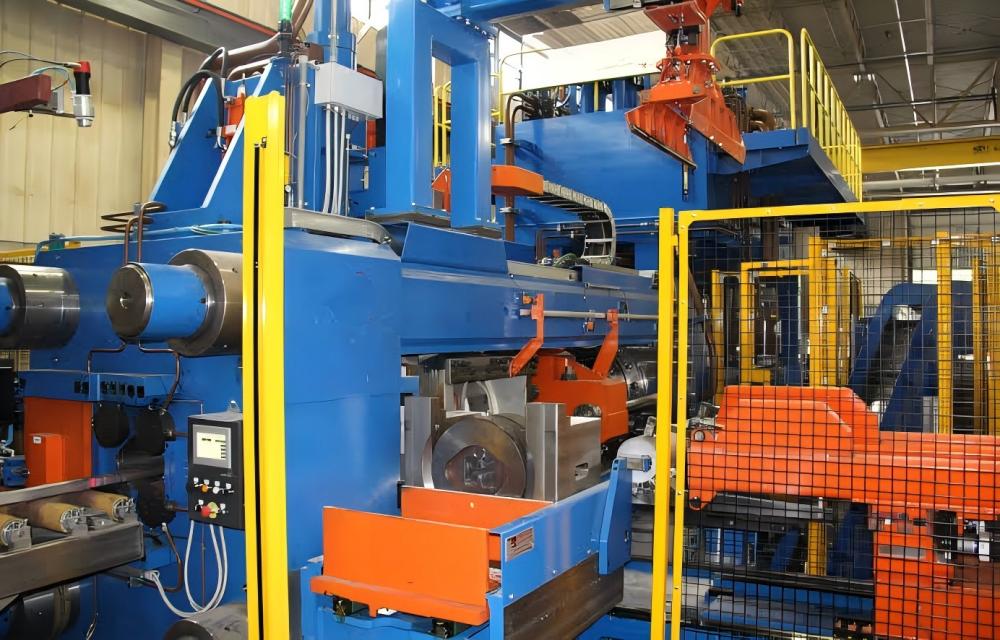
The mechanical structure of an extrusion press is its skeleton, and like any skeleton, it must be perfectly aligned to function. The most critical mechanical components are the tie rods, the platens, and the guide rails. Tie rods are under immense tension; if the tension is not uniform across all four rods, the press will ‘stretch’ unevenly, throwing the entire system out of alignment. Periodically checking tie rod tension using ultrasonic measuring devices is a sophisticated but necessary step to keep aluminium extrusion press alignment accurate.
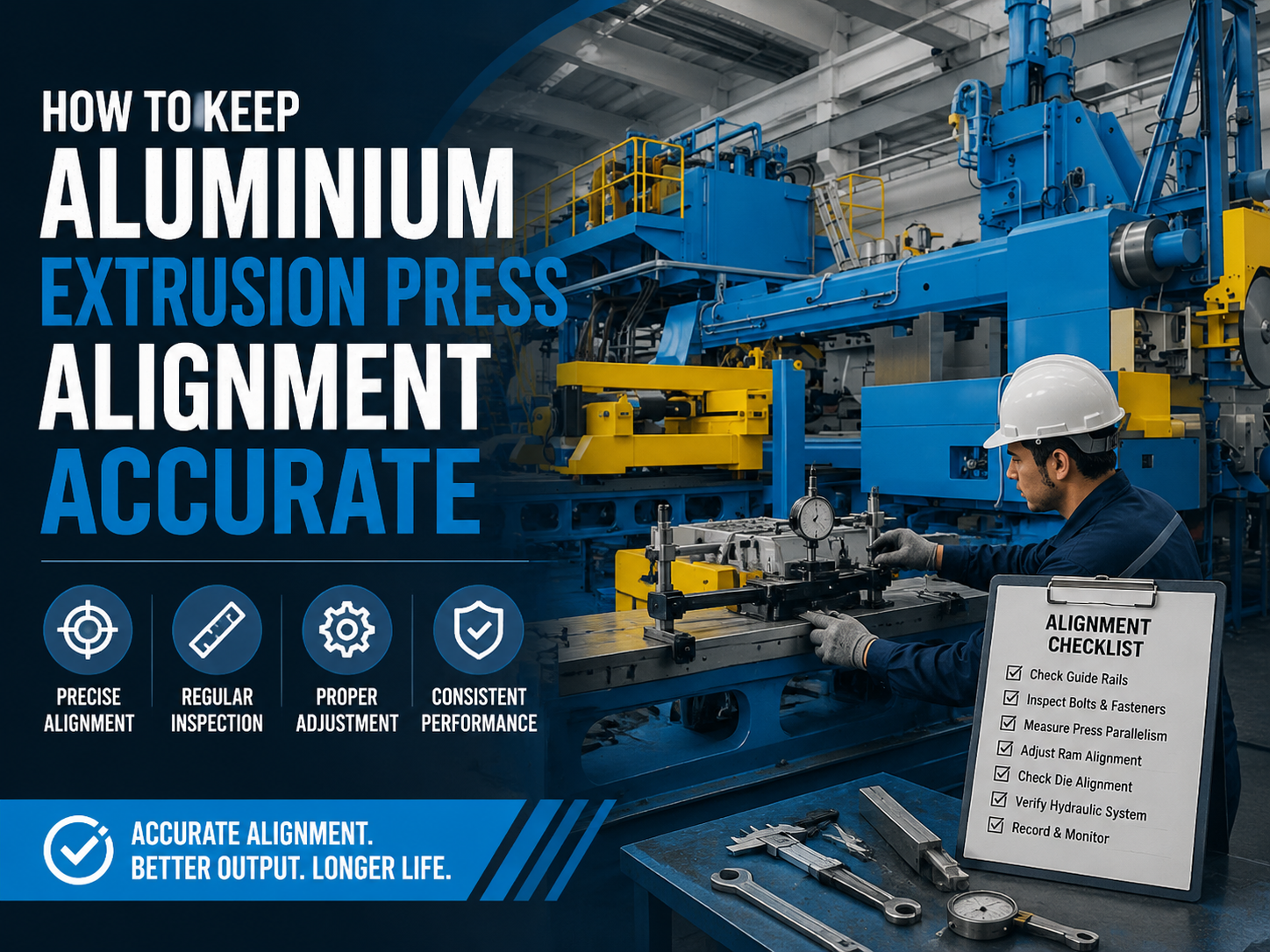
The parallelism of the platens is another mechanical priority. The front platen (which holds the die) and the cylinder platen must remain perfectly parallel throughout the stroke. Any deviation here will cause the main ram to travel at an angle. Technicians should use precision levels and dial indicators to measure the distance between platens at multiple points. If the measurements vary, the guide shoes must be adjusted or shimmed to restore parallelism.
Finally, the guide rails or ‘ways’ that support the moving crosshead and the container must be checked for straightness and wear. Over time, the constant sliding motion can create ‘valleys’ in the rails. If the rails are not perfectly straight, the container will ‘dip’ or ‘weave’ as it moves, making it impossible to maintain a consistent centerline. Regular mechanical surveys, often involving laser alignment tools, are the gold standard for verifying that the physical structure of the press remains true to its original engineering specifications.
Hydraulic and Electrical System Synchronization
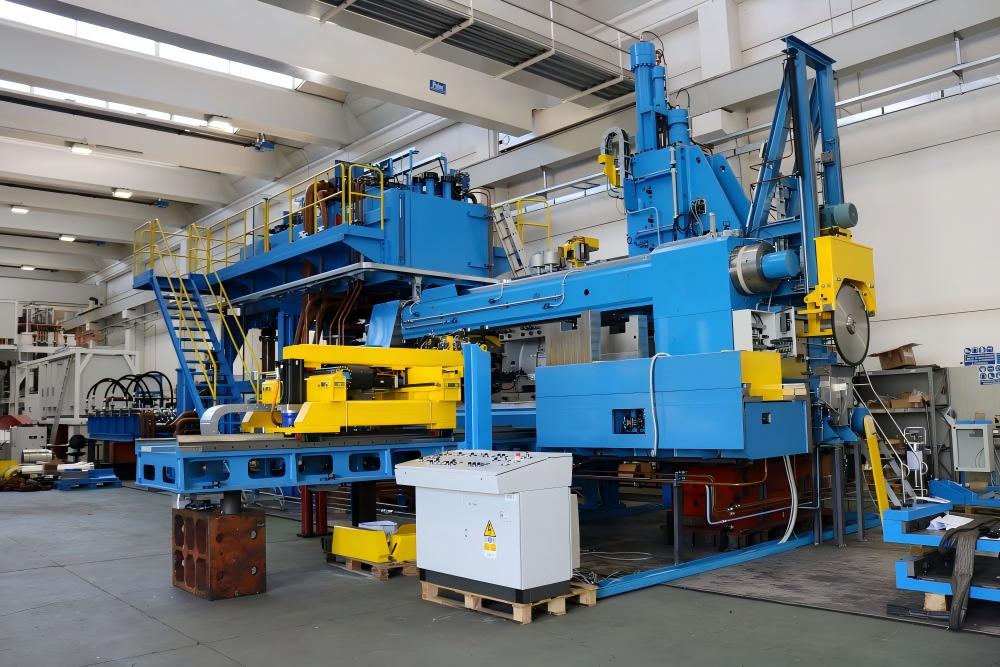
While mechanical components provide the structure, the hydraulic and electrical systems provide the movement. If these systems are not synchronized, they can force the press out of alignment. In a hydraulic extrusion press, the main ram is often supported by side cylinders or ‘jack’ cylinders. If the hydraulic pressure is not distributed evenly, or if a valve is lagging, the ram may experience ‘cocking’—a slight tilt that occurs at the beginning of the stroke. Monitoring hydraulic pressures and ensuring that all valves are firing with millisecond precision is vital to keep aluminium extrusion press alignment accurate.
The electrical system, specifically the PLC (Programmable Logic Controller) and linear transducers, acts as the brain of the operation. Transducers measure the exact position of the ram and the container. If a transducer is miscalibrated, the PLC may believe the press is aligned when it is actually skewed. Regular calibration of these sensors is essential. Furthermore, modern presses use ‘active alignment’ systems where sensors detect tilt in real-time and adjust hydraulic flow to compensate. Ensuring these electronic feedback loops are functioning correctly is a high-tech necessity in modern metal fabrication.
Electrical interference can also play a role. Shielding cables from the high-heat environment and ensuring that electrical noise doesn’t distort the signals from the transducers prevents ‘ghost’ errors in alignment. A well-maintained electrical cabinet, free of dust and properly cooled, ensures that the logic controlling the press’s movement remains flawless. When the hydraulics and electronics work in perfect harmony, the mechanical components are subjected to much lower stress, making it easier to keep aluminium extrusion press alignment accurate.
The Lubrication Plan: Reducing Friction and Wear
Lubrication is the lifeblood of any heavy machinery, but for an extrusion press, it is also a tool for alignment preservation. Friction is the enemy of precision. If a guide way is poorly lubricated, it will create resistance, causing the moving component to ‘stutter’ or lean away from the resistance. A comprehensive lubrication plan is therefore mandatory to keep aluminium extrusion press alignment accurate. This plan must specify the type of lubricant, the volume, and the frequency of application for every moving part.
In the high-temperature zone near the container and die, specialized high-temperature greases or graphite-based lubricants are required. Standard grease will break down and carbonize, creating a gritty paste that actually increases wear. For the main ram and the crosshead guides, automatic lubrication systems are preferred. These systems deliver small, consistent doses of oil or grease, ensuring that a protective film is always present. Maintenance teams must regularly inspect the lines of these automatic systems to ensure they aren’t clogged or leaking.
Beyond just applying lubricant, the plan should include ‘cleaning’ cycles. Over time, lubricant can trap metallic fines and debris, forming an abrasive slurry. Periodically cleaning the guide rails and applying fresh, clean lubricant prevents this slurry from grinding away the precision-machined surfaces. By minimizing wear through superior lubrication, you maintain the tight tolerances required to keep aluminium extrusion press alignment accurate for years, rather than months.
Troubleshooting Signals: Identifying Misalignment Early
Even with the best maintenance, misalignment can occur. The key is to recognize the signals before they lead to a breakdown. One of the most common signals is ‘bananaing’ of the extruded profile. If the aluminium emerges from the die and immediately begins to curve, it usually means the metal is flowing faster on one side than the other, often due to the container or stem being off-center. This is a clear sign that you need to stop and check how to keep aluminium extrusion press alignment accurate in that specific setup.
Another signal is excessive vibration during the ‘breakthrough’ phase—the moment when the pressure builds up and the aluminium starts to flow through the die. If the press shakes or makes a loud ‘thump,’ it indicates that the components are not seated correctly or that the stem is hitting the edge of the container. Furthermore, check the dummy block. If the dummy block shows uneven wear or if it gets stuck in the container frequently, the alignment between the stem and the container is likely compromised.
Finally, look at the scrap. The ‘butt’ or the remaining piece of the billet after extrusion should be uniform in thickness. If the butt is wedge-shaped, the press is definitely out of alignment. Monitoring these output-based signals allows operators to troubleshoot the root cause. Is it a worn guide shoe? A loose tie rod nut? Or a failing hydraulic seal? By correlating product defects with specific machine behaviors, you can quickly implement the necessary adjustments to keep aluminium extrusion press alignment accurate.
Comprehensive Maintenance Schedule Table
To maintain a high-performing extrusion line, follow this structured maintenance schedule. This table provides a roadmap for technicians to ensure no critical alignment check is missed.
| Frequency | Component | Action Required | Goal |
|---|---|---|---|
| Daily | Extrusion Stem | Visual check for scuffing and centering. | Prevent stem breakage. |
| Daily | Container & Die | Check for even flash and butt thickness. | Ensure profile uniformity. |
| Weekly | Guide Rails | Clean debris and verify lubrication flow. | Reduce friction and lateral shift. |
| Weekly | Hydraulic System | Check for leaks and monitor pressure gauges. | Ensure balanced force distribution. |
| Monthly | Platens | Measure parallelism with dial indicators. | Maintain stroke accuracy. |
| Monthly | Sensors/Transducers | Calibrate linear position sensors. | Ensure accurate PLC feedback. |
| Quarterly | Tie Rods | Check nut tightness and ultrasonic tension. | Prevent frame distortion. |
| Annually | Foundation | Verify press level and anchor bolt torque. | Ensure structural stability. |
| Annually | Full Press Survey | Laser alignment of the entire centerline. | Restore factory precision. |
Frequently Asked Questions (FAQ)
1. How often should I perform a full laser alignment?
For most high-volume operations, a full laser alignment survey should be conducted annually. However, if the press has undergone a major repair (like a tie rod replacement) or if you notice persistent quality issues that daily maintenance cannot fix, an immediate laser survey is recommended to keep aluminium extrusion press alignment accurate.
2. Can temperature changes really affect alignment that much?
Yes, absolutely. Aluminium extrusion presses are massive steel structures. Steel expands as it heats. A 10-meter press can expand by several millimeters when it reaches operating temperature. If the guide systems are not designed to accommodate this expansion while maintaining the centerline, the press will naturally drift out of alignment.
3. What is the most common cause of stem misalignment?
The most common cause is worn guide shoes on the moving crosshead. As these shoes wear down, the crosshead (and thus the stem) begins to sag. Regular inspection and shimming of these shoes are the most frequent tasks required to keep aluminium extrusion press alignment accurate.
4. Does the type of aluminium alloy affect alignment?
While the alloy doesn’t change the physical alignment of the machine, harder alloys (like the 7000 series) require much higher extrusion pressures. These higher pressures put more stress on the press frame, which can exacerbate any existing minor misalignments, making them more visible in the final product.
5. How do I know if my tie rods are unevenly tensioned?
Uneven tension often manifests as the press ‘opening up’ more on one side during the extrusion stroke. You can measure this using ‘stretch’ indicators or by observing if the gap between the platens is inconsistent under full load. Correcting this is vital to keep aluminium extrusion press alignment accurate and prevent rod failure.
6. Is manual lubrication sufficient for a modern press?
While manual lubrication is better than none, it is rarely sufficient for the precision required today. Human error often leads to missed spots or over-lubrication. Automatic systems are highly recommended to ensure the consistent, thin film of lubricant necessary to keep aluminium extrusion press alignment accurate.