Choosing Scrap Metal Baler Applications for Heavy-Duty Industrial Scrap Reduction and Shipping


Introduction to Heavy-Duty Scrap Metal Management
In the modern industrial landscape, the management of metal waste has evolved from a secondary concern to a primary driver of operational efficiency and sustainability. Choosing Scrap Metal Baler Applications Heavy-Duty Industrial Scrap Reduction Shipping is a critical decision for facilities ranging from automotive manufacturing plants to large-scale demolition sites. As global metal prices fluctuate and environmental regulations tighten, the ability to efficiently process, densify, and transport scrap metal determines the profitability of a recycling operation. HARSLE, a leader in metal fabrication machinery, provides the robust technology required to transform loose, voluminous scrap into high-density bales ready for the furnace or international shipping.
The fundamental goal of a scrap metal baler is volume reduction. Loose scrap metal, such as offcuts from stamping presses or structural steel from demolition, occupies a massive amount of space relative to its weight. This inefficiency leads to high storage costs and exorbitant shipping fees, as trucks and containers reach their volume capacity long before they reach their weight limit. By implementing the right baling application, industrial players can achieve a reduction ratio of up to 10:1, drastically lowering the carbon footprint of their logistics and maximizing the value of every ton of material processed.

Application Scenarios for Industrial Scrap Balers
The versatility of modern hydraulic balers allows them to be deployed across various sectors. One of the most common application scenarios is in the automotive industry. Stamping plants produce thousands of tons of steel and aluminum offcuts daily. Without a dedicated baling system, these offcuts would require constant hauling, disrupting the production flow. A heavy-duty baler integrated into the production line ensures that scrap is processed in real-time, maintaining a clean workspace and providing a steady stream of furnace-ready material.
Another critical scenario is found in professional scrap yards and recycling centers. These facilities receive a diverse range of materials, from old appliances (white goods) to industrial piping and copper wiring. Here, the baler must be a multi-purpose workhorse. Choosing Scrap Metal Baler Applications Heavy-Duty Industrial Scrap Reduction Shipping in this context means selecting a machine with high shearing force and a large charging box to accommodate irregular shapes. The ability to switch between different material profiles without extensive downtime is what separates a profitable yard from one struggling with bottlenecks.
Demolition and construction sites also represent a significant application area. Portable or semi-mobile balers are often used to process structural steel, rebar, and aluminum siding on-site. By baling material at the source, contractors can reduce the number of truck trips required to clear a site, which is particularly beneficial in urban environments where traffic and logistics are tightly controlled. Furthermore, baled scrap is much easier to inventory and sell to foundries, as the density and purity of the material are more easily verified.
Finally, the shipbuilding and heavy machinery industries utilize balers to handle thick-gauge plate scrap. These applications require the highest levels of hydraulic pressure and reinforced chamber structures. In these environments, the baler is not just a recycling tool but a necessary component of the manufacturing ecosystem, ensuring that the massive volume of waste generated by cutting large steel plates does not overwhelm the facility’s floor space.
Material and Process Requirements
When Choosing Scrap Metal Baler Applications Heavy-Duty Industrial Scrap Reduction Shipping, understanding the specific characteristics of the material is paramount. Not all scrap is created equal, and the physical properties of the metal dictate the required compression force and chamber design. For instance, aluminum is highly elastic and tends to “spring back” after compression. To achieve a stable bale, the baler must maintain pressure for a specific duration or utilize a locking mechanism that secures the bale before ejection.
Ferrous metals, such as carbon steel and stainless steel, require significantly higher shearing and compression forces. Heavy-duty industrial scrap reduction often involves HMS 1 and HMS 2 (Heavy Melting Scrap). These materials can be several millimeters thick and require a baler equipped with high-strength manganese steel liners to resist the abrasive nature of the metal. The process requirement for these materials often includes a “pre-shredding” or “shearing” phase, which many HARSLE balers incorporate directly into the lid or side-ram action to ensure the material fits within the compression chamber.
The desired bale density is another critical process requirement, especially for shipping. International shipping containers have strict weight limits. To maximize the ROI of a shipment, the bales must be sized and densified so that the container reaches its maximum weight capacity (typically around 25-28 tons) without exceeding the volume. This requires precise control over the hydraulic cylinders and a deep understanding of the material’s compression curve. For example, copper scrap might be baled into smaller, ultra-dense cubes, while light steel might be formed into larger bales for domestic transport.
Material Compatibility Table
| Material Type | Density Requirement | Compression Force | Recommended Baler Type |
|---|---|---|---|
| Aluminum Cans/Sheet | Medium | Low to Medium | Triple Action / Side Push |
| Steel Offcuts (Stamping) | High | Medium to High | Side Push / Turn Out |
| HMS 1 & 2 (Heavy Steel) | Very High | Very High | Heavy-Duty Triple Action |
| Copper/Brass Wire | High | Medium | Small Chamber High Pressure |
| Stainless Steel Plate | High | High | Reinforced Chamber Side Push |
Recommended Machine Configuration
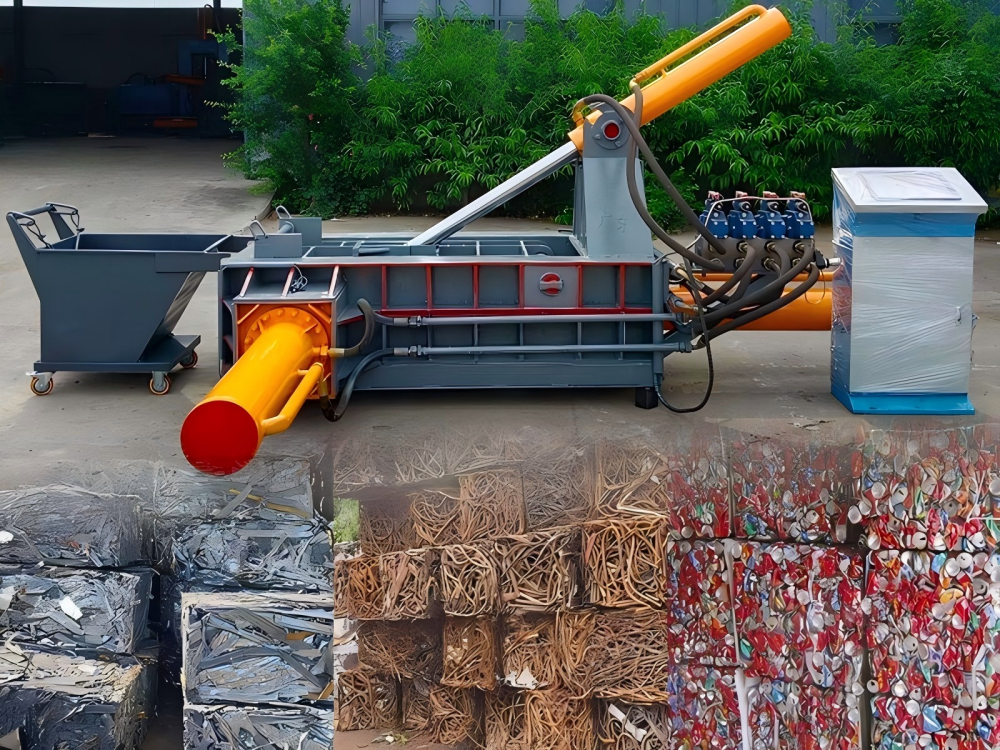
For heavy-duty industrial scrap reduction, the configuration of the baler must be robust and technologically advanced. HARSLE recommends a triple-action hydraulic system for most high-volume applications. This configuration uses three distinct rams: a lid ram for pre-compression and shearing, a side ram for secondary compression, and a main ram for final densification. This ensures that even the most stubborn materials are forced into a uniform shape, which is essential for stable stacking during shipping.
The hydraulic system itself should feature variable displacement pumps and high-pressure valves from reputable brands like Rexroth or Vickers. These components allow the machine to adjust its power output based on the resistance encountered, saving energy during the initial stages of compression and providing maximum force only when needed. Additionally, an integrated oil cooling system (either air or water-cooled) is mandatory for heavy-duty applications to prevent the hydraulic fluid from overheating during continuous 24/7 operations.
Control systems are the brain of the baler. A Siemens PLC with a user-friendly HMI (Human Machine Interface) allows operators to select pre-programmed cycles for different materials. For example, an “Aluminum Mode” might involve a longer hold time at peak pressure, while a “Steel Mode” focuses on rapid shearing and ejection. Automation features, such as infrared sensors for automatic cycle initiation and remote diagnostic modules, significantly reduce the need for manual intervention and minimize downtime due to maintenance issues.
Wear resistance is another critical configuration factor. The interior of the compression chamber should be lined with replaceable Hardox or similar high-abrasion-resistant plates. These plates protect the main structure of the machine from the constant grinding of metal scrap. In a heavy-duty environment, these liners are the first line of defense, and their ease of replacement is a key consideration for long-term operational costs.
Workflow of an Industrial Baling Operation
The workflow of Choosing Scrap Metal Baler Applications Heavy-Duty Industrial Scrap Reduction Shipping begins with material collection and sorting. In a high-efficiency plant, scrap is sorted at the source to prevent contamination. For instance, mixing stainless steel with carbon steel significantly reduces the scrap value. Once sorted, the material is transported to the baler’s charging area, often via a conveyor belt or a heavy-duty orange-peel grab crane.
Once the material is loaded into the charging box, the compression cycle begins. In a HARSLE Y81 series baler, the lid closes first, shearing off any overhanging material and providing the first stage of volume reduction. Next, the side cylinder moves in, narrowing the material into a long strip. Finally, the main cylinder pushes forward, compressing the strip into a dense, rectangular bale. This multi-stage process is essential for achieving the high densities required for industrial shipping.
After the compression is complete, the bale must be ejected. Depending on the machine configuration, this can be done via “turn-out,” where the bale is flipped out of the chamber, or “side-push,” where the main ram or a separate ejection ram pushes the bale out through a side gate. The choice of ejection method often depends on the facility layout and how the bales will be moved to the storage area. Automated systems often include a discharge chute that leads directly to a weighing scale and a labeling station.
The final step in the workflow is logistics integration. Bales are stacked using forklifts or specialized bale clamps. Because the bales are uniform in size, they can be packed tightly into shipping containers or onto flatbed trucks. This uniformity is not just about space; it also ensures the safety of the transport, as dense bales are less likely to shift during transit compared to loose scrap. This streamlined workflow, from the moment the scrap is generated to the moment it is loaded for shipping, is what defines a successful industrial scrap reduction strategy.
Productivity and Economic Benefits
The primary benefit of Choosing Scrap Metal Baler Applications Heavy-Duty Industrial Scrap Reduction Shipping is the dramatic reduction in logistics costs. For many industrial firms, the cost of moving scrap can eat up a significant portion of the material’s value. By increasing the density of the scrap, companies can reduce the number of required shipments by 50% to 80%. This directly translates to lower fuel costs, fewer driver hours, and reduced wear and tear on transport vehicles.
Beyond logistics, baling increases the market value of the scrap. Foundries and steel mills prefer baled material because it is easier to handle and more efficient to melt. Loose scrap has a high surface-area-to-volume ratio, which leads to higher oxidation losses during the melting process. Dense bales sink into the molten bath more effectively, leading to higher yields and lower energy consumption for the smelter. Consequently, many mills offer a premium price for high-quality, high-density bales, providing a direct boost to the recycler’s bottom line.
Operational safety and floor space optimization are also significant benefits. Loose scrap is a safety hazard; it can have sharp edges, it’s difficult to stack, and it can attract pests or create fire hazards if contaminated with oils. Baling the scrap creates a tidy, organized environment. The space saved by densifying scrap can be repurposed for additional production lines or inventory storage, effectively increasing the productive capacity of the existing facility without the need for physical expansion.
Finally, there is the environmental and regulatory benefit. Many jurisdictions now require industrial facilities to have a documented waste management plan. Efficient baling demonstrates a commitment to the circular economy and reduces the environmental impact of the manufacturing process. By minimizing the volume of waste and optimizing transport, companies can significantly lower their Scope 3 carbon emissions, which is increasingly important for corporate social responsibility (CSR) reporting and compliance with international environmental standards.
Case Example: Automotive Stamping Plant Optimization
Consider a mid-sized automotive stamping plant that produces approximately 500 tons of steel scrap per month. Initially, the plant used open-top containers to collect loose offcuts. This required 40 truck trips per month to transport the scrap to a local processor, with each truck carrying only about 12.5 tons despite having a 25-ton weight capacity. The logistics costs were high, and the plant floor was constantly cluttered with overflowing bins.
The plant decided to implement a HARSLE heavy-duty hydraulic baler with an integrated conveyor system. By Choosing Scrap Metal Baler Applications Heavy-Duty Industrial Scrap Reduction Shipping, they selected a model capable of producing 600kg bales with a density of 2500 kg/m³. After the installation, the plant was able to load 25 tons of baled scrap into every truck. This immediately halved the number of truck trips from 40 to 20 per month.
The economic impact was profound. The reduction in transport costs saved the company over $5,000 per month. Additionally, because the bales were of high quality and uniform density, they were able to negotiate a $20 per ton premium from the steel mill, adding another $10,000 to their monthly revenue. The ROI on the baler was achieved in less than 18 months, and the plant floor became significantly safer and more organized. This case illustrates how the right baling application can transform a waste stream into a significant profit center.
Frequently Asked Questions (FAQ)
1. What is the average lifespan of a heavy-duty scrap metal baler?
With proper maintenance, a high-quality industrial baler from HARSLE can last 15 to 20 years or more. The key to longevity is regular hydraulic oil changes, timely replacement of wear liners, and ensuring that the machine is not consistently pushed beyond its rated capacity. Many of our machines from the early 2000s are still in active service today.
2. Can one baler handle both aluminum and steel?
Yes, most heavy-duty balers can handle a variety of metals. However, it is important to adjust the pressure settings and cycle times for different materials. Aluminum requires different handling than heavy steel to prevent spring-back and ensure bale integrity. Modern PLC systems make these adjustments easy for the operator.
3. How much floor space is required for a baler installation?
The footprint of the baler itself varies by model, but you must also account for the “working zone.” This includes space for the loading equipment (cranes or conveyors), a bale storage area, and maintenance access. A typical heavy-duty installation might require an area of 50 to 100 square meters.
4. What kind of maintenance is required for the hydraulic system?
The hydraulic system is the heart of the baler. Maintenance involves checking for leaks, monitoring oil temperature, and replacing filters regularly. The hydraulic oil should be tested annually for contamination and replaced every 2,000 to 4,000 operating hours, depending on the environment and usage intensity.
5. Are there automated options for bale tying?
While many scrap metal balers rely on the density and interlocking of the metal to hold the bale together (especially for steel), some applications for lighter materials or specific shipping requirements may use automated wire-tying systems. However, for heavy-duty industrial scrap, the compression force is usually sufficient to create a stable bale without ties.
Conclusion and Call to Action
Choosing Scrap Metal Baler Applications Heavy-Duty Industrial Scrap Reduction Shipping is a strategic investment that pays dividends in logistics savings, material value, and operational efficiency. Whether you are managing a high-volume manufacturing plant or a specialized recycling facility, the right baler configuration is essential for staying competitive in today’s market. HARSLE offers a comprehensive range of hydraulic scrap metal balers designed for durability, power, and ease of use.
Don’t let your scrap metal management be an afterthought. Contact HARSLE today to speak with our technical experts. We can help you analyze your material flow, calculate your potential ROI, and select the perfect baling solution tailored to your specific industrial needs. Visit our website or reach out to our sales team to take the first step toward a more efficient and profitable recycling operation.