Comprehensive Guide: How to Troubleshoot Electrical Control Failures in a Recycling Baler

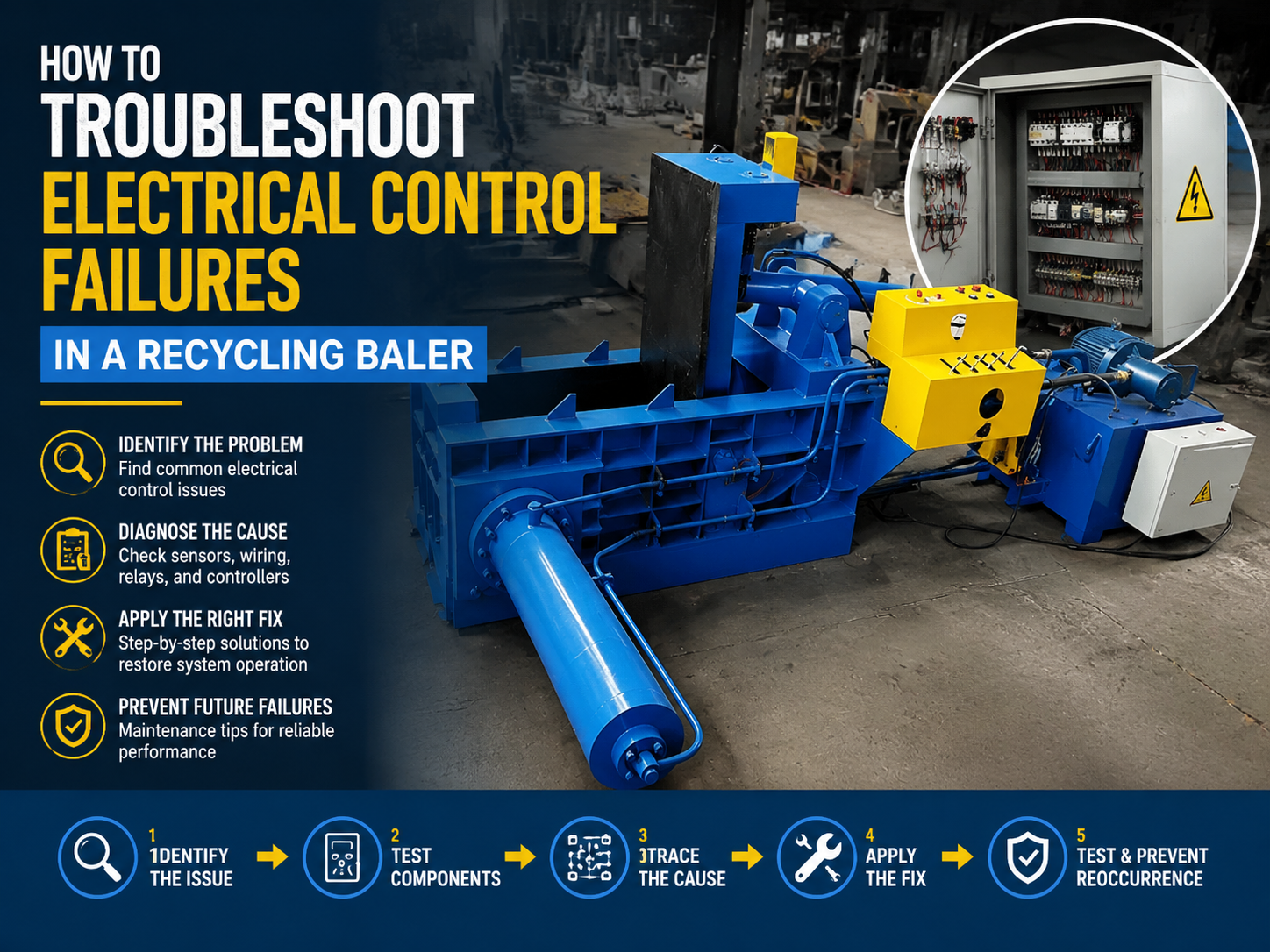
Introduction to Electrical Systems in Modern Recycling Balers
In the high-intensity world of scrap metal processing, the recycling baler stands as a cornerstone of efficiency. These machines, designed to compress voluminous metal waste into manageable, high-density blocks, rely on a sophisticated interplay of hydraulic power and electrical precision. However, the electrical control system is often the most complex and sensitive part of the machine. When a failure occurs, it can halt production entirely, leading to costly downtime and logistical bottlenecks. Understanding how to troubleshoot electrical control failures in a recycling baler is not just a maintenance skill; it is a critical operational necessity for any facility using HARSLE equipment or similar industrial machinery.
Modern recycling balers have evolved from simple manual lever-operated machines to fully automated systems governed by Programmable Logic Controllers (PLCs), Human-Machine Interfaces (HMIs), and an array of sensors. While these advancements increase productivity and safety, they also introduce new failure points. Electrical issues can range from simple loose wires caused by the machine’s inherent vibration to complex logic errors within the PLC software. This guide aims to provide a systematic approach to identifying, diagnosing, and resolving these issues to ensure your baling operations remain fluid and profitable.
Before diving into the technicalities, it is essential to recognize that electrical troubleshooting in industrial environments requires a blend of theoretical knowledge and practical safety awareness. A recycling baler operates under high voltage and significant mechanical pressure. Therefore, every troubleshooting step must be performed with a “safety-first” mindset, utilizing proper Personal Protective Equipment (PPE) and following strict Lockout/Tagout (LOTO) procedures. By the end of this article, you will have a comprehensive framework for managing the electrical health of your recycling baler.
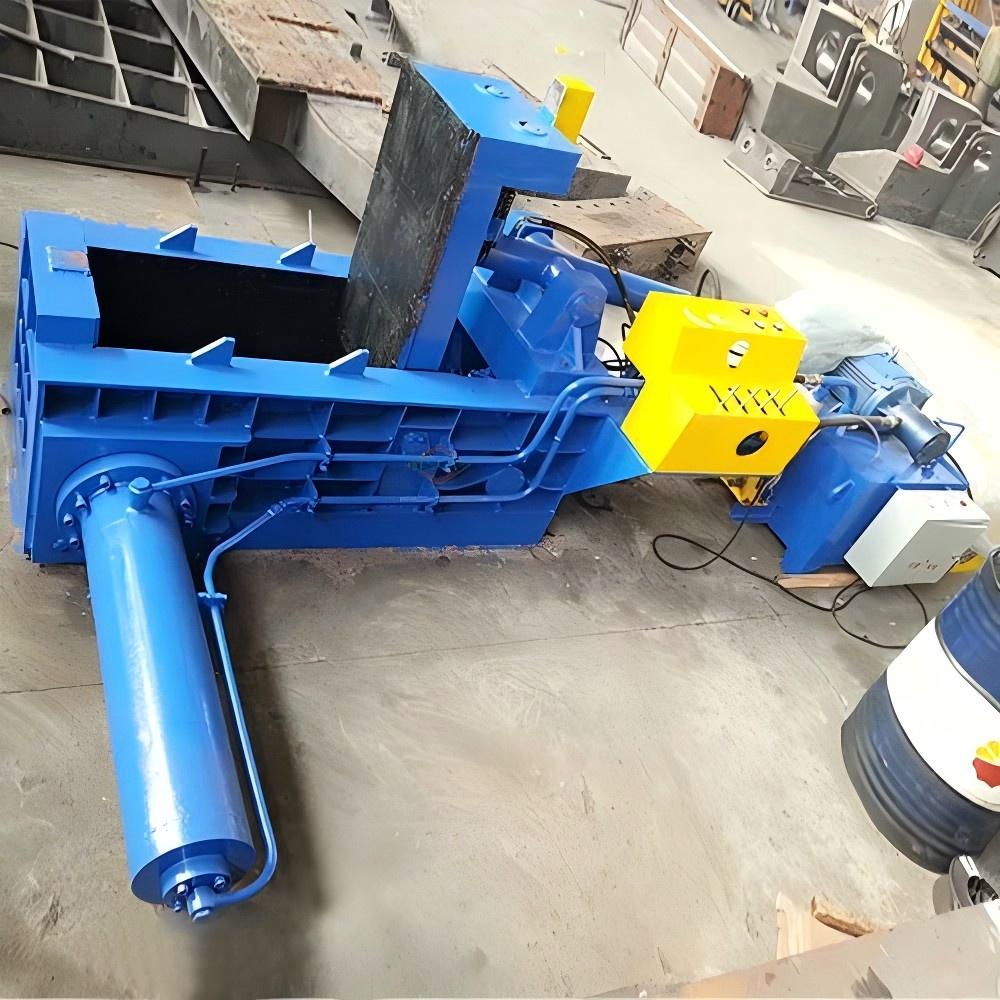
Key Considerations Before Troubleshooting
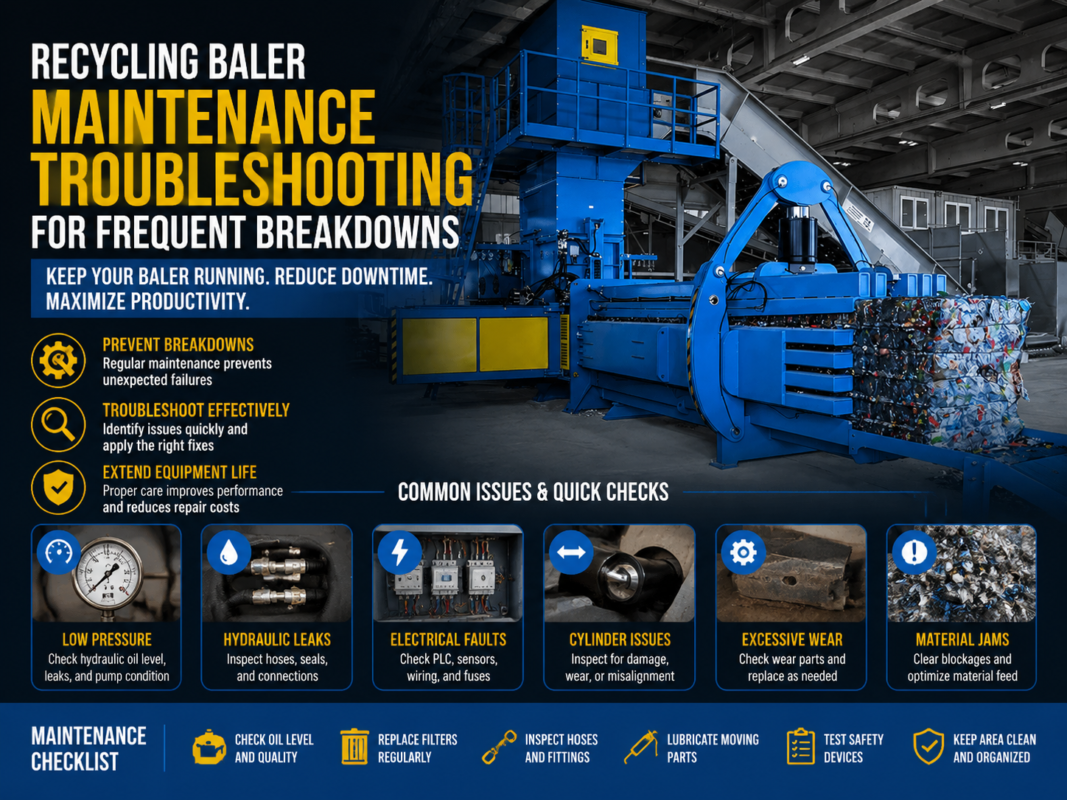
When you set out to troubleshoot electrical control failures in a recycling baler, the first consideration is the environment. Recycling facilities are notoriously harsh; they are often filled with metallic dust, moisture, and extreme temperature fluctuations. Metallic dust is particularly hazardous as it is conductive and can settle on circuit boards or inside contactors, causing short circuits. Always begin by assessing the cleanliness of the electrical cabinet. If the cabinet is coated in grime, a thorough but careful cleaning with compressed air or specialized electronic cleaners may resolve intermittent faults before you even open a multimeter.
Another critical consideration is the machine’s vibration profile. Recycling balers, especially those processing heavy scrap, generate significant structural vibration during the compression and shearing cycles. Over time, these vibrations can loosen terminal screws, weaken solder joints, and cause wires to chafe against sharp metal edges. A visual inspection of the wiring harness and terminal blocks is a mandatory first step. Look for discolored insulation, which indicates overheating, or wires that have pulled out of their ferrules. Often, the solution to a “dead” machine is as simple as tightening a loose neutral wire in the control circuit.
Furthermore, one must consider the age and technology level of the baler. Older machines might use relay logic, where troubleshooting involves checking physical coils and contacts. Newer HARSLE models utilize PLCs, which require a different approach involving status LEDs and software diagnostics. Understanding which system you are working with determines the tools you need. For a PLC system, a laptop with the appropriate communication cable and software is as important as a screwdriver. For relay-based systems, a reliable multimeter and a deep understanding of the machine’s wiring schematic are your primary weapons.
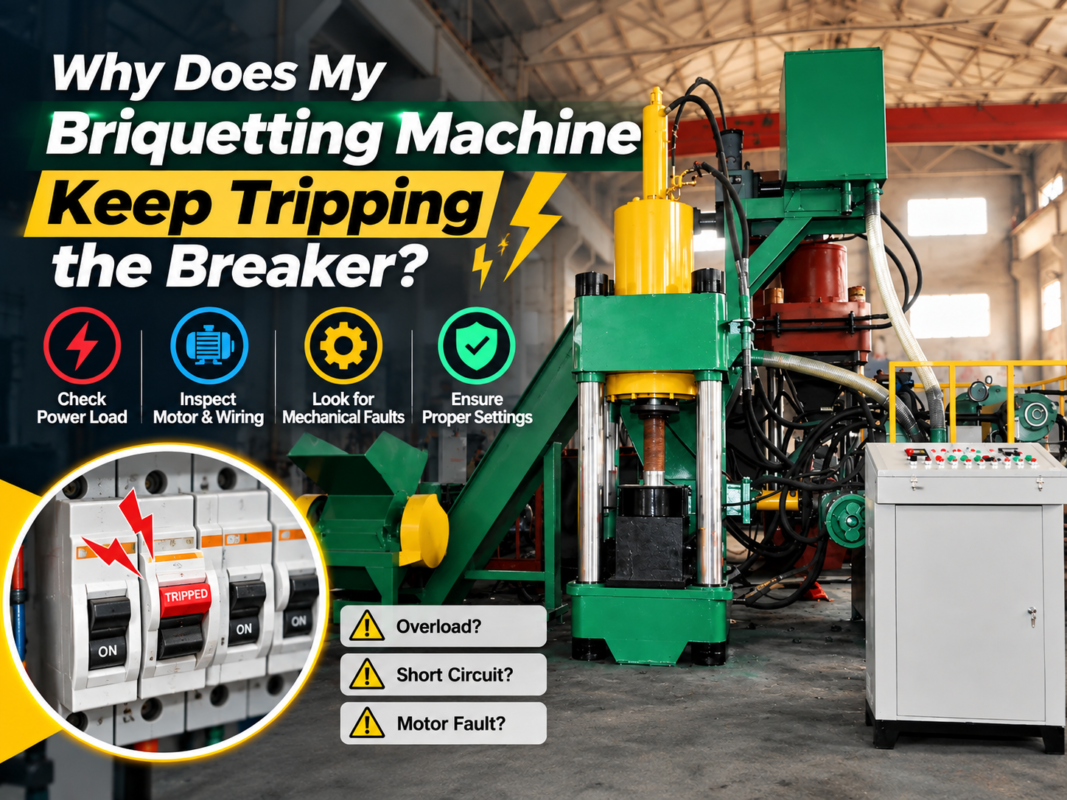
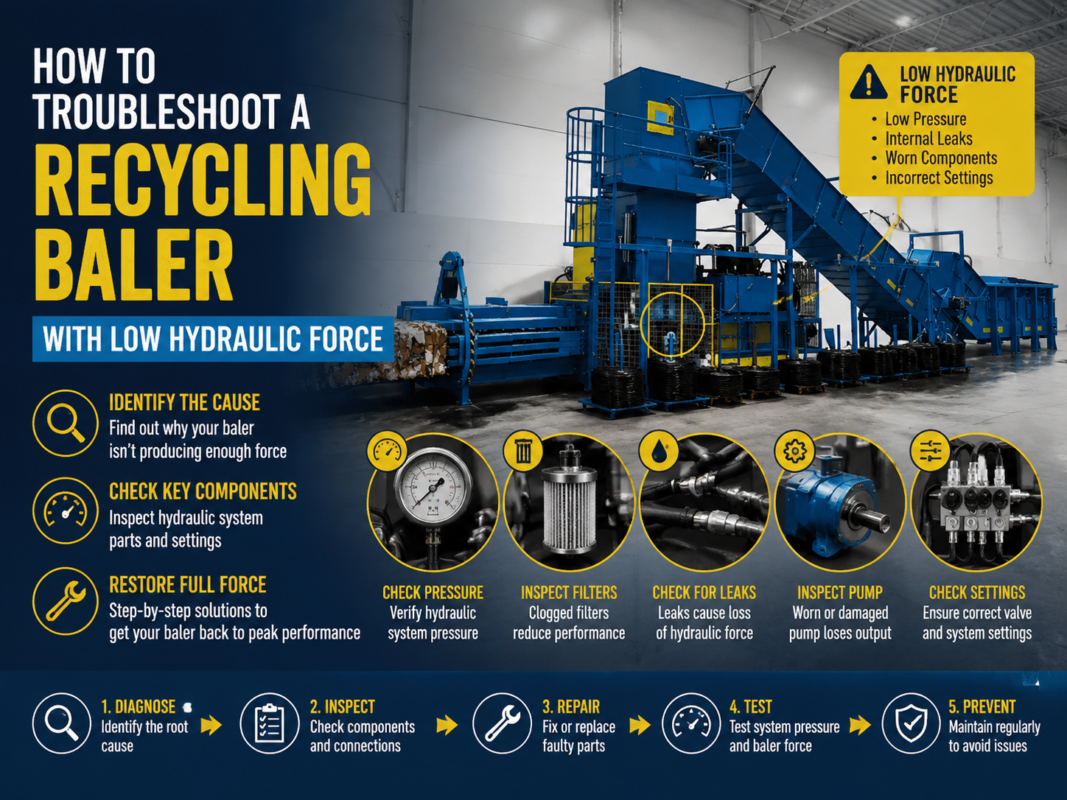
Lastly, always consider the history of the machine. Has it recently undergone a hydraulic pump replacement? Was there a recent power surge in the facility? Often, electrical failures are secondary symptoms of mechanical issues or external environmental factors. For instance, a motor starter that keeps tripping might not be faulty itself; it might be reacting to a hydraulic valve that is stuck, causing the motor to draw excessive current. Always look at the machine as a holistic system rather than a collection of isolated parts.
Technical Details: Systematic Troubleshooting Steps
1. Power Supply and Incoming Voltage Analysis
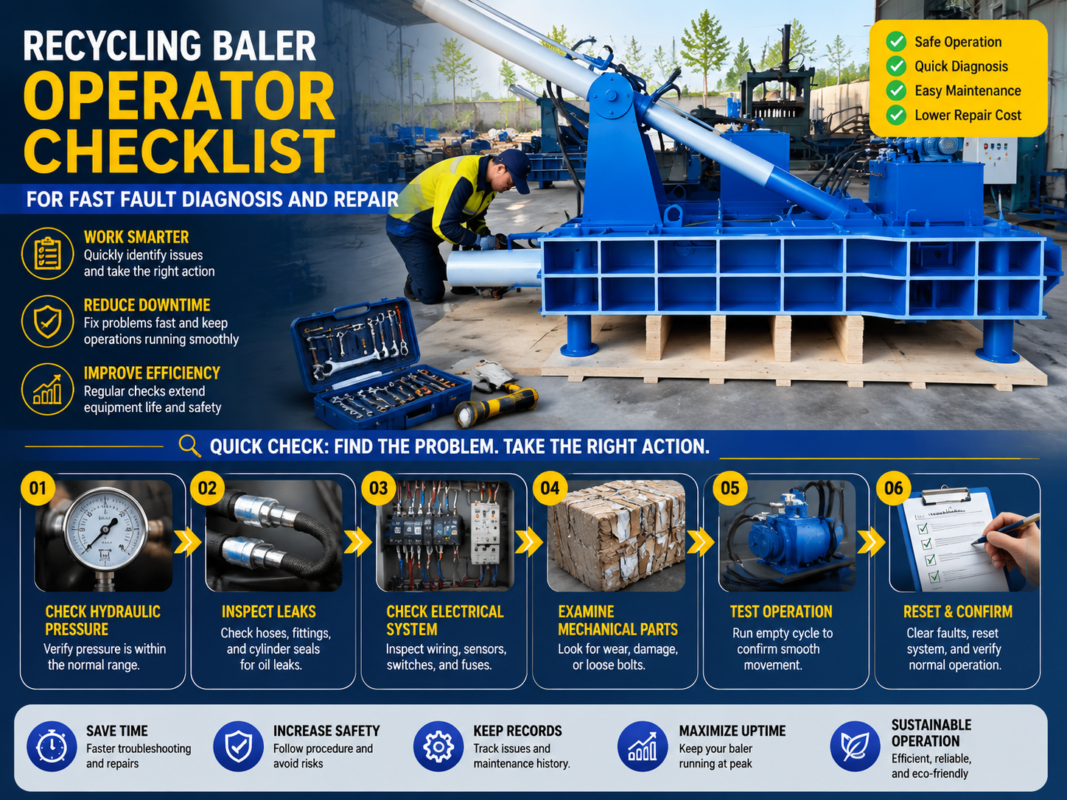
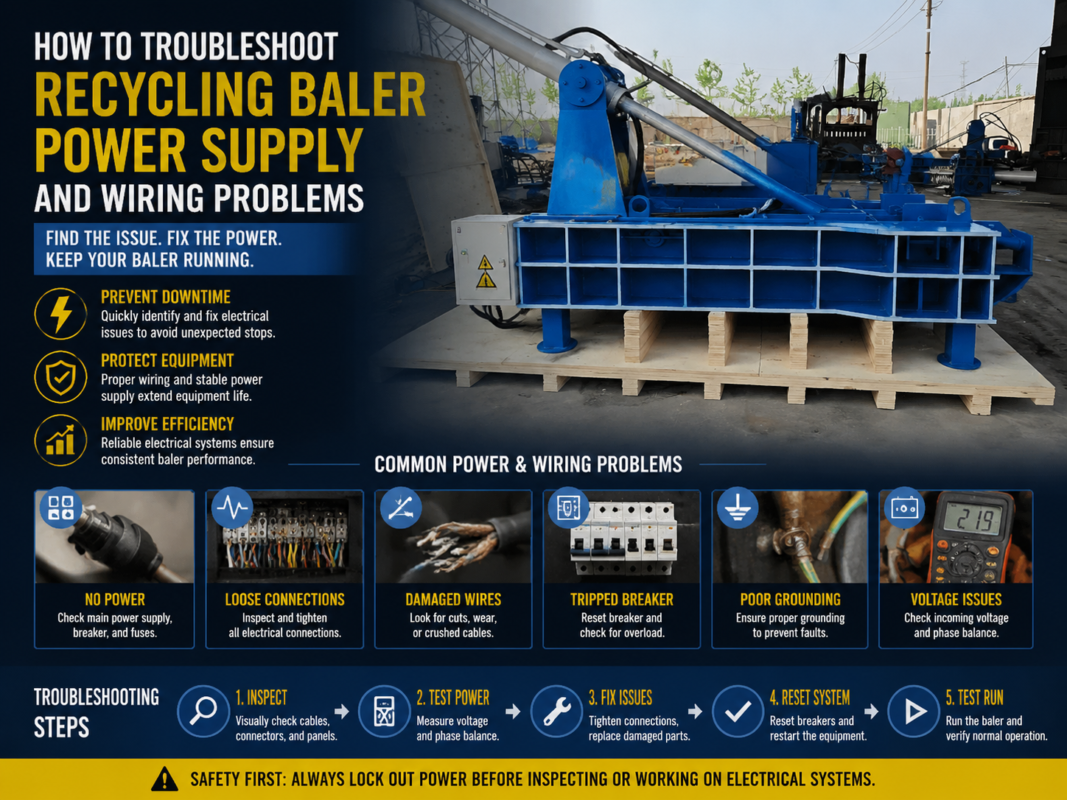
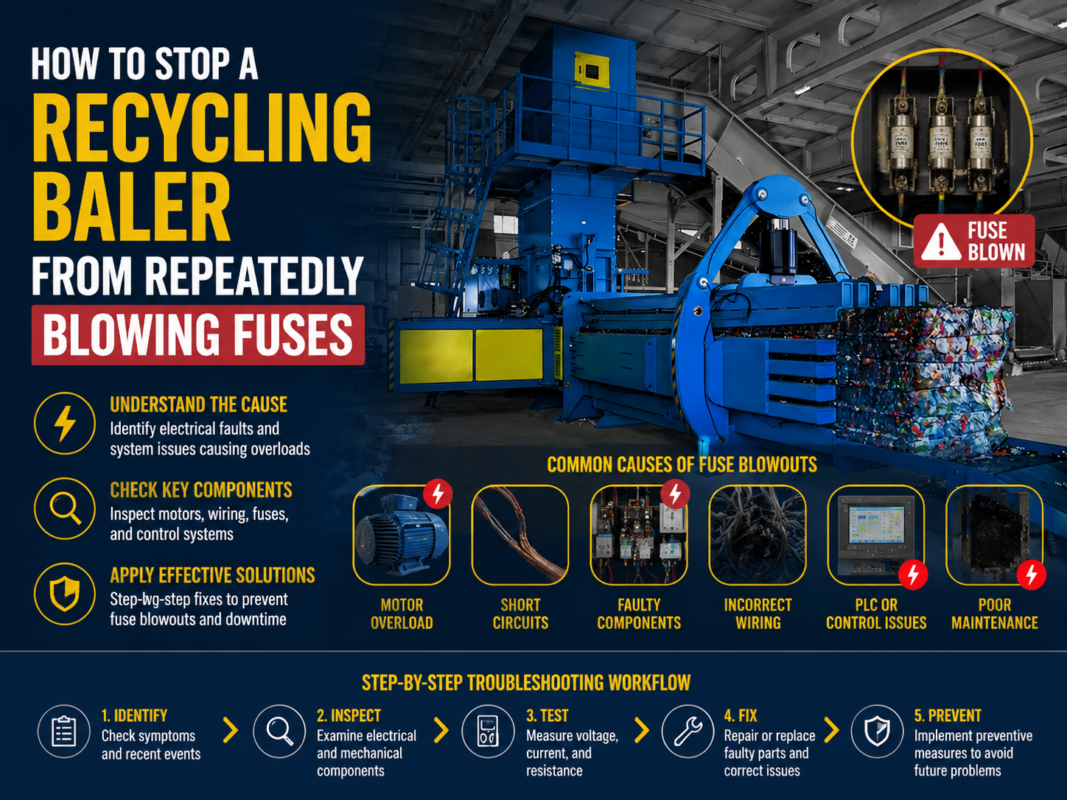
The foundation of any electrical system is the power supply. To troubleshoot electrical control failures in a recycling baler, you must first verify that the machine is receiving the correct voltage. Use a calibrated multimeter to check the incoming three-phase power at the main disconnect. Ensure that all three phases are balanced; a significant voltage imbalance (usually more than 2-3%) can cause motors to overheat and control transformers to behave errably. Check for blown fuses or tripped circuit breakers at the primary input.
Beyond the main power, check the secondary control voltage. Most balers use a transformer to step down the high voltage to 24V DC or 110V AC for the control circuit. If the 24V power supply is failing, the PLC will not boot, and sensors will not trigger. Measure the output of the DC power supply; if it reads significantly below 24V, the system may enter an unstable state where some components work while others fail intermittently. This is a common cause of “ghost” errors that disappear and reappear without explanation.
2. PLC Diagnostics and Input/Output (I/O) Mapping
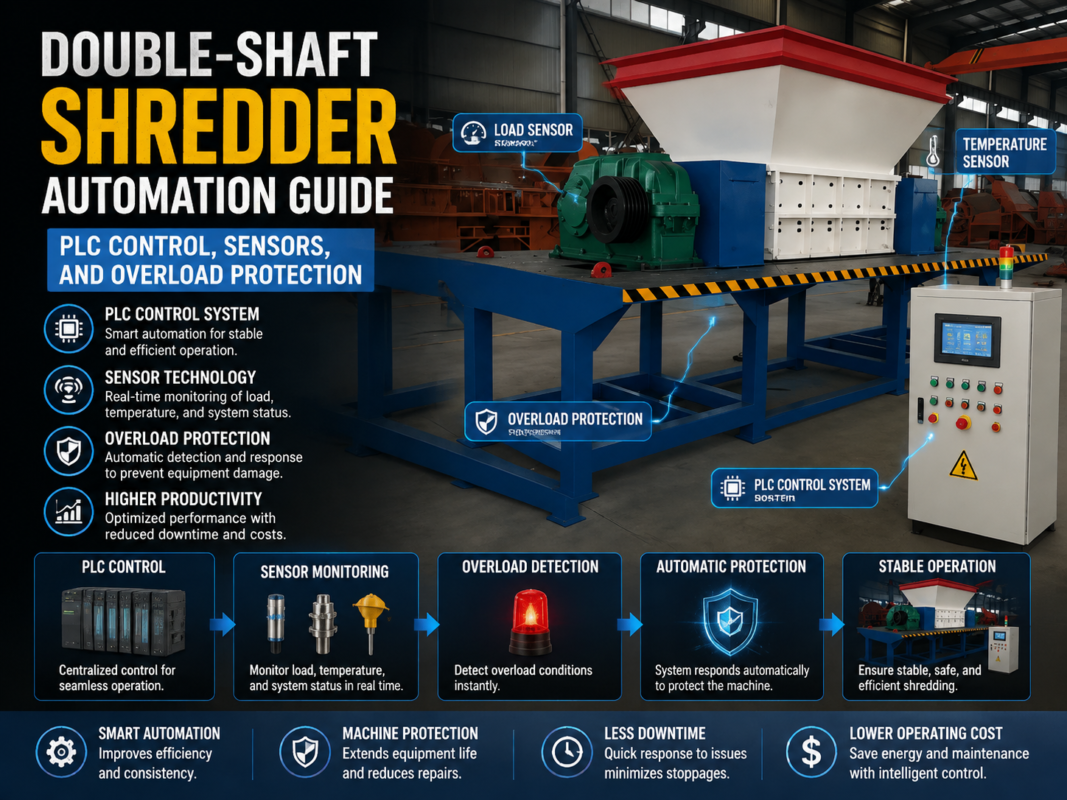
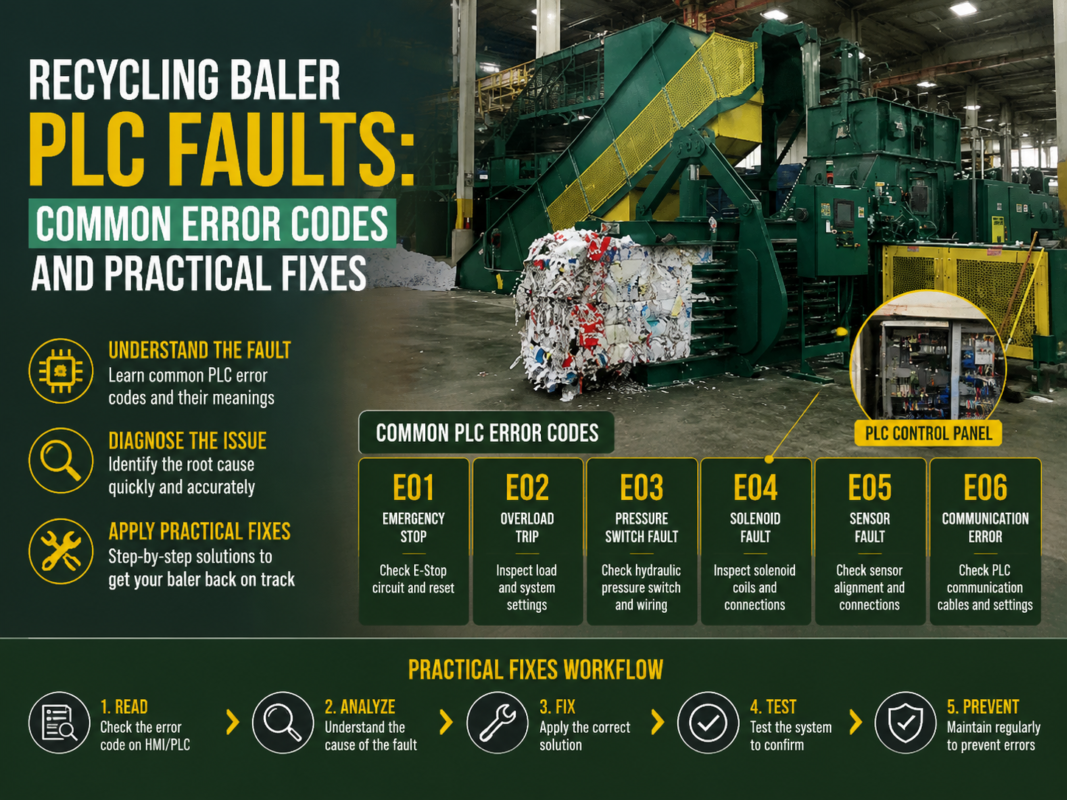
The PLC is the brain of the recycling baler. When troubleshooting, the PLC’s status lights are your best friend. Most PLCs have LEDs for ‘Power’, ‘Run’, and ‘Fault’. A red ‘Fault’ light usually indicates an internal hardware failure or a critical software error. However, the most useful LEDs are the I/O indicators. Each input (from buttons, limit switches, and sensors) and each output (to solenoids and contactors) typically has a corresponding LED. By manually triggering a sensor and watching the PLC, you can instantly tell if the signal is reaching the controller.
If the input LED lights up but the machine doesn’t respond, the issue lies either in the PLC logic or the output circuit. If the input LED does not light up, the problem is the sensor, the wiring, or the power supply to that specific sensor. This “binary search” method allows you to isolate the fault to a specific segment of the circuit very quickly. For HARSLE balers equipped with advanced HMIs, check the alarm history page. Modern systems will often provide a specific error code, such as “E04: Main Ram Forward Limit Not Reached,” which points you directly to the problematic component.
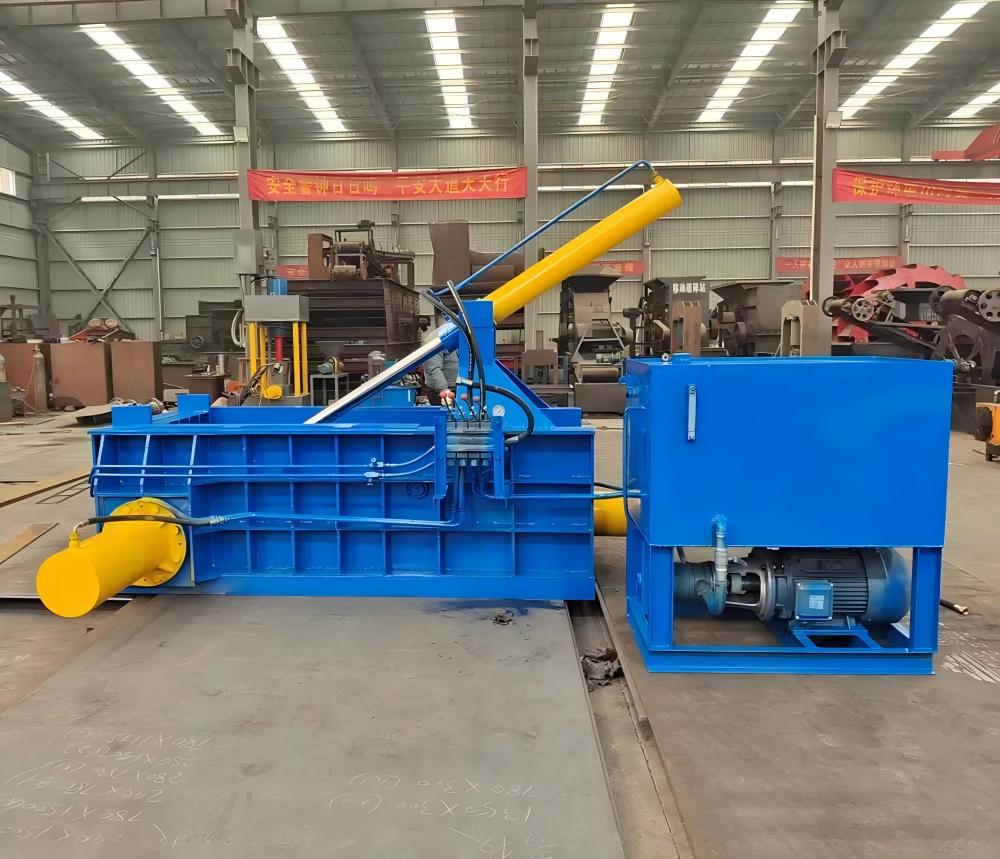
3. Sensor and Limit Switch Verification
Recycling balers rely heavily on proximity sensors and limit switches to track the position of the compression rams and the bale discharge door. These components are in the “line of fire” for debris and mechanical shock. A common failure occurs when a sensor becomes misaligned or covered in metallic sludge, leading the PLC to believe a ram is in the wrong position. This prevents the next step of the cycle from initiating, effectively locking the machine.
To test a proximity sensor, ensure the machine is in a safe state and bring a piece of metal close to the sensor’s face. The indicator light on the back of the sensor should toggle. If it doesn’t, check for 24V power at the sensor’s connector. For mechanical limit switches, check for physical damage to the actuator arm. In the harsh environment of a scrap yard, it is common for a piece of flying metal to bend or snap a limit switch arm. Replacing these with heavy-duty, shielded versions can significantly improve the machine’s uptime.
4. Motor Starters, Contactors, and Solenoids
If the PLC is sending an output signal but the motor doesn’t turn or the hydraulic valve doesn’t shift, the problem lies in the execution layer. Motor contactors can suffer from “pitted” contacts due to the high current arcs that occur during starting. This can lead to a phase loss at the motor, causing it to hum loudly and trip the thermal overload. Inspect the contactor points for signs of burning or welding. If the contactor chatters (rapidly opens and closes), it usually indicates a voltage drop in the control circuit or a failing coil.
Solenoid valves, which direct the hydraulic fluid, are another frequent failure point. The electrical coil on the solenoid can burn out or become shorted. You can test a solenoid coil by checking its resistance with an ohmmeter; an open circuit (infinite resistance) means the coil is dead. Additionally, many solenoids have a manual override button. If pressing the manual button moves the ram but the electrical signal does not, you have confirmed that the hydraulic side is functional and the fault is purely electrical.
Selection Advice for Reliable Electrical Systems
When purchasing a new machine, the ability to easily troubleshoot electrical control failures in a recycling baler should be a top priority. Not all electrical designs are created equal. Look for machines, like those from HARSLE, that utilize globally recognized components from brands such as Schneider, Siemens, or Omron. Using name-brand components ensures that if a relay or PLC module fails, you can source a replacement locally and quickly, rather than waiting weeks for a proprietary part from overseas.
Furthermore, evaluate the quality of the electrical cabinet’s construction. A high-quality baler will have a well-organized cabinet with clearly labeled wires that match the provided schematics. Avoid machines with “spaghetti wiring,” where cables are tangled and unlabeled; these are a nightmare to troubleshoot and often lead to further errors during repair. A cabinet with integrated cooling (fans or heat exchangers) is also vital, as heat is the primary enemy of electronic longevity.
Consider the diagnostic capabilities of the machine’s interface. A baler with a comprehensive HMI that displays real-time I/O status and descriptive fault messages will save your maintenance team hundreds of hours over the life of the machine. Some advanced HARSLE models even offer remote diagnostic capabilities, allowing factory technicians to log into the machine’s PLC via the internet to help identify complex issues. This level of support is invaluable for facilities without a dedicated electrical engineer on staff.
Frequently Asked Questions (FAQ)
How often should I inspect the electrical cabinet of my recycling baler?
It is recommended to perform a visual inspection monthly. Check for dust accumulation, loose connections, and signs of overheating. A more thorough annual inspection should include tightening all terminal screws and verifying the calibration of pressure switches and sensors.
What is the most common cause of PLC failure in a baler?
While actual PLC hardware failures are rare, the most common “PLC issues” are actually caused by external factors: power surges, moisture ingress into the cabinet, or corrupted memory due to a failing backup battery. Always ensure your PLC has a fresh battery and the cabinet is properly sealed.
Can I bypass a faulty limit switch to keep production running?
Bypassing safety or positioning switches is extremely dangerous and is never recommended. Doing so can lead to catastrophic mechanical failure (e.g., a ram overextending and damaging the frame) or severe injury to operators. Always replace faulty components with original spec parts.
Why does my baler stop mid-cycle without any error message?
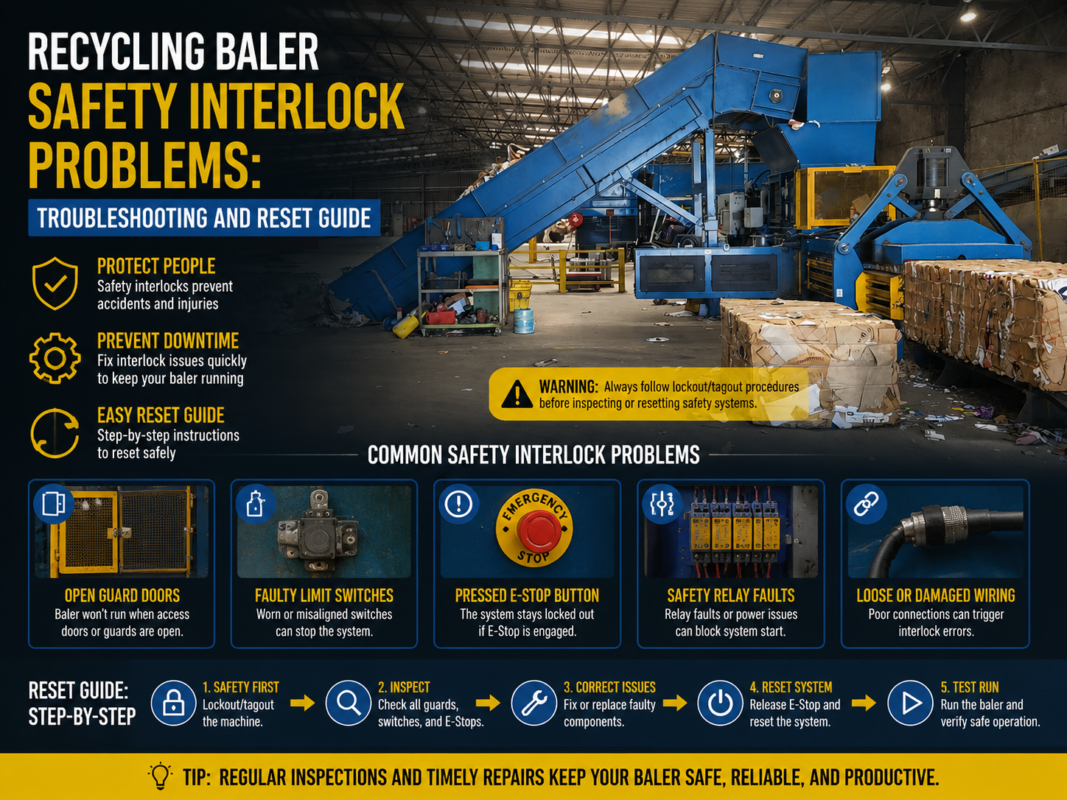
This often indicates an intermittent loss of the “Safety String.” If an Emergency Stop button is slightly loose or a safety gate sensor is vibrating at the edge of its sensing range, the circuit may break for a millisecond, causing the PLC to halt the machine for safety without having enough time to register a specific fault code.
How do I know if a solenoid coil is bad?
The easiest way is to check for magnetism. When the coil is energized, it should be able to hold a small screwdriver against its frame. If there is no magnetic pull despite receiving voltage, the coil is likely burnt out. You can also verify this by measuring the resistance (Ohms) of the coil; it should have a specific resistance value, not zero or infinity.
Conclusion: Proactive Maintenance for Long-Term Reliability
To effectively troubleshoot electrical control failures in a recycling baler, one must move from a reactive mindset to a proactive one. The electrical system is the nervous system of your machinery; it requires clean power, a stable environment, and regular check-ups. By implementing a systematic diagnostic approach—starting with the power supply, moving through the PLC logic, and ending with the mechanical actuators—you can drastically reduce the time it takes to return a machine to service.
Investing in high-quality equipment from manufacturers like HARSLE provides a significant advantage, as these machines are designed with serviceability in mind. However, even the best machine requires a skilled operator and a diligent maintenance team. Keep your schematics updated, your cabinets clean, and your staff trained on the latest diagnostic tools. In the long run, the effort you put into understanding and maintaining your baler’s electrical controls will pay dividends in the form of increased productivity, enhanced safety, and a longer machine lifespan. Remember, in the world of industrial recycling, uptime is the ultimate metric of success, and a healthy electrical system is the key to achieving it.