
Industrial Shredder Power Loss Troubleshooting: Electrical and Mechanical Causes

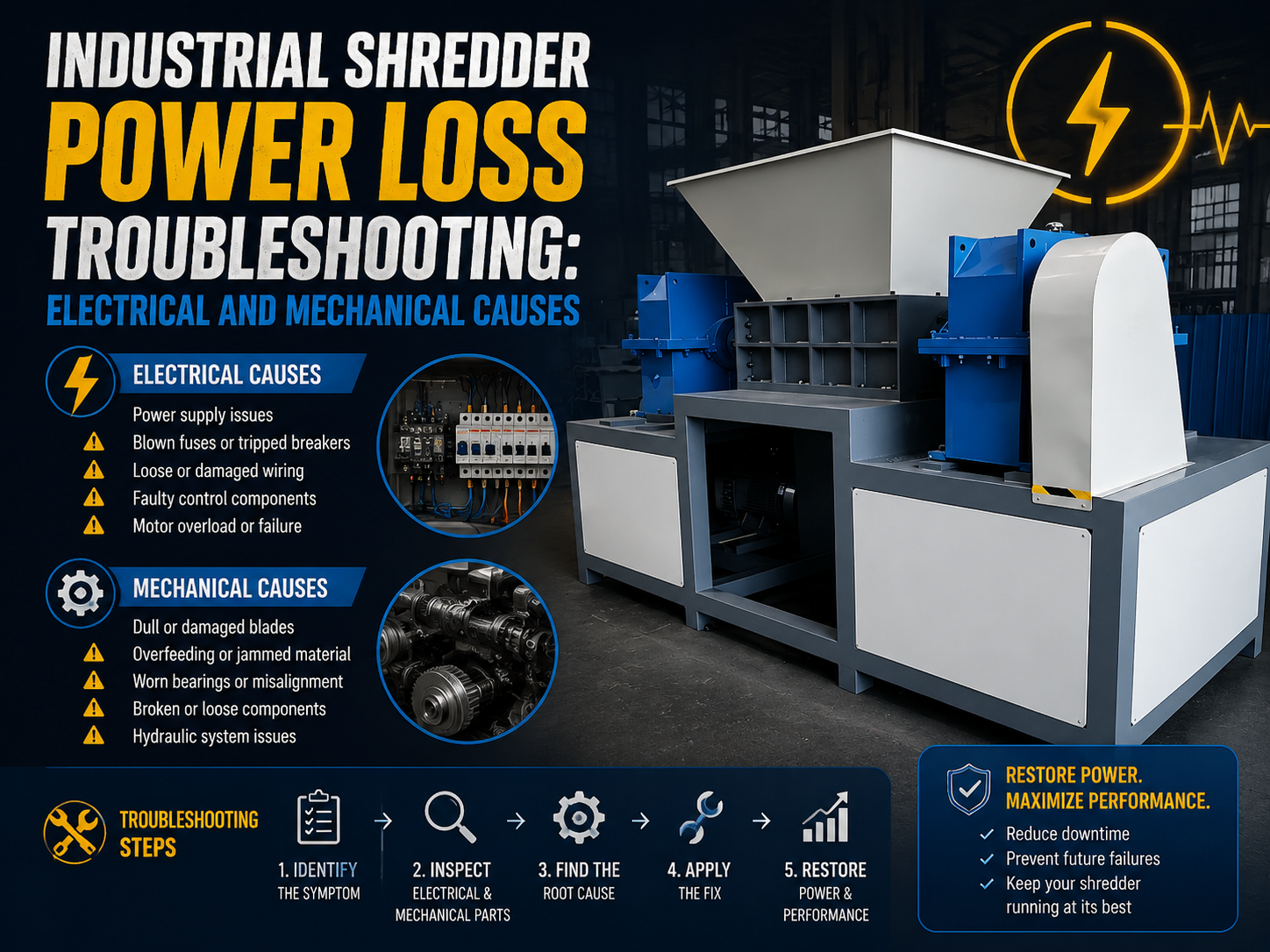
Introduction to Industrial Shredder Power Loss
In the world of heavy-duty recycling and waste management, the industrial shredder stands as a cornerstone of productivity. Whether processing scrap metal, plastics, or electronic waste, these machines are engineered to exert massive amounts of torque. However, even the most robust equipment, such as those manufactured by HARSLE, can encounter performance issues. One of the most frustrating challenges for operators is a sudden or gradual loss of power. Understanding Industrial Shredder Power Loss Troubleshooting: Electrical Mechanical Causes is essential for minimizing downtime and protecting your capital investment.
Power loss in an industrial shredder doesn’t always mean the machine stops completely. It often manifests as a decrease in throughput, the inability to process materials that were previously handled with ease, or frequent motor tripping. These symptoms indicate that the energy being drawn from the source is not being efficiently converted into cutting force at the shafts. To resolve these issues, a systematic approach is required, separating the electrical supply and control systems from the mechanical transmission and cutting components.
HARSLE has long been a leader in providing high-performance metal fabrication and recycling machinery. Our dual-shaft and single-shaft shredders are designed for durability, but environmental factors, improper maintenance, and operational strain can lead to power inefficiencies. This guide aims to provide a deep dive into the technical nuances of power loss, offering actionable insights for maintenance teams and facility managers to restore their equipment to peak performance.
Key Considerations Before Troubleshooting
Before diving into the technical specifics of Industrial Shredder Power Loss Troubleshooting: Electrical Mechanical Causes, safety must be the primary concern. Industrial shredders operate with immense force and often utilize high-voltage electrical systems. Always follow Lockout-Tagout (LOTO) procedures before inspecting internal components or electrical panels. Ensure that all residual energy, including hydraulic pressure or kinetic energy in heavy flywheels, is fully dissipated.
Another critical consideration is the distinction between a ‘hard failure’ and ‘performance degradation.’ A hard failure, such as a snapped shaft or a blown main fuse, is usually easy to identify. Performance degradation, however, is more subtle. It requires a baseline of the machine’s normal operating parameters—such as standard amperage draw under load and typical shaft RPM—to identify when the machine is underperforming. Keeping detailed maintenance logs is invaluable during this diagnostic phase.
Environmental factors also play a significant role. Industrial shredders often operate in dusty, hot, or humid environments. These conditions can accelerate the wear of electrical contacts and lead to the overheating of mechanical components. When troubleshooting, consider the ‘health’ of the environment. Is the ventilation for the motor adequate? Is the electrical cabinet sealed against metallic dust? Addressing these external factors is often the first step in a comprehensive troubleshooting strategy.
Technical Details: Electrical Causes of Power Loss
1. Voltage Fluctuations and Phase Imbalance
The electrical motor is the heart of the shredder. For it to deliver its rated torque, it requires a stable and clean power supply. Voltage drops (brownouts) are a common cause of power loss. If the incoming voltage drops below the motor’s rated tolerance (typically +/- 10%), the motor will draw more current to compensate, leading to overheating and a reduction in torque. In severe cases, the motor’s internal thermal protection will trip, shutting down the machine.
Phase imbalance is another critical electrical issue. In three-phase systems, if the voltage across the three phases is not equal, it creates a ‘negative sequence’ magnetic field in the motor. This field opposes the primary rotation, significantly reducing efficiency and causing the motor to vibrate and overheat. A phase imbalance of even 3% can lead to a 20% increase in temperature, which rapidly degrades the motor windings and reduces output power.
2. Variable Frequency Drive (VFD) and Control Logic Issues
Modern HARSLE shredders often utilize Variable Frequency Drives (VFDs) to manage motor speed and torque. While VFDs offer excellent control, they can also be a source of power loss if misconfigured. If the VFD parameters—such as the torque limit or current limit—are set too low, the drive will artificially cap the motor’s output, preventing it from powering through tough materials. Additionally, aging capacitors within the VFD can lead to ‘dirty’ power output, causing the motor to hum and lose efficiency.
3. Faulty Contactors and Loose Wiring
The physical connections between the power source and the motor are frequent failure points. Over time, the constant vibration of the shredding process can loosen terminal screws. A loose wire creates high resistance, which generates heat and drops the voltage reaching the motor. Similarly, the silver contacts inside electrical contactors can become pitted or carbonized due to repeated arcing. This increased resistance acts as a bottleneck for electrical current, effectively starving the motor of the power it needs to maintain shaft speed under load.
Technical Details: Mechanical Causes of Power Loss
1. Blade Wear and Improper Clearance
From a mechanical perspective, ‘power loss’ is often actually an increase in the resistance the machine must overcome. The most common culprit is dull or damaged blades. When shredder blades lose their sharp edge, they stop ‘cutting’ and start ‘tearing’ or ‘crushing’ the material. This requires significantly more energy. If the blades are dull, the motor may reach its maximum amperage draw while processing only a fraction of its rated capacity.
Furthermore, the clearance between the blades (in dual-shaft models) or between the blades and the counter-knives (in single-shaft models) is critical. If the gap is too wide, material can become wedged between the cutting elements rather than being sheared. This ‘wedging’ effect creates massive friction, which consumes the torque that should be used for shredding, leading to what feels like a loss of power.
2. Gearbox Inefficiency and Lubrication Failure
The gearbox is responsible for converting the high-speed rotation of the motor into the high-torque, low-speed rotation required by the shafts. If the gearbox oil is contaminated, depleted, or of the wrong viscosity, internal friction increases. Overheating in the gearbox is a clear sign of energy being wasted as heat rather than being transmitted to the shafts. Worn gears or failing bearings within the gearbox can also create mechanical drag, reducing the overall mechanical advantage of the system.
3. Bearing Seizure and Shaft Misalignment
The shafts of an industrial shredder are supported by heavy-duty bearings designed to handle radial and axial loads. If these bearings are not lubricated according to the manufacturer’s schedule, they can begin to seize. Even a partial seizure creates immense drag. Similarly, if the motor and gearbox, or the gearbox and the shredder shafts, become misaligned due to structural stress or loose mounting bolts, the coupling must work harder to transmit power. This misalignment introduces parasitic loads that drain the system’s effective power.
Selection Advice: Minimizing Power Loss Through Better Equipment
When purchasing a new industrial shredder, selecting a machine with the right specifications can prevent many power loss issues before they start. At HARSLE, we recommend focusing on the following criteria:
- Service Factor of the Gearbox: Ensure the gearbox has a high service factor (typically 1.5 or higher). This means the gearbox is rated to handle significantly more torque than the motor can produce, providing a safety margin that prevents overheating and mechanical fatigue.
- Motor Insulation Class: Look for motors with Class H insulation. These are designed to withstand higher temperatures, making them more resilient to the heat generated during voltage fluctuations or heavy loading cycles.
- Advanced Control Systems: Choose shredders equipped with ‘Auto-Reverse’ logic. This feature detects when the motor is reaching a pre-set amperage limit (indicating a potential jam or overload) and automatically reverses the shafts to clear the material. This prevents the motor from stalling and reduces electrical stress.
- Ease of Maintenance: A shredder that is easy to maintain is more likely to be maintained. HARSLE designs focus on accessible lubrication points and easy-to-replace wear parts, ensuring that mechanical friction is kept to a minimum throughout the machine’s life.
| Component | Potential Issue | Diagnostic Action |
|---|---|---|
| Main Motor | Phase Imbalance | Measure voltage across all three phases under load. |
| Cutting Blades | Dullness/Wear | Visual inspection of cutting edges and gap measurement. |
| VFD / Inverter | Parameter Limit | Check torque and current limit settings in the software. |
| Gearbox | Oil Degradation | Perform oil analysis or check for burnt smell/discoloration. |
| Bearings | Lack of Grease | Use a thermal camera to check for localized hot spots. |
FAQ: Industrial Shredder Power Loss
Q: Why does my shredder lose power after running for an hour?
A: This is often related to heat. As electrical components (like contactors or motor windings) or mechanical components (like gearboxes) heat up, their resistance increases. If the cooling system is inadequate or if there is excessive friction, the machine will lose efficiency as it reaches operating temperature. Check for proper ventilation and lubrication.
Q: Can a dull blade really cause the motor to trip?
A: Absolutely. Dull blades increase the mechanical resistance of the shredding process. The motor must work harder to force the blades through the material, which increases the amperage draw. If the draw exceeds the safety limit set on the circuit breaker or VFD, the system will trip to prevent the motor from burning out.
Q: How often should I check the electrical connections?
A: In high-vibration environments like metal shredding, we recommend a quarterly inspection of all major electrical terminals. Thermal imaging (using an infrared camera) is an excellent way to find loose connections without shutting down the system, as loose wires will appear significantly hotter than the surrounding components.
Q: What is the most common mechanical cause of power loss?
A: Aside from blade wear, the most common cause is material buildup or ‘wrapping’ around the shafts. Materials like wire, plastic film, or fabric can wrap tightly around the shaft and press against the side walls or seals, creating massive amounts of friction that the motor must overcome before it even begins to shred new material.
Conclusion
Mastering Industrial Shredder Power Loss Troubleshooting: Electrical Mechanical Causes is a vital skill for any facility operating heavy-duty recycling equipment. By understanding that power loss is rarely a single-factor issue, operators can more effectively diagnose whether the problem lies in the ‘push’ (the electrical system) or the ‘resistance’ (the mechanical system). Regular maintenance, including blade sharpening, proper lubrication, and electrical inspections, remains the most effective way to ensure your HARSLE shredder continues to deliver the torque and throughput your operations demand.
Investing in high-quality machinery is only the first step; maintaining that machinery through a rigorous understanding of its technical requirements ensures long-term profitability and operational success. If you continue to experience power loss after following these troubleshooting steps, consult with a HARSLE technical specialist to perform a deeper analysis of your system’s performance and configuration.


