Four-Shaft Shredder for Waste Treatment Plants: Technical Applications and Benefits

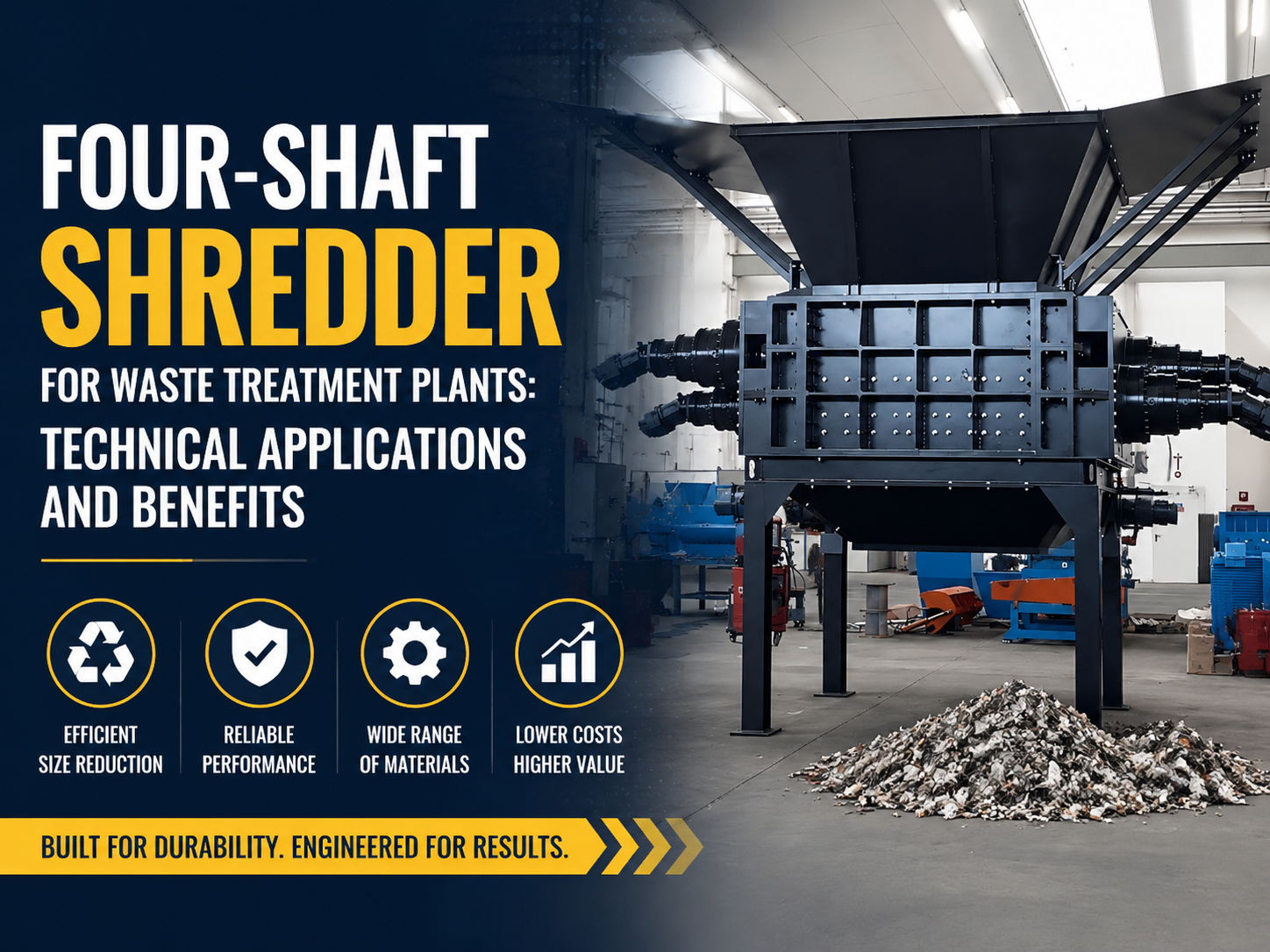
Technical Overview of Four-Shaft Shredders in Modern Waste Management
In the rapidly evolving landscape of industrial waste management, the four-shaft shredder has emerged as a cornerstone technology for facilities requiring precise particle size control and high-torque processing. Unlike traditional single or double-shaft shredders, the four-shaft configuration utilizes two primary cutting shafts and two secondary cleaning/feeding shafts. This complex interaction allows for a unique ‘recirculation’ effect where material that does not pass through the integrated screen is automatically pulled back into the cutting zone by the upper shafts. This ensures that the output is consistently sized, making it an ideal solution for waste treatment plants that feed downstream processes like pyrolysis, pelletizing, or refuse-derived fuel (RDF) production.
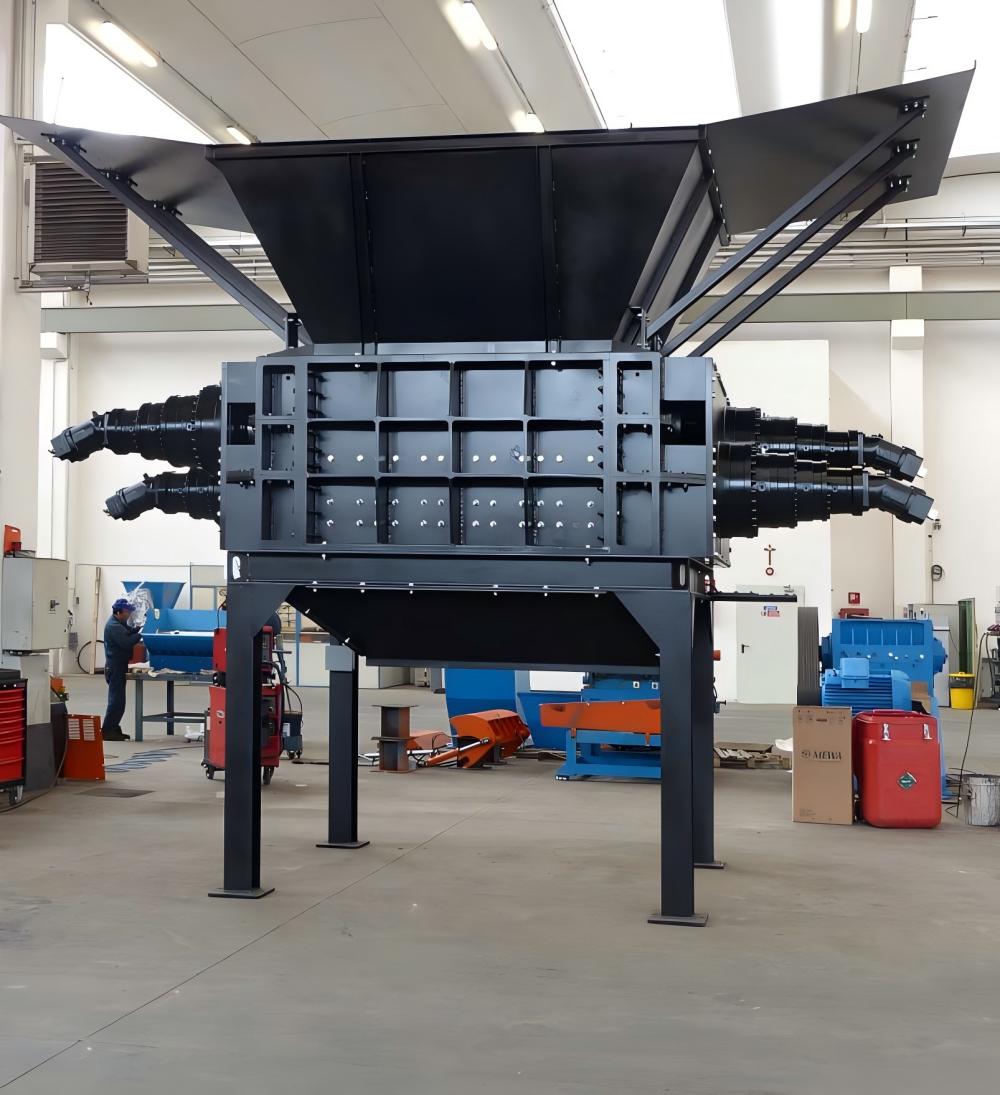
The mechanical architecture of a HARSLE four-shaft shredder is designed to handle heterogeneous waste streams, including plastics, electronic waste (e-waste), medical waste, and even light metal scrap. The primary advantage lies in the torque distribution. By spreading the load across four shafts, the machine can maintain high cutting force even at lower RPMs, which significantly reduces heat generation and dust emissions. For waste treatment plants, this translates to lower operational risks and a cleaner working environment. The integration of a modular screen beneath the shafts allows operators to define the exact maximum dimensions of the shredded material, a feature that is often difficult to achieve with standard two-shaft models without external screening equipment.
Furthermore, the four-shaft design excels in ‘grabbing’ bulky items. In a two-shaft system, large hollow objects like plastic drums or car bumpers can sometimes ‘bounce’ on top of the cutters. In a four-shaft system, the upper shafts act as active feeders, forcing the material down into the primary cutting zone. This positive feed mechanism increases throughput efficiency by up to 30% compared to traditional designs of similar power ratings. As waste treatment plants face increasing pressure to process higher volumes with tighter specifications, the technical superiority of the four-shaft system becomes a critical competitive advantage.
The Role of Blade Geometry and Metallurgy
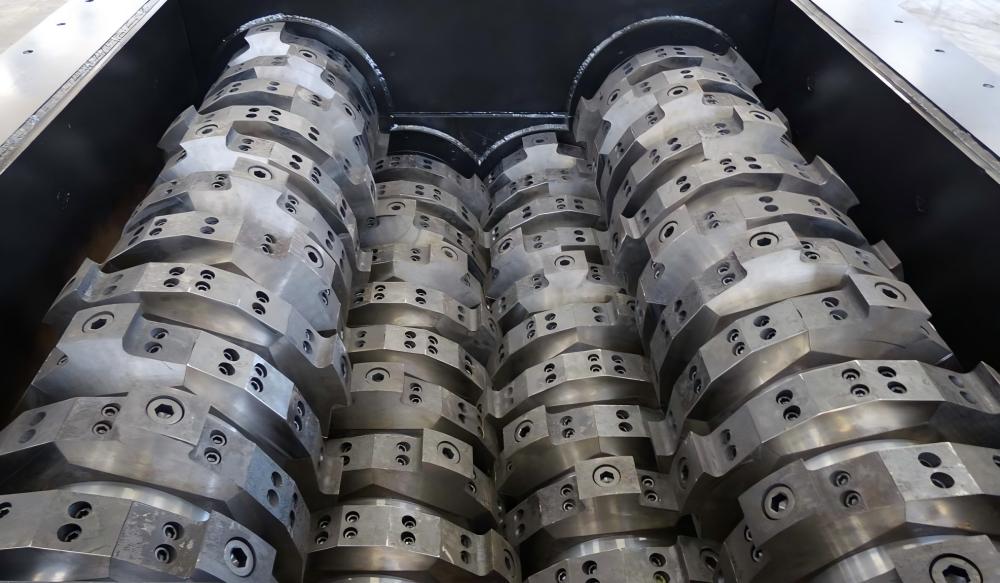
The heart of any shredder is its blade set. For four-shaft shredders, blade geometry is not a one-size-fits-all specification. Engineers must consider the hook profile, the number of teeth, and the thickness of the blade relative to the material being processed. For instance, shredding tough textiles requires a sharp, aggressive hook to prevent wrapping, while shredding brittle e-waste requires a more robust, impact-resistant tooth profile. HARSLE utilizes high-alloy steels such as D2 or SKD-11, which undergo vacuum heat treatment to achieve a hardness of 58-62 HRC, ensuring long-term wear resistance against abrasive waste components.
Another technical nuance is the ‘staggered’ arrangement of the blades. By offsetting the cutting teeth across the shafts, the machine reduces the peak instantaneous load on the motor and gearbox. This results in a smoother power curve and extends the lifespan of the drive train. In a waste treatment plant operating 24/7, these small engineering details manifest as significantly lower maintenance costs and fewer unplanned shutdowns. The ability to individually replace or sharpen blades without dismantling the entire shaft assembly is another hallmark of a well-engineered four-shaft system, allowing for rapid onsite servicing.
Core Parameters and Engineering Specifications
When evaluating a four-shaft shredder for a waste treatment plant, several core parameters dictate the machine’s performance and suitability. The most prominent is the motor power, typically ranging from 30kW to over 200kW in heavy-duty applications. However, power alone is misleading; the real metric of performance is the torque delivered at the shaft. Through advanced planetary gearboxes, the high-speed rotation of the electric motor is converted into massive crushing force. For waste treatment, a high torque-to-speed ratio is preferred to handle tough contaminants without stalling the machine.
Shaft speed is another critical parameter. Typically, the primary shafts in a four-shaft shredder rotate at different speeds (e.g., 15 RPM and 25 RPM). This differential speed creates a tearing and shearing action rather than a simple crushing action. The secondary shafts often rotate faster to facilitate material intake. This speed synchronization is managed by a sophisticated PLC (Programmable Logic Controller) system that monitors the current draw of each motor. If a jam is detected, the PLC triggers an automatic reverse cycle to clear the obstruction before resuming operation, protecting the mechanical components from catastrophic failure.
Screen Size and Throughput Correlation
The screen size is the primary determinant of the final product size. In four-shaft shredders, the screen wraps around the lower half of the cutting chamber. Common screen hole diameters range from 20mm to 100mm. It is important to note that as the screen size decreases, the throughput (tons per hour) also decreases because the material must remain in the cutting chamber longer to be reduced to the required size. Waste treatment plant operators must find the optimal balance between the required particle size for downstream equipment and the desired hourly capacity. HARSLE machines are designed with quick-change screen cradles to allow for rapid adjustments when switching between different waste streams.
Calculation Method for Shredder Throughput and Torque
To accurately size a shredder for a waste treatment facility, engineers use specific calculation methods. The theoretical throughput ($Q$) can be estimated using the following formula:
Q = V × n × ρ × η
Where:
– V is the volume of material displaced by the cutters per revolution.
– n is the rotational speed of the shafts (RPM).
– ρ is the bulk density of the waste material.
– η is the filling efficiency factor (usually between 0.2 and 0.5 depending on material type).
Calculating the required torque ($T$) is even more critical to prevent motor burnout. Torque is a function of the material’s shear strength and the radius of the cutter:
T = F × r
Where F is the force required to shear the material (Shear Strength × Area of Cut) and r is the distance from the center of the shaft to the tip of the cutter tooth. For a waste treatment plant processing mixed plastics with a shear strength of 50 MPa, the torque requirements can be immense, necessitating the use of high-service-factor gearboxes. HARSLE provides detailed torque curve analysis for specific material types to ensure that the selected model has a sufficient safety margin for the toughest expected loads.
Technical Parameter Table for HARSLE Four-Shaft Shredders
| Model Series | Power (kW) | Chamber Size (mm) | Blade Qty (pcs) | Throughput (kg/h) | Typical Application |
|---|---|---|---|---|---|
| FS-800 | 30 – 45 | 800 x 600 | 40 – 60 | 500 – 1,200 | Medical Waste, E-waste |
| FS-1200 | 55 – 90 | 1200 x 900 | 60 – 80 | 1,500 – 3,500 | Plastic Drums, RDF |
| FS-1600 | 110 – 160 | 1600 x 1200 | 80 – 120 | 4,000 – 8,000 | Tires, Large MSW |
| FS-2000 | 180 – 250 | 2000 x 1500 | 100 – 150 | 10,000+ | Heavy Industrial Waste |
Common Engineering Mistakes in Shredder Implementation
One of the most frequent mistakes in waste treatment plants is the ‘Over-Sizing Fallacy.’ Operators often believe that a larger motor will solve all throughput issues. However, if the blade geometry is not matched to the material, a larger motor will simply consume more energy while the blades fail to grab the material effectively. This leads to ‘glazing’ where the blades rub against the waste rather than cutting it, generating excessive heat and potentially melting plastics, which then clog the screen.
Another common error is neglecting the ‘Screen Trap.’ In high-moisture waste environments, such as organic waste processing or wet plastic recycling, small screen holes can quickly become blinded (clogged). Once the screen is blinded, the material cannot exit, the internal temperature rises, and the machine eventually trips on overload. Engineering a solution requires either a larger screen mesh or an integrated cleaning system. Furthermore, many plants fail to implement proper magnetic separation before the shredder. While four-shaft shredders are robust, consistent ingestion of heavy tramp metal (like thick steel bolts or rebar) will lead to premature blade chipping and shaft fatigue.
Finally, improper lubrication of the main bearings and gearbox is a silent killer of industrial shredders. In the dusty environment of a waste treatment plant, seals can degrade, allowing abrasive particles to enter the bearing housing. HARSLE recommends automated lubrication systems that provide consistent, metered grease delivery, ensuring that the machine’s core rotating components remain protected even during continuous high-load operation.
Selection Checklist for Waste Treatment Plant Managers
Choosing the right four-shaft shredder requires a systematic approach. Use the following checklist to ensure all technical requirements are met:
- Material Characterization: Define the maximum size, moisture content, and shear strength of the input material.
- Output Requirements: Specify the exact particle size needed for downstream processes. Does it need to be 30mm, 50mm, or 100mm?
- Throughput Targets: Calculate the required tons per hour, accounting for peak delivery times at the facility.
- Blade Metallurgy: Ensure the blade material (e.g., D2, DC53) is appropriate for the abrasiveness of the waste.
- Drive System: Decide between electric drive (standard) or hydraulic drive (for extremely high shock loads).
- PLC Logic: Verify that the control system includes auto-reverse, overload protection, and data logging for maintenance.
- Maintenance Access: Check if the screen and blades can be accessed easily without a full machine teardown.
- Footprint and Integration: Ensure the machine fits within the existing plant layout and integrates with conveyors and hoppers.
- Safety Features: Confirm the presence of emergency stops, safety interlocks on access doors, and noise dampening if required.
- Total Cost of Ownership (TCO): Look beyond the initial price; consider energy consumption, blade replacement costs, and expected uptime.
Frequently Asked Questions (FAQ)
1. How often do the blades on a four-shaft shredder need sharpening?
The frequency of sharpening depends entirely on the material being processed. For clean plastics, blades may last 1,000 to 2,000 hours before needing attention. For abrasive materials like glass-filled polymers or e-waste, this may drop to 500 hours. HARSLE blades are designed to be sharpened multiple times before replacement is necessary.
2. Can a four-shaft shredder handle metal?
Four-shaft shredders are excellent for light metals such as aluminum profiles, copper wiring, and thin-gauge steel cans. However, they are not intended for heavy structural steel or thick engine blocks. For those applications, a dedicated heavy-duty metal crusher or a high-torque two-shaft shredder without a screen is usually preferred.
3. What is the advantage of a four-shaft shredder over a granulator?
A granulator operates at much higher speeds and is designed for fine grinding of relatively clean, uniform materials. A four-shaft shredder is a ‘primary’ or ‘secondary’ reducer that handles much larger, bulkier, and more contaminated waste. The shredder is far more robust and less susceptible to damage from non-shreddable contaminants.
4. How does the screen affect the machine’s power consumption?
The smaller the screen, the more ‘work’ the machine has to do to force material through it. This increases the residence time of the material in the chamber, leading to higher energy consumption per ton of output. It is always more energy-efficient to use the largest screen size that your downstream process can tolerate.
5. Is it possible to automate the feeding process?
Yes, HARSLE four-shaft shredders are typically integrated into automated lines. We recommend using a vibrating feeder or a heavy-duty belt conveyor with a load-sensing control. This allows the shredder’s PLC to communicate with the conveyor, slowing down or stopping the feed if the shredder’s motor current exceeds a certain threshold, preventing overloads.