How Horizontal Baler Tying Systems Work: Wire, Strap, and Automation Options

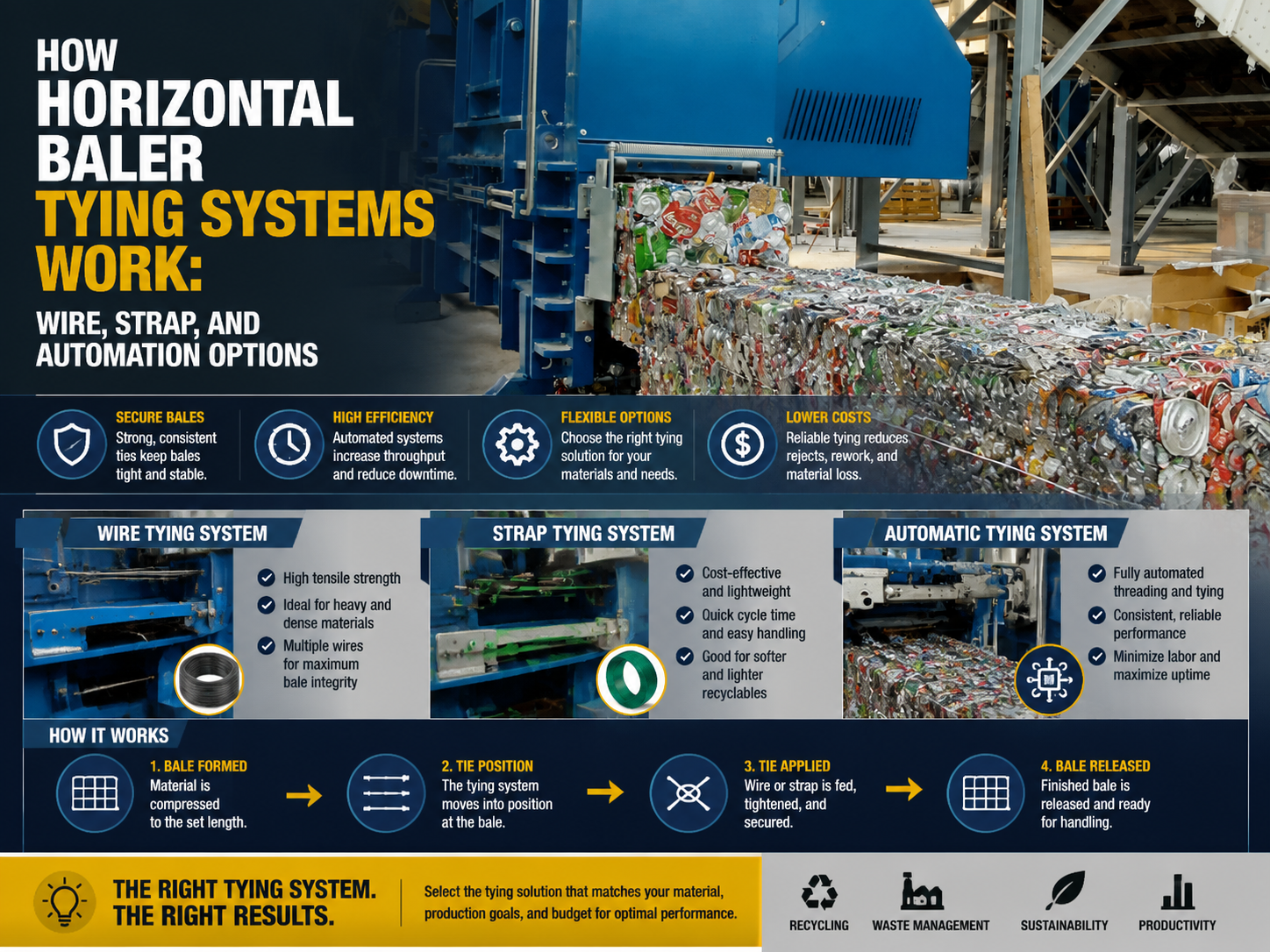
Technical Overview of Horizontal Baler Tying Systems
In the world of industrial waste management and metal fabrication, the horizontal baler stands as a cornerstone of efficiency. However, the true heart of a horizontal baler’s productivity lies not just in its compression force, but in its tying system. Understanding how horizontal baler tying systems work—encompassing wire, strap, and automation options—is essential for any facility looking to optimize its throughput and ensure bale integrity during transport. At HARSLE, we emphasize the precision engineering required to make these systems seamless, durable, and cost-effective.
The tying process begins once the material—whether it be OCC (old corrugated cardboard), plastic film, or non-ferrous metals—has been compressed to a predetermined length or density. The horizontal baler utilizes a series of needles that pass through slots in the compression ram. These needles carry the tying medium (usually galvanized wire or polyester strapping) across the bale. Once the needles reach the opposite side, a twisting or sealing mechanism secures the ends, creating a tensioned loop that holds the compressed material together. This cycle must be executed with millisecond precision to prevent ‘bale expansion’ or ‘tie failure,’ which can lead to significant downtime and safety hazards.
Modern tying systems are categorized into manual, semi-automatic, and fully automatic configurations. Manual systems require an operator to thread the wire and twist it, which is common in low-volume vertical balers but rare in high-capacity horizontal units. Semi-automatic systems automate the needle pass but may require manual intervention for knotting. Fully automatic systems, the gold standard for HARSLE machinery, handle the entire sequence—feeding, tensioning, twisting, and cutting—without human intervention, allowing for continuous operation and significantly higher ROI.
The Mechanics of Wire Tying vs. Strapping
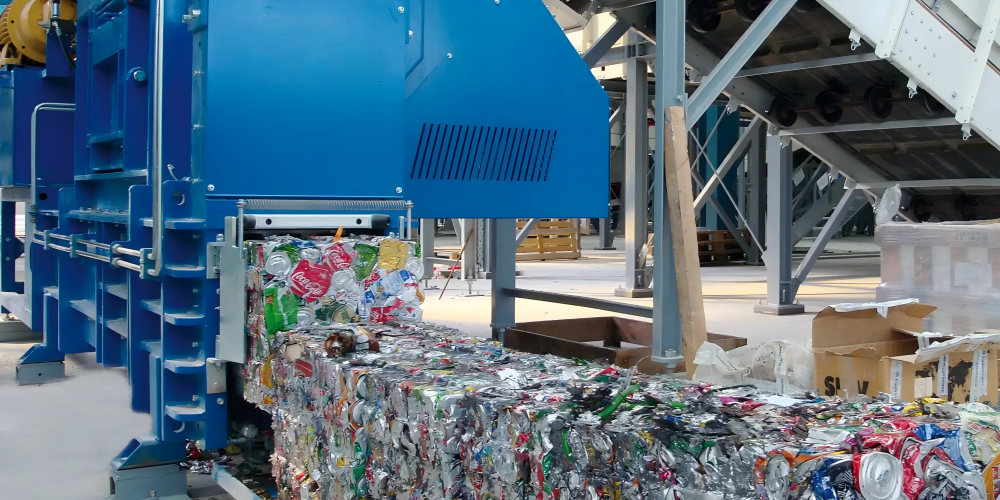
Wire tying remains the most prevalent method for heavy-duty horizontal balers. Typically using 10 to 14-gauge galvanized wire, this system is favored for its high tensile strength and resistance to the internal pressures of dense bales. The wire is fed from large coils (often 1,000 lbs or more) through a series of tensioning rollers. When the tie cycle triggers, the ‘twister head’ performs a specific number of rotations to create a secure knot that won’t slip under the expansion force of the material.
Strapping systems, often utilizing PET (Polyester) or PP (Polypropylene) straps, are gaining traction in specific industries, particularly where wire is considered a contaminant. For instance, in certain plastic recycling streams or waste-to-energy plants, metal wire can damage downstream processing equipment. Strapping systems use friction welding or ultrasonic sealing to join the ends of the strap. While slightly less robust than steel wire for ultra-high-density metal scrap, modern PET strapping offers impressive elongation recovery, meaning the strap stretches slightly as the bale expands and then maintains a tight grip.
Core Parameters of Tying Systems
When evaluating horizontal baler tying systems, several core parameters dictate the performance and suitability of the machine for a specific application. The first is Cycle Time. In a high-volume facility, every second counts. A high-end automatic tying system should complete a full 4 or 5-wire tie in under 30 seconds. This includes the needle travel, twisting, and reset phases. If the tying system is too slow, it becomes the bottleneck of the entire production line, regardless of how fast the main hydraulic ram moves.
The second parameter is Tensile Strength and Wire Gauge. For materials with high ‘memory’ (materials that want to expand significantly after compression, like plastic bottles), a higher gauge wire or a strap with high break strength is required. Using a wire that is too thin will result in ‘bale pops,’ where the ties snap during storage or transport. Conversely, using wire that is excessively thick increases operational costs unnecessarily. HARSLE machines are designed to calibrate the tensioning force to match the specific material density, ensuring optimal wire usage.
Thirdly, Knotter Reliability is a critical metric. The knotter or twister head is the most complex mechanical part of the tying system. It must operate in dusty, debris-filled environments without jamming. Parameters such as the ‘twist count’ and ‘cutter blade hardness’ are vital. A high-quality tying system will feature hardened steel components and an automated lubrication system to minimize wear and tear on these moving parts. Furthermore, the Needle Stroke Precision ensures that the needles align perfectly with the ram slots every time, preventing catastrophic needle breakage.
Calculation Method for Tying Efficiency
To manage costs and predict operational expenses, facility managers must calculate the consumption of tying materials. The formula for calculating wire consumption per bale is relatively straightforward but must account for the ‘tail’ or waste produced during the twisting process. The basic formula is:
Total Wire per Bale = (Bale Perimeter + Twist Allowance) × Number of Ties
For example, if a bale has a cross-section of 40″ x 30″, the perimeter is 140 inches. If the twist allowance (the extra wire needed for the knotter to grab and twist) is 10 inches, and the baler uses 5 ties, the total wire per bale is 750 inches (or 62.5 feet). By knowing the weight per foot of the specific wire gauge (e.g., 12-gauge wire is approximately 0.02 lbs per foot), you can calculate that each bale uses roughly 1.25 lbs of wire. Multiplying this by the number of bales produced per day gives a clear picture of consumable costs.
Another vital calculation is the Tying System Throughput Ratio. This is calculated by dividing the total cycle time of the baler by the time taken specifically for the tying process. If the tying process takes up more than 20% of the total cycle time, the system may need optimization, such as upgrading to a faster twister head or adjusting the needle speed. Efficiency is also measured by the ‘Missed Tie Rate,’ which should ideally be less than 0.1% in a well-maintained HARSLE horizontal baler.
Parameter Comparison Table
The following table compares the three primary tying options available for modern horizontal balers to help in the selection process.
| Feature | Galvanized Steel Wire | PET/PP Strapping | Manual Tie (Wire/Rope) |
|---|---|---|---|
| Tensile Strength | Very High (Up to 1,800 lbs) | High (Up to 1,200 lbs) | Moderate |
| Automation Level | Fully Automatic | Fully/Semi-Automatic | Manual |
| Material Compatibility | Metal, OCC, Paper, Hard Plastic | PET, Soft Plastic, Fiber | Low-volume waste |
| Consumable Cost | Moderate | Higher per foot | Lowest |
| Maintenance Needs | High (Twister cleaning) | Moderate (Sealer cleaning) | Minimal |
| Bale Integrity | Excellent (No stretch) | Good (Elastic recovery) | Variable |
| Industry Preference | Scrap Metal / Heavy Recycling | Distribution Centers / PET | Small Retail / Grocery |
Common Engineering Mistakes in Tying System Operation
One of the most frequent mistakes in operating horizontal baler tying systems is improper wire tensioning. If the tension is too loose, the bale will expand too much once it leaves the chamber, making it difficult to stack and transport. If the tension is too tight, the wire may snap during the twisting process or shortly after the bale is ejected. Operators often fail to adjust the tensioning rollers when switching between different wire gauges or material types, leading to inconsistent bale quality.
Another common error is neglecting the ‘Home Position’ of the needles. The needles must return to a precise home position to allow the next charge of material to enter the chamber. If the sensors (limit switches or encoders) are dirty or misaligned, the needles may remain partially in the chamber, leading to a collision with the ram on the next stroke. This results in bent needles and significant repair costs. Regular cleaning of the needle tracks and sensor eyes is a simple but often overlooked maintenance task.
Furthermore, using substandard tying wire can wreak havoc on the tying system. Wire that is not properly galvanized or has inconsistent diameters can cause ‘birds-nesting’ in the feed system or premature wear on the twister hooks. Engineering teams should always specify the wire grade recommended by the manufacturer. Lastly, insufficient lubrication of the twister head is a leading cause of mechanical failure. Because the tying area is inherently dusty, the lubricant can mix with debris to create a grinding paste. Using the correct type of dry lubricant or ensuring the auto-lube system is functioning is paramount.
Selection Checklist for Tying Systems
Choosing the right tying system for your horizontal baler involves more than just picking the cheapest option. Use this checklist to ensure your selection aligns with your operational goals:
- Material Type: Does the material have high expansion force (like plastic) or is it relatively stable (like shredded paper)? High expansion requires stronger wire and more ties.
- Throughput Requirements: How many tons per hour do you need to process? Fully automatic systems are mandatory for anything over 5 tons per hour.
- Downstream Requirements: Will the ties need to be removed easily? Is metal wire a contaminant for the end-user of your bales?
- Labor Availability: Do you have dedicated operators to manage manual or semi-auto ties, or do you need a ‘set and forget’ fully automated solution?
- Space Constraints: Automatic tying systems require side clearance for the wire inserters and coil stands. Ensure your floor plan accommodates this.
- Budget for Consumables: Calculate the annual cost of wire vs. strap based on your projected volume.
- Maintenance Capability: Does your on-site team have the skills to maintain complex hydraulic/electric twister heads, or do you need a simpler system?
Frequently Asked Questions (FAQ)
1. Why does my horizontal baler keep missing ties?
Missed ties are usually caused by one of three things: dirty sensors that fail to detect the wire, a dull cutter blade that doesn’t cleanly sever the wire, or misaligned needles. Start by cleaning the entire tying assembly with compressed air and checking the alignment of the needles relative to the twister hooks.
2. Can I switch from wire to plastic strapping on the same machine?
Generally, no. Wire tying systems and strapping systems use completely different mechanical heads. A wire system uses a twister, while a strapping system uses a heat or friction sealer. Converting a machine usually requires a significant retrofit of the entire tying module.
3. How often should I replace the twister hooks?
Twister hooks are wear items. Depending on your volume, they typically last between 6 to 12 months. You should inspect them monthly for signs of grooving or thinning. If the wire starts slipping during the twist, it’s a sign the hooks are worn out.
4. What is the advantage of a ‘Side-Tie’ vs. a ‘Top-Tie’ system?
Side-tie systems are generally preferred for materials that produce a lot of small debris (like glass or fine dust), as the debris falls past the tying mechanism rather than settling on top of it. Top-tie systems are often easier to access for maintenance but can be more prone to debris-related jams in certain applications.
5. Does the wire gauge affect the bale density?
The wire gauge doesn’t affect the density achieved by the ram, but it does affect the ‘retained density.’ A stronger wire prevents the bale from expanding once the pressure is released, meaning you can fit more weight into a shipping container because the bales stay compact.
6. Is an automatic tying system worth the investment for a small facility?
If you are baling more than 2-3 times a day, the labor savings and the increase in safety (as operators don’t have to reach near the machinery) usually justify the cost of an automatic system within 18-24 months. For very low volumes, a manual tie horizontal baler may suffice.