
Understanding Direct Vs Indirect Aluminium Extrusion Press Systems: A Comprehensive Technical Guide

Technical Overview: The Mechanics of Extrusion
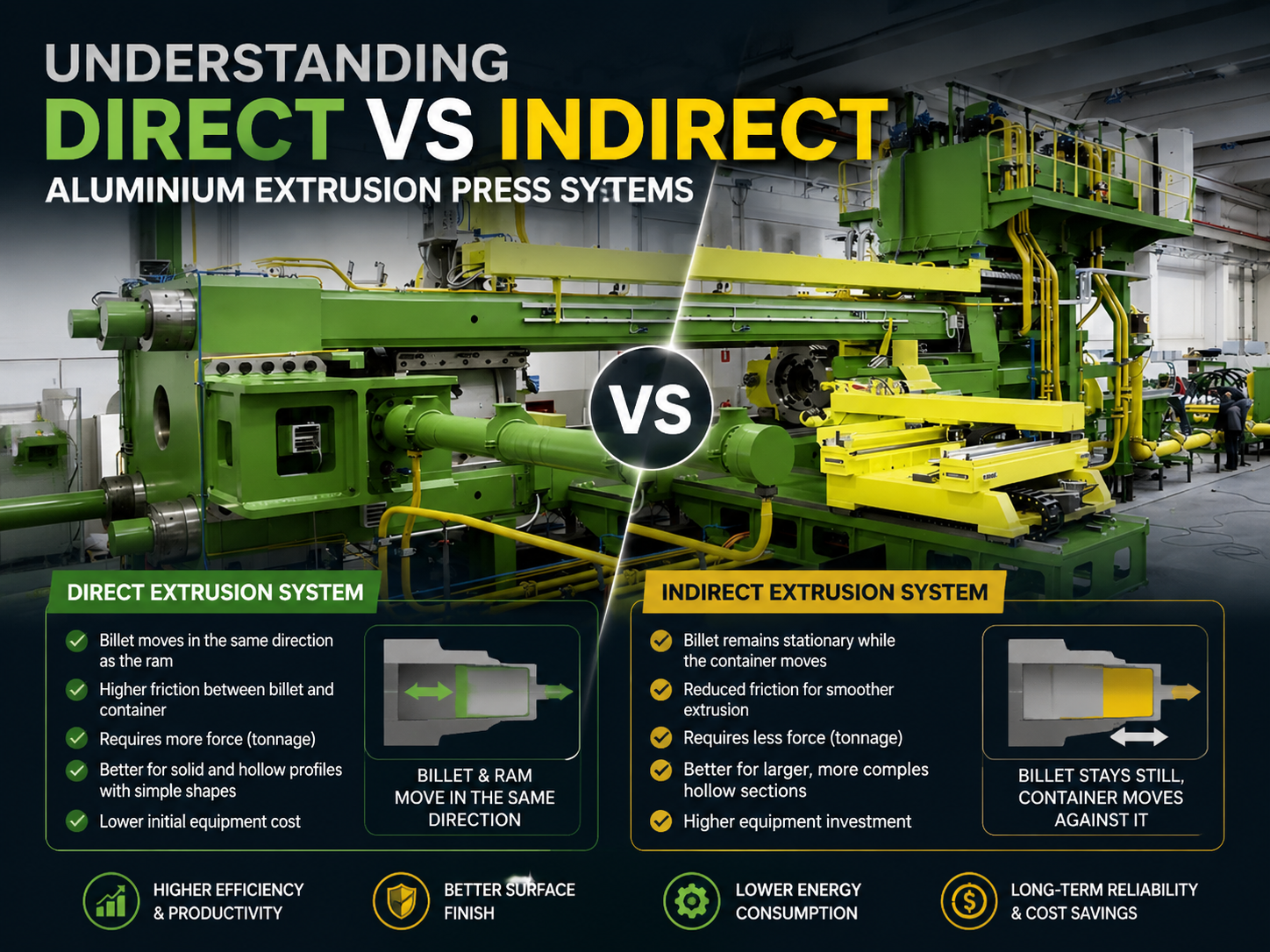
In the realm of metal fabrication, the aluminium extrusion process stands as a cornerstone for creating complex cross-sectional profiles. At the heart of this operation lies the extrusion press, a machine designed to force a heated aluminium billet through a shaped die. When evaluating the efficiency of a production line, the primary distinction lies in the mechanical configuration of the press: Direct vs. Indirect extrusion.
Direct extrusion, often referred to as forward extrusion, is the most common method in the industry. In this setup, the ram pushes the billet through a stationary die. The billet moves relative to the container wall, which creates significant friction. This friction necessitates higher force requirements and results in a non-uniform temperature distribution across the billet as it moves toward the die.
Conversely, indirect extrusion—or backward extrusion—utilizes a hollow ram that carries the die. In this configuration, the die moves into the stationary billet. Because the billet does not move relative to the container wall, friction is virtually eliminated. This fundamental difference in movement dictates the energy consumption, surface quality, and structural integrity of the final aluminium profile.
Understanding Direct Vs Indirect Aluminium Extrusion Press Systems is essential for manufacturers looking to optimize their output. While direct presses offer versatility and are easier to maintain, indirect presses provide superior efficiency for high-strength alloys and complex shapes. Choosing the right system requires a deep dive into the specific metallurgical requirements of your product line.
Core Parameters Influencing Extrusion Performance
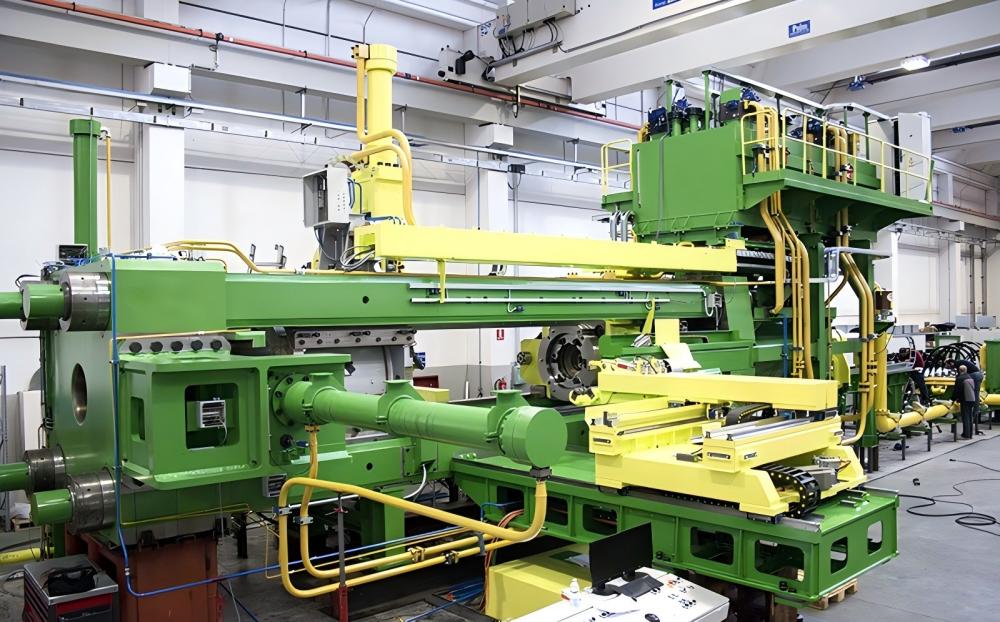
The performance of an aluminium extrusion press is governed by several critical parameters. The first is the extrusion ratio, which defines the relationship between the cross-sectional area of the billet and the cross-sectional area of the final profile. A higher ratio generally requires more pressure and places greater stress on the die, making the choice between direct and indirect systems vital for long-term tool life.
Billet temperature is another non-negotiable parameter. Aluminium must be heated to a specific plastic state—typically between 400°C and 500°C—to ensure optimal flow. In direct extrusion, the friction between the billet and the container wall generates additional heat, which can lead to surface defects if not carefully managed. Indirect systems, by removing this friction, allow for more precise temperature control throughout the process.
Ram speed and pressure capacity are the mechanical pillars of the press. Direct presses often require higher initial force to overcome the friction of the billet moving through the container. Indirect presses, however, can operate with lower total force for the same billet size because they do not need to overcome container friction. This allows for smaller, more energy-efficient hydraulic systems in indirect configurations.
Finally, the die design and lubrication protocols play a significant role. In direct extrusion, the die must withstand higher shear forces. In indirect extrusion, the die assembly is more complex due to the hollow ram requirement, but the reduced friction allows for thinner, more intricate profile designs that might otherwise fail under the high-pressure conditions of a direct press.
Calculation Method for Extrusion Force
Calculating the required extrusion force is a prerequisite for selecting the correct HARSLE aluminium extrusion press. For direct extrusion, the total force (F) is calculated as the sum of the force required for deformation (Fd) and the force required to overcome friction (Ff). The formula is generally expressed as F = Fd + Ff, where Ff is proportional to the billet length and the friction coefficient between the billet and the container.
In the indirect extrusion method, the friction component (Ff) is effectively zero. Therefore, the force calculation simplifies significantly to F = Fd. This reduction in required force is why indirect presses can often achieve higher extrusion speeds with lower power consumption. Engineers must calculate the flow stress of the specific aluminium alloy being used, as this value changes based on temperature and strain rate.
To perform these calculations accurately, one must account for the billet diameter and the container diameter. The pressure exerted by the ram must exceed the flow stress of the material at the die opening. If the calculated force exceeds the press capacity, the system will stall, potentially damaging the billet or the die. Always include a safety margin of at least 15-20% when sizing your press.
Advanced simulation software is now standard for these calculations. By inputting the alloy composition, billet temperature, and desired profile geometry, engineers can predict the exact pressure curve. This data-driven approach ensures that the chosen press is neither underpowered nor excessively large, optimizing both capital expenditure and operational costs.
Parameter Comparison Table
| Feature | Direct Extrusion | Indirect Extrusion |
|---|---|---|
| Friction | High (Billet moves in container) | Negligible (Billet is stationary) |
| Force Requirement | Higher | Lower |
| Energy Efficiency | Moderate | High |
| Billet Length | Limited by friction | Longer billets possible |
| Surface Quality | Good | Excellent |
| System Complexity | Lower | Higher |
| Maintenance | Easier | More complex |
Common Engineering Mistakes in Extrusion
One of the most frequent mistakes in the industry is ignoring the impact of billet taper heating. In direct extrusion, the back of the billet is often hotter than the front to compensate for the heat generated by friction during the stroke. If this is not calibrated correctly, the profile will exhibit inconsistent mechanical properties along its length, leading to scrap and wasted material.
Another common error is the improper selection of die materials. Because direct extrusion involves higher friction, the die must be made of high-grade tool steel with specialized coatings to prevent galling. Using an inferior die material in a high-pressure direct press will lead to premature failure and costly downtime. Always consult with HARSLE technical support to match your die specifications to your press type.
Many manufacturers also underestimate the importance of container maintenance. In direct extrusion, the container liner wears down over time due to the constant movement of the billet. If the liner is not replaced or refurbished according to a strict schedule, the resulting friction will spike, causing the press to consume more energy and potentially damaging the main ram seals.
Finally, failing to account for alloy-specific flow characteristics is a critical oversight. Different aluminium alloys have different flow stresses. Attempting to extrude a high-strength 7000-series alloy using parameters optimized for a 6000-series alloy will result in press overload. Always perform a trial run with a new alloy to establish the correct pressure and speed profiles before moving to full-scale production.
Selection Checklist for Your HARSLE Press
When you are ready to invest in an aluminium extrusion press, use this checklist to ensure you are making the right choice for your facility:
- Define your product range: Are you producing simple bars or complex, thin-walled profiles? Complex shapes often favor indirect extrusion.
- Analyze your alloy requirements: High-strength alloys require higher pressure and more robust press frames.
- Evaluate production volume: High-volume, continuous production benefits from the energy efficiency of indirect systems.
- Assess maintenance capabilities: Direct presses are generally easier to maintain in-house; indirect presses may require specialized training.
- Check space constraints: Indirect presses can sometimes be more compact, but they require specific foundation work.
- Review energy costs: If your local electricity rates are high, the energy savings of an indirect press will provide a faster ROI.
- Consult with HARSLE engineers: Provide your specific profile drawings and material specs for a custom machine recommendation.
FAQ: Understanding Direct Vs Indirect Aluminium Extrusion Press Systems
Which system is better for beginners?
Direct extrusion is generally recommended for beginners due to its simpler mechanical design, easier maintenance, and lower initial investment cost. It is the industry standard for a wide range of general-purpose profiles.
Can I convert a direct press to an indirect press?
Generally, no. The structural design, ram configuration, and hydraulic requirements are fundamentally different. It is more cost-effective to purchase a machine designed for the specific process you intend to run.
Does indirect extrusion always produce better surface quality?
Yes, because the billet does not rub against the container wall, there is significantly less surface shear. This results in a more uniform surface finish, which is ideal for profiles that will be anodized or powder-coated.
How does HARSLE support the selection process?
HARSLE provides comprehensive technical consultations, including force calculations, die design advice, and site-specific installation planning to ensure your press meets your production goals.
What is the lifespan of an extrusion press?
With proper maintenance and regular replacement of wear parts like liners and seals, a HARSLE aluminium extrusion press can operate efficiently for 20 years or more in a high-production environment.












