Hydraulic Cylinder Pump Selection High-Performance Horizontal Balers: The Ultimate Technical Guide

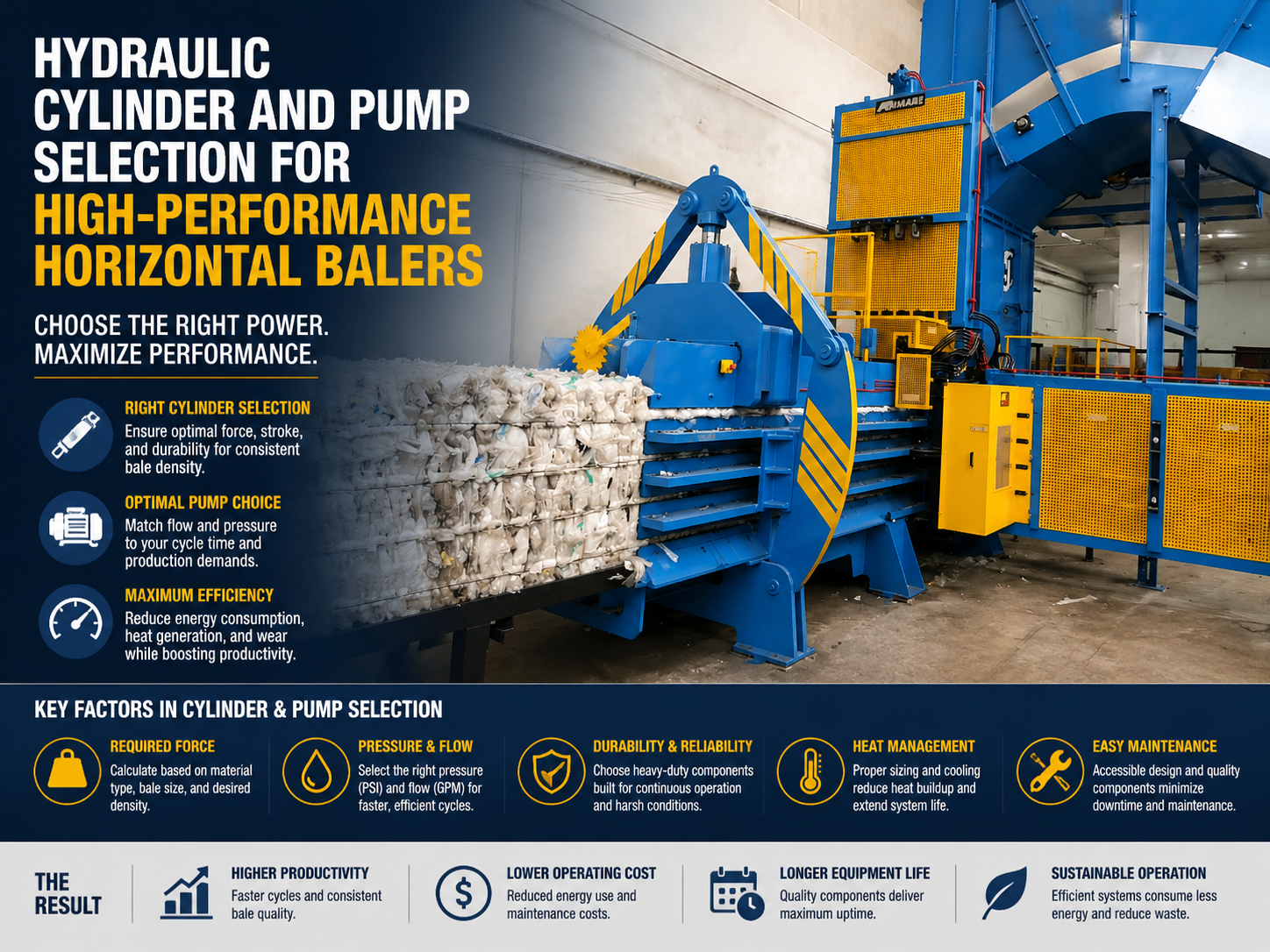
Technical Overview of Hydraulic Systems in Horizontal Balers
In the realm of industrial waste management and recycling, the efficiency of a horizontal baler is almost entirely dependent on its hydraulic system. When we discuss Hydraulic Cylinder Pump Selection High-Performance Horizontal Balers, we are looking at the synergy between the ‘heart’ of the machine (the pump) and the ‘muscle’ (the cylinder). A high-performance horizontal baler must process vast quantities of material—ranging from OCC (Old Corrugated Containers) and plastics to non-ferrous metals—with consistent force and speed. The hydraulic system is responsible for converting electrical energy into mechanical force, and any mismatch in component selection can lead to catastrophic failure, excessive energy consumption, or insufficient bale density.
HARSLE engineering focuses on the optimization of these two components to ensure that the baler operates within its peak efficiency curve. The hydraulic cylinder provides the linear force required to compress the material, while the pump provides the flow rate (GPM or LPM) and pressure (PSI or Bar) necessary to drive that cylinder. In high-performance applications, the cycle time is a critical KPI (Key Performance Indicator). To achieve a fast cycle time without sacrificing compression force, the pump must be capable of delivering high flow at low pressure during the ‘approach’ phase and high pressure at lower flow during the ‘compression’ phase. This is often achieved through variable displacement pumps or multi-stage pump configurations.
Furthermore, the integration of advanced manifolds and logic valves ensures that the transition between these phases is seamless. For a horizontal baler to be classified as ‘high-performance,’ it must handle continuous duty cycles. This means the hydraulic cylinder must be designed with heavy-duty seals and high-tensile steel rods to withstand the lateral forces often encountered when compressing unevenly distributed waste. Similarly, the pump must be selected for its volumetric efficiency and noise reduction capabilities, as industrial environments are increasingly sensitive to acoustic pollution and energy waste.
Understanding the relationship between the cylinder’s bore size and the pump’s output is the first step in mastering Hydraulic Cylinder Pump Selection High-Performance Horizontal Balers. A larger cylinder bore provides more force but requires more oil volume to move, which in turn necessitates a larger pump. If the pump is too small for a large cylinder, the machine will be agonizingly slow. If the pump is too large for the cylinder’s plumbing, it will cause excessive heat, turbulence, and potential cavitation, leading to premature component failure. HARSLE’s design philosophy balances these factors to provide a machine that is both powerful and agile.
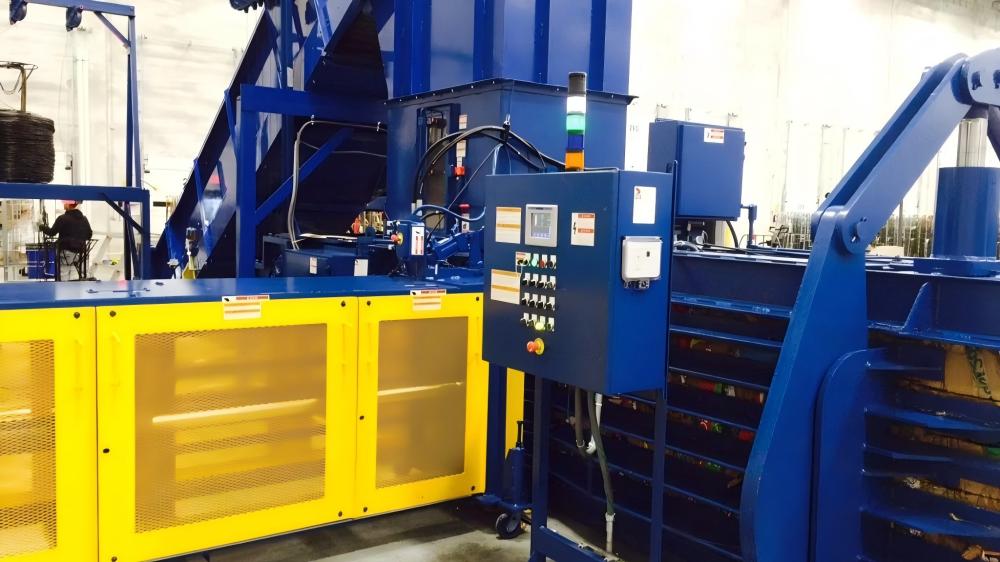
Core Parameters for Hydraulic Cylinder and Pump Selection
When selecting components for a high-performance horizontal baler, several core parameters must be evaluated. These parameters are interconnected; changing one will inevitably affect the others. The primary goal is to meet the required bale density while maintaining the desired throughput (tons per hour).
1. Cylinder Bore and Rod Diameter
The bore diameter is the internal diameter of the cylinder barrel. This dimension determines the total force the cylinder can exert at a given pressure. For high-performance balers, bore sizes typically range from 160mm to 300mm or more, depending on the tonnage requirement (e.g., 100-ton vs. 200-ton balers). The rod diameter is also crucial; it must be thick enough to prevent buckling under high compressive loads, especially during the final stages of the baling cycle where resistance is at its peak. A larger rod also results in a faster retraction speed because there is less volume to fill on the ‘annulus’ side of the cylinder.
2. Pump Displacement and Flow Rate
The pump’s displacement (cc/rev) determines how much oil is moved per revolution of the motor. When coupled with an electric motor (usually 1450 RPM or 1750 RPM), this defines the flow rate. In Hydraulic Cylinder Pump Selection High-Performance Horizontal Balers, the flow rate directly dictates the speed of the ram. High-performance machines often utilize axial piston pumps with load-sensing capabilities. These pumps can adjust their output based on the resistance encountered, ensuring that the motor is not overloaded while maximizing speed during the non-compressive parts of the cycle.
3. System Pressure Ratings
Most modern horizontal balers operate at pressures between 210 Bar (3000 PSI) and 315 Bar (4500 PSI). The selection of the pump and cylinder must be rated for these pressures with a significant safety margin. High-performance systems often push the limits of standard hydraulics, requiring high-pressure hoses, forged steel fittings, and precision-machined valve blocks. Operating at higher pressures allows for smaller cylinder bores to achieve the same force, which can reduce the overall footprint of the machine and the volume of hydraulic oil required.
4. Duty Cycle and Heat Dissipation
High-performance balers are often used in 24/7 operations. This continuous duty cycle generates significant heat due to internal friction and pressure drops across valves. Therefore, the selection process must include an evaluation of the pump’s efficiency (to minimize heat generation) and the inclusion of high-capacity oil coolers. If the hydraulic oil temperature exceeds 60°C, the viscosity drops, leading to increased wear on the pump and potential seal failure in the cylinder. HARSLE balers incorporate oversized reservoirs and efficient cooling circuits to mitigate this risk.
Calculation Method for Hydraulic Synchronization
To ensure the Hydraulic Cylinder Pump Selection High-Performance Horizontal Balers is accurate, engineers use specific mathematical formulas. Let’s walk through the essential calculations required to size a system for a 120-ton horizontal baler.
Step 1: Calculating Required Cylinder Area
First, we determine the force required. 120 tons is approximately 1,200,000 Newtons. If our target operating pressure is 250 Bar (25 MPa), we use the formula:
Area (A) = Force (F) / Pressure (P)
A = 1,200,000 N / 25,000,000 Pa = 0.048 m².
To find the bore diameter (d):
A = π * (d/2)² => d = √(4A / π) = √(0.192 / 3.14159) ≈ 0.247m or 247mm. Thus, a 250mm bore cylinder would be the standard selection.
Step 2: Calculating Flow Rate for Cycle Time
If the desired cycle time for a 2-meter stroke is 20 seconds for the full extension, we need to calculate the required flow (Q).
Volume (V) = Area * Stroke = 0.049 m² * 2m = 0.098 m³ (or 98 Liters).
Required Flow (Q) = Volume / Time = 98L / 20s = 4.9 L/s = 294 Liters Per Minute (LPM).
This calculation tells us that the pump must be capable of delivering nearly 300 LPM to meet the performance target.
Step 3: Calculating Motor Power
To drive a pump at 294 LPM and 250 Bar, the required electric motor power (kW) is:
Power = (Pressure in Bar * Flow in LPM) / (600 * Efficiency)
Assuming a total system efficiency of 85% (0.85):
Power = (250 * 294) / (600 * 0.85) = 73,500 / 510 ≈ 144 kW.
This highlights why high-performance balers often use dual-motor setups or variable frequency drives (VFDs) to manage such high power requirements efficiently.
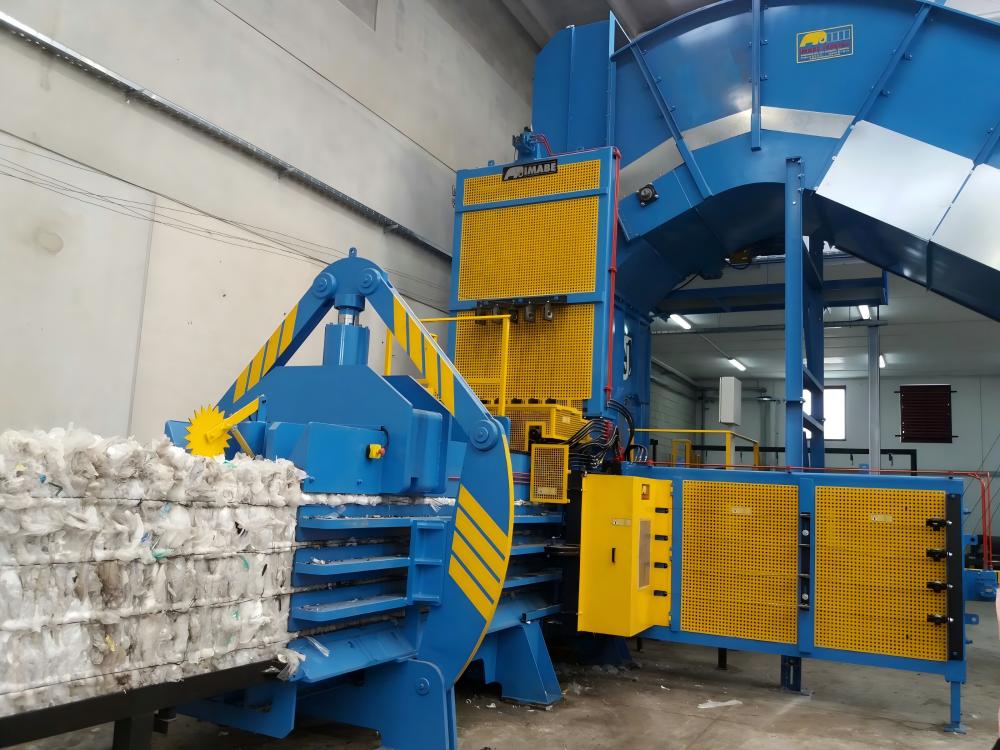
Parameter Table for High-Performance Baler Models
The following table illustrates typical configurations for HARSLE horizontal balers based on different performance tiers. This serves as a reference for Hydraulic Cylinder Pump Selection High-Performance Horizontal Balers.
| Baler Model (Tonnage) | Cylinder Bore (mm) | Pump Flow (LPM) | Max Pressure (Bar) | Motor Power (kW) | Cycle Time (sec) |
|---|---|---|---|---|---|
| HARSLE-60T | 160 | 120 | 210 | 30 | 25 |
| HARSLE-100T | 200 | 180 | 250 | 45 | 22 |
| HARSLE-160T | 250 | 320 | 280 | 75 x 2 | 18 |
| HARSLE-200T | 300 | 450 | 315 | 90 x 2 | 15 |
Note: The use of dual motors (e.g., 75 x 2) allows for staged pump activation, which is a hallmark of Hydraulic Cylinder Pump Selection High-Performance Horizontal Balers. This allows the machine to run at half-power for lighter materials or during maintenance, providing redundancy and energy savings.
Common Engineering Mistakes in Selection
Even with the right formulas, several common pitfalls can compromise the performance of a horizontal baler. Avoiding these is essential for long-term reliability.
1. Undersizing the Hydraulic Reservoir
A common mistake is using a reservoir that is too small for the flow rate. The general rule for high-performance systems is that the tank should hold 3 to 5 times the pump’s flow per minute. If the tank is too small, the oil does not have enough time to settle, leading to air entrainment (foaming) and inadequate cooling. This results in pump cavitation and erratic cylinder movement.
2. Ignoring Pressure Spikes (Water Hammer)
In high-speed baling operations, the sudden stopping or reversing of the heavy ram creates massive pressure spikes. If the Hydraulic Cylinder Pump Selection High-Performance Horizontal Balers does not account for these spikes through the use of accumulators or decompression valves, the cylinder seals will fail prematurely, and the pump housing may even crack. HARSLE utilizes soft-shift valves to bleed off this energy safely.
3. Poor Filtration Strategy
High-performance pumps, especially axial piston pumps, have extremely tight tolerances. Even microscopic contaminants can score the piston shoes or the swashplate. Many operators fail to invest in high-quality 10-micron return line filters and suction strainers. Furthermore, failing to include a kidney-loop filtration system for continuous cleaning of the oil is a major oversight in heavy-duty recycling environments.
4. Mismatched Hose and Valve Sizes
If the pump provides 300 LPM but the valves and hoses are only rated for 200 LPM, the fluid velocity will be too high. This creates excessive backpressure and heat. High fluid velocity also causes turbulence, which can lead to the vibration of the hydraulic lines, eventually causing fatigue cracks in the steel piping. Proper sizing of the entire circuit, not just the pump and cylinder, is vital.
Selection Checklist for High-Performance Horizontal Balers
When evaluating a machine or designing a custom hydraulic power unit (HPU), use this checklist to ensure all aspects of Hydraulic Cylinder Pump Selection High-Performance Horizontal Balers are covered:
- Material Density: Does the cylinder force exceed the rebound pressure of the material being baled (e.g., plastic vs. paper)?
- Throughput Requirements: Is the pump flow sufficient to meet the required bales-per-hour target?
- Environmental Conditions: Will the baler operate in extreme heat or cold? (Requires oil heaters or oversized coolers).
- Seal Compatibility: Are the cylinder seals compatible with the type of hydraulic fluid used (e.g., fire-resistant fluids)?
- Pump Type: Is a variable displacement pump used to optimize energy consumption during the cycle?
- Mounting Configuration: Is the cylinder trunnion-mounted or clevis-mounted to handle potential misalignment?
- Redundancy: Does the system use multiple pumps to allow for continued operation if one unit fails?
- PLC Integration: Does the hydraulic system include pressure transducers for real-time monitoring and automated cycle adjustment?
Frequently Asked Questions (FAQ)
Q1: Why is my horizontal baler losing pressure during the final compression?
This is often due to internal leakage in the hydraulic cylinder (bypass) or a worn-out pressure relief valve. In some cases, the pump may be unable to maintain high pressure due to internal wear. Regular testing of the cylinder seals and checking the pump’s volumetric efficiency can identify the culprit.
Q2: Can I upgrade the pump to make my baler faster?
Yes, but with caution. Increasing the pump flow will increase the ram speed, but you must ensure that the existing valves, hoses, and filters can handle the increased flow. Additionally, a larger pump will require a more powerful electric motor and potentially a larger cooling system to handle the extra heat.
Q3: What is the benefit of a twin-cylinder design in horizontal balers?
Twin-cylinder designs are often used to provide a more balanced force across a wide ram. This reduces the risk of the ram tilting or ‘cocking’ when the material is unevenly distributed in the chamber. However, it requires precise synchronization of the hydraulic flow to both cylinders to ensure they move in unison.
Q4: How often should I change the hydraulic oil in a high-performance baler?
For high-performance machines running multiple shifts, oil should be analyzed every 1,000 hours and typically changed every 2,000 to 4,000 hours, depending on the environment and filtration quality. Using oil analysis services can help you extend the life of the oil while ensuring the system remains protected.
Q5: What is ‘regenerative’ hydraulic circuitry?
A regenerative circuit redirects the oil from the rod side of the cylinder back into the cap side during the extension phase. This significantly increases the extension speed at the cost of reduced force. It is an excellent feature for high-performance balers to speed up the ‘approach’ part of the cycle before high-pressure compression is needed.
Conclusion
Mastering Hydraulic Cylinder Pump Selection High-Performance Horizontal Balers is a balance of physics, engineering, and practical experience. By selecting the right bore size, pump displacement, and system pressure, and by avoiding common pitfalls like undersized reservoirs or poor filtration, you can ensure that your HARSLE horizontal baler delivers maximum ROI. Whether you are processing cardboard, plastics, or metals, the hydraulic system is the key to a dense, consistent bale and a long-lasting machine. Always consult with HARSLE technical experts when considering upgrades or custom configurations to ensure your hydraulic system is perfectly matched to your operational needs.