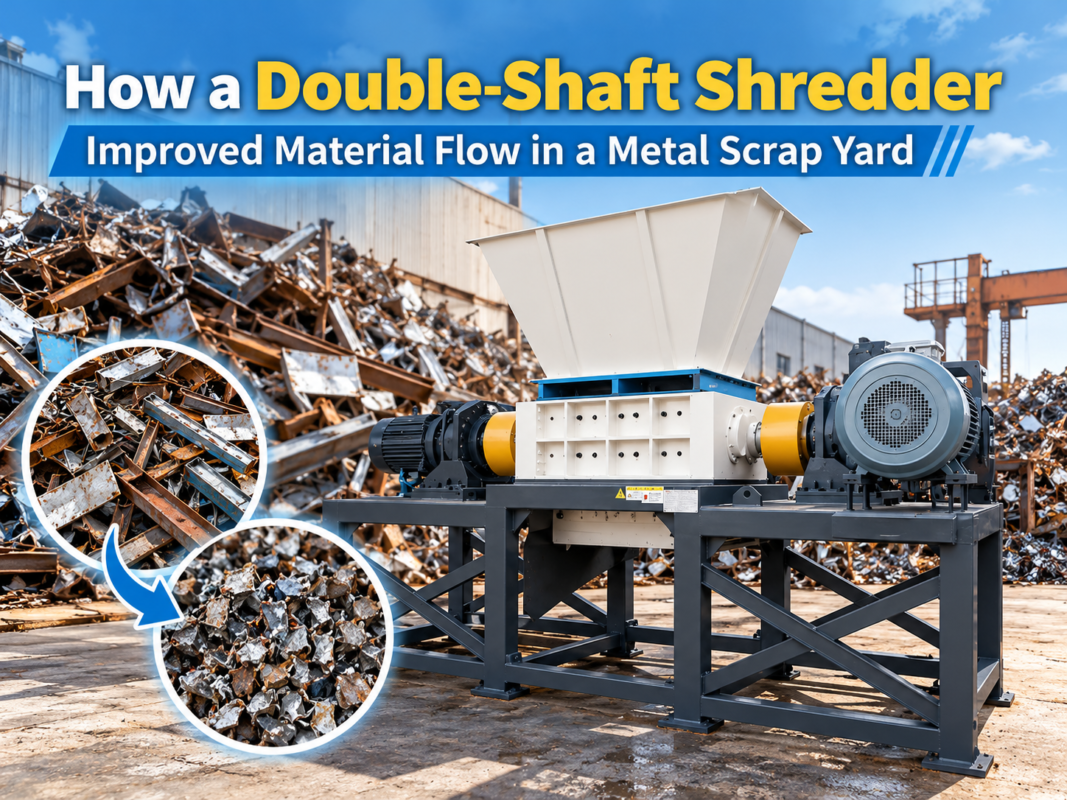
Double-Shaft Shredder Blade Material Guide: Choosing the Right Alloy for Durability

Technical Overview of Double-Shaft Shredder Blade Mechanics
The double-shaft shredder is the workhorse of the modern recycling and waste management industry. Unlike single-shaft shredders that rely on high-speed rotation and a screen to determine particle size, the double-shaft shredder operates at low speeds with high torque. This mechanical configuration allows it to process bulky, high-strength materials such as scrap metal, industrial plastics, rubber tires, and electronic waste. However, the efficiency of this process is almost entirely dependent on the Double-Shaft Shredder Blade Material : Choosing Alloy Durability. The blades, or cutters, are subjected to extreme shear forces, compressive stress, and abrasive wear during every rotation.
In a dual-shaft system, two parallel shafts rotate toward each other. The blades are mounted on these shafts in an interlocking pattern. As material is fed into the hopper, the hooks on the blades grab the material and pull it into the cutting chamber. The shearing action occurs at the interface where the blades of the two shafts pass each other with minimal clearance. This requires the material of the blade to maintain a sharp edge while resisting the tendency to chip or deform under the massive pressure exerted by the hydraulic or electric drive systems.
Choosing the right alloy is not merely a matter of picking the hardest steel available. It is a delicate balancing act between hardness, toughness, and wear resistance. A blade that is too hard will be brittle and may shatter when it encounters an unshreddable object like a thick steel plate. Conversely, a blade that is too soft will dull quickly, leading to increased energy consumption, reduced throughput, and frequent downtime for sharpening or replacement. Understanding the metallurgical properties of various alloys is essential for any facility manager looking to optimize their shredding operations.
Furthermore, the geometry of the blade—whether it is a single-claw, multi-claw, or specialized hook design—interacts with the material properties. For instance, shredding elastic materials like rubber requires a different shear angle and material toughness compared to shredding brittle materials like cast aluminum. This guide explores the technical parameters that define blade performance and provides a roadmap for selecting the ideal alloy for your specific application.
Core Parameters of Shredder Blade Alloys
When evaluating Double-Shaft Shredder Blade Material : Choosing Alloy Durability, several core metallurgical parameters must be considered. The first and most discussed is Hardness, typically measured on the Rockwell C scale (HRC). Hardness determines the blade’s ability to resist surface indentation and abrasive wear. For most industrial shredding applications, a hardness range of 50 to 60 HRC is targeted. However, as hardness increases, the material’s Toughness (the ability to absorb energy and deform plastically before fracturing) generally decreases.
The chemical composition of the alloy is the foundation of these properties. Key elements include:
- Carbon (C): Increases hardness and tensile strength but reduces ductility.
- Chromium (Cr): Enhances wear resistance and provides a degree of corrosion resistance. High-chromium steels like D2 or SKD-11 are excellent for abrasive environments.
- Molybdenum (Mo): Improves deep-hardening characteristics and toughness, especially at higher temperatures.
- Vanadium (V): Refines the grain structure and forms extremely hard carbides, significantly boosting wear resistance.
- Tungsten (W): Increases red-hardness, allowing the blade to maintain its edge even if the shredding process generates significant heat.
Another critical parameter is the Heat Treatment Process. Even the best alloy will fail if the quenching and tempering cycles are not executed correctly. Proper heat treatment ensures a uniform martensitic structure throughout the blade, preventing soft spots that could lead to uneven wear. For heavy-duty blades, vacuum heat treatment is often preferred to prevent surface decarburization and ensure maximum structural integrity.
Finally, the Impact Strength is vital for shredders processing mixed waste. Mixed waste often contains “tramp metal” or unexpected hard objects. A blade with high impact strength can withstand these sudden shocks without catastrophic failure. This is why alloys like H13 or specialized shock-resisting steels are sometimes used in primary shredders where the input material is unpredictable.
Calculation Method for Blade Selection and Life Expectancy
To scientifically approach Double-Shaft Shredder Blade Material : Choosing Alloy Durability, engineers use several calculation methods to predict performance. The most basic is the Shear Stress Calculation. The force (F) required to shear a material is calculated as F = L × T × S, where L is the length of the cut, T is the thickness of the material, and S is the shear strength of the material. The blade must be made of an alloy with a yield strength significantly higher than the maximum force generated by the shredder’s motor at peak torque.
Another important metric is the Wear Rate Ratio. This is often determined through empirical testing, comparing the volume of material processed to the mass of the blade lost to wear. For example, if a set of Cr12MoV blades processes 5,000 tons of plastic before requiring a regrind, and a set of 9CrSi blades processes only 2,500 tons, the Cr12MoV has a 2x wear efficiency. When factoring in the cost of the alloy and the labor cost of blade changes, the more expensive alloy often proves to be the more economical choice over the long term.
Engineers also calculate the Torque Distribution across the blade hooks. In a double-shaft shredder, the torque is not distributed evenly. The “grab” phase of the hook experiences the highest stress. By calculating the bending moment on the hook, manufacturers can determine the minimum thickness and the required fracture toughness of the alloy. If the calculated stress exceeds 70% of the alloy’s yield strength, a higher-grade material or a thicker blade profile is required.
Comparison Table of Common Shredder Blade Materials
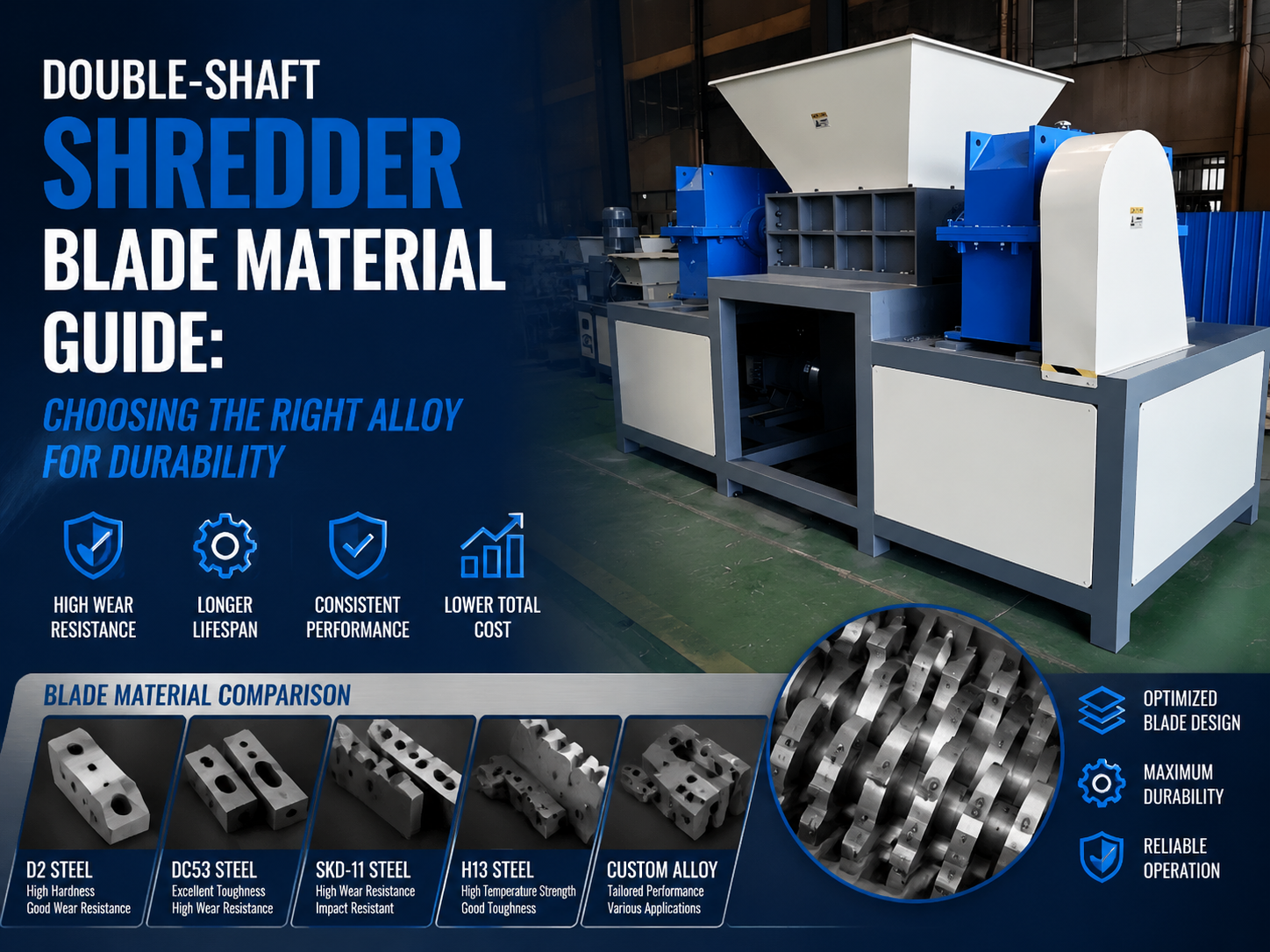
The following table provides a technical comparison of the most common alloys used in double-shaft shredder blades. This data helps in Double-Shaft Shredder Blade Material : Choosing Alloy Durability by highlighting the strengths and weaknesses of each grade.
| Material Grade | Hardness (HRC) | Toughness | Wear Resistance | Best Application |
|---|---|---|---|---|
| 9CrSi | 50-54 | Moderate | Low | Wood, thin plastics, paper, and light domestic waste. |
| Cr12MoV | 55-58 | Good | High | Standard industrial waste, thick plastics, and rubber. |
| SKD-11 / D2 | 56-60 | Moderate | Very High | Metal scrap, electronic waste, and highly abrasive materials. |
| H13 (4Cr5MoSiV1) | 48-52 | Excellent | Moderate | Heavy-duty metal shredding where impact is the primary concern. |
| DC53 | 58-62 | High | Excellent | Premium choice for high-strength steel and difficult recycling tasks. |
Common Engineering Mistakes in Blade Selection
One of the most frequent mistakes in Double-Shaft Shredder Blade Material : Choosing Alloy Durability is the “Hardness Trap.” Many operators believe that a harder blade is always better. However, in the world of metal recycling, a blade that is too hard (e.g., 62 HRC) often lacks the necessary ductility to handle the shock of a heavy steel beam or an engine block. This results in “chipping,” where small pieces of the blade edge break off. Once a blade begins to chip, the structural integrity of the edge is compromised, leading to rapid failure and potential damage to the shafts.
Another common error is neglecting the Heat Affected Zone (HAZ) during the sharpening process. When blades are reground using improper cooling or aggressive grinding wheels, the surface temperature can rise above the tempering temperature of the alloy. This creates a soft layer on the cutting edge, which will dull almost immediately once the shredder is put back into service. Always ensure that blade maintenance is performed by specialists who understand the thermal limits of the specific alloy.
Furthermore, many facilities fail to match the blade material to the Contamination Level of their waste stream. For example, if you are shredding plastic bottles that are heavily contaminated with sand or glass, a standard 9CrSi blade will wear down in days. In this scenario, the abrasive nature of the glass requires a high-chromium alloy like D2, even though the plastic itself is soft. Ignoring the “hidden” components of the waste stream is a recipe for high operational costs.
Finally, some engineers overlook the importance of Blade Fit and Tolerance. Even the best material will fail if the blades are not precision-machined to fit the shaft with minimal play. Loose blades create vibration and uneven loading, which can lead to fatigue failure of the alloy. The interaction between the blade material and the shaft material (usually a high-strength forged steel like 42CrMo) must be carefully managed to prevent galling or fretting at the interface.
Selection Checklist for Shredder Blade Alloys
To ensure you are making the right choice for your equipment, use this comprehensive checklist for Double-Shaft Shredder Blade Material : Choosing Alloy Durability:
- Identify the Primary Material: Is it metal, plastic, wood, or tires? (Metal requires higher toughness; plastic requires higher wear resistance).
- Assess Contamination: Does the waste contain sand, glass, or stones? (If yes, prioritize high-chromium alloys).
- Evaluate Impact Risk: Is there a high probability of large, unshreddable metal objects entering the chamber? (If yes, choose H13 or shock-resistant grades).
- Verify Heat Treatment: Request a hardness test report and heat treatment certification from the blade manufacturer.
- Check Blade Geometry: Ensure the number of claws and the hook height are optimized for the material’s bulk density.
- Calculate Total Cost of Ownership (TCO): Compare the initial price of the blades against the expected tonnage processed and the cost of downtime.
- Review Sharpening Capabilities: Do you have the equipment to sharpen high-alloy steels without causing thermal damage?
- Consult the OEM: Manufacturers like HARSLE provide specific recommendations based on the shredder’s motor power and gearbox torque ratings.
Frequently Asked Questions (FAQ)
1. How often should I sharpen my double-shaft shredder blades?
The frequency depends entirely on the material being processed and the alloy used. For abrasive materials like glass-filled plastics, sharpening may be required every 500-1,000 hours. For clean wood or soft plastics, blades can last 3,000+ hours. A drop in throughput or an increase in motor amperage is a clear sign that the blades are dull.
2. Can I weld or hard-face a chipped shredder blade?
While hard-facing is possible for some large-scale primary shredders, it is generally not recommended for precision double-shaft blades. The welding process introduces intense heat that can warp the blade and change the metallurgical properties of the base alloy, leading to cracks or catastrophic failure under load.
3. What is the difference between D2 and SKD-11?
D2 is the American (ASTM) designation, while SKD-11 is the Japanese (JIS) designation. They are chemically very similar—both are high-carbon, high-chromium cold-work tool steels. In practice, they are often used interchangeably, though some manufacturers prefer SKD-11 for its slightly better grain uniformity in certain heat treatment cycles.
4. Why are my blades breaking even though I bought the most expensive alloy?
High-cost alloys like D2 or DC53 are very hard but can be brittle. If your waste stream contains heavy tramp metal, the impact might be exceeding the material’s fracture toughness. You may need to switch to a tougher, slightly softer alloy like H13 or implement better pre-shredding sorting (e.g., magnetic separators).
5. Does the thickness of the blade affect the material choice?
Yes. Thicker blades (e.g., 50mm+) have a larger cross-section and can handle more torque, allowing for the use of harder, more brittle materials. Thinner blades (e.g., 20mm) are more prone to bending and snapping, so they often require an alloy with higher ductility and toughness.
6. How does HARSLE ensure the quality of their shredder blades?
HARSLE utilizes advanced CNC machining and vacuum heat treatment to ensure that every blade meets strict dimensional tolerances and hardness specifications. By matching the alloy to the specific machine model and customer application, HARSLE maximizes the service life and efficiency of the shredding system.