Car Body Baler Safety Guide: Essential Controls, Lockout Procedures, and Operator Training

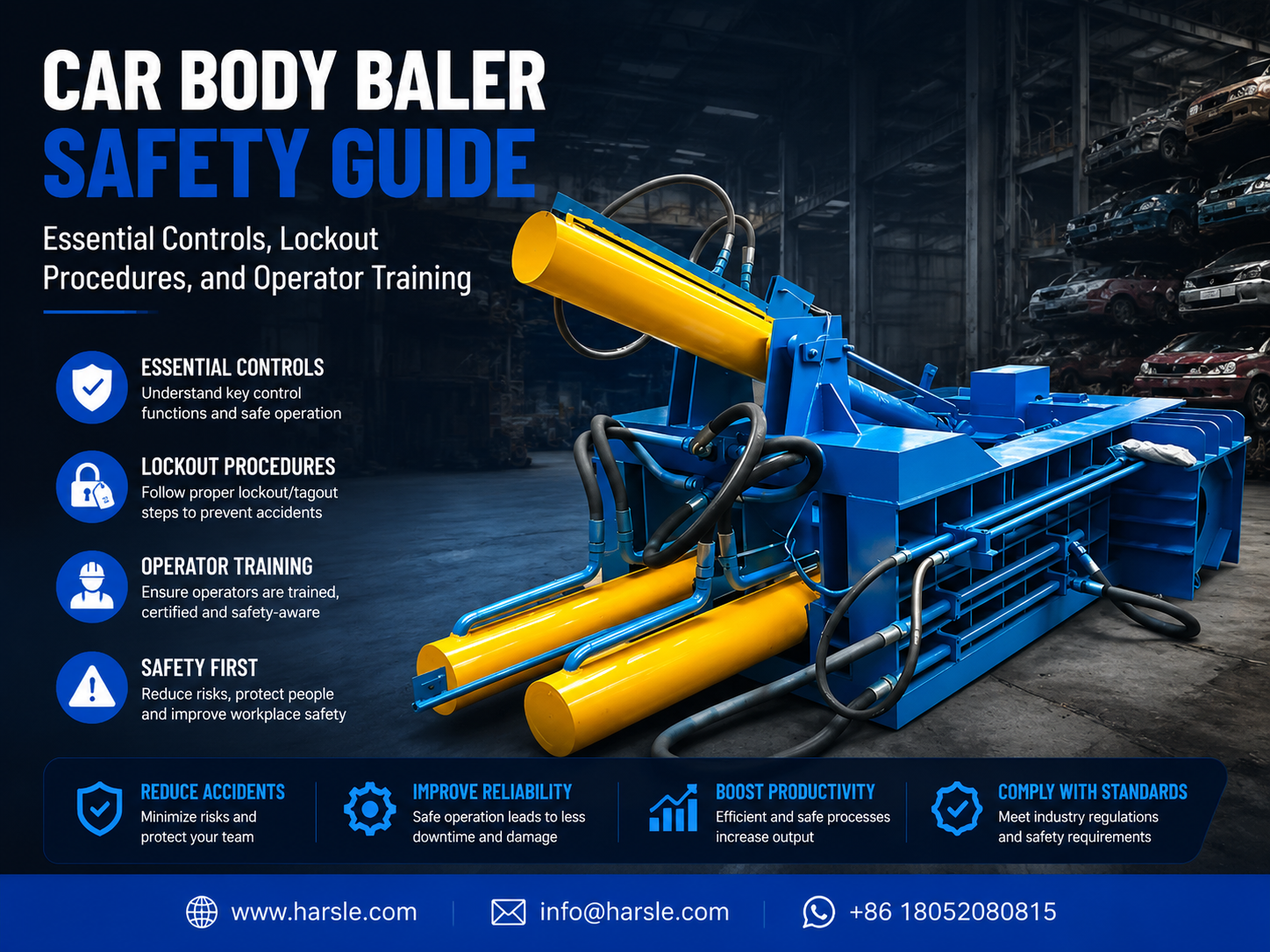
Technical Overview of Car Body Baler Safety Systems
In the high-stakes environment of scrap metal recycling, the car body baler stands as a cornerstone of efficiency. However, the immense hydraulic forces required to crush an entire vehicle chassis into a compact cube necessitate rigorous safety protocols. A modern car body baler, such as those engineered by HARSLE, utilizes advanced hydraulic circuits and structural reinforcements to manage pressures often exceeding 200 tons. Safety in these machines is not merely an afterthought but an integrated engineering discipline that encompasses mechanical, hydraulic, and electronic safeguards.
The technical architecture of a safe car body baler begins with the frame. Using high-tensile steel and submerged arc welding, the chamber must withstand repeated cyclic loading without fatigue. Beyond the structural integrity, the hydraulic system is the primary focus of safety engineering. This includes the use of logic valves, pressure transducers, and redundant piping to prevent catastrophic failure. When we discuss ‘Car Body Baler Safety: Essential Controls, Lockout Procedures, and Operator Training,’ we are looking at a holistic ecosystem designed to protect the operator while maximizing the machine’s lifecycle.
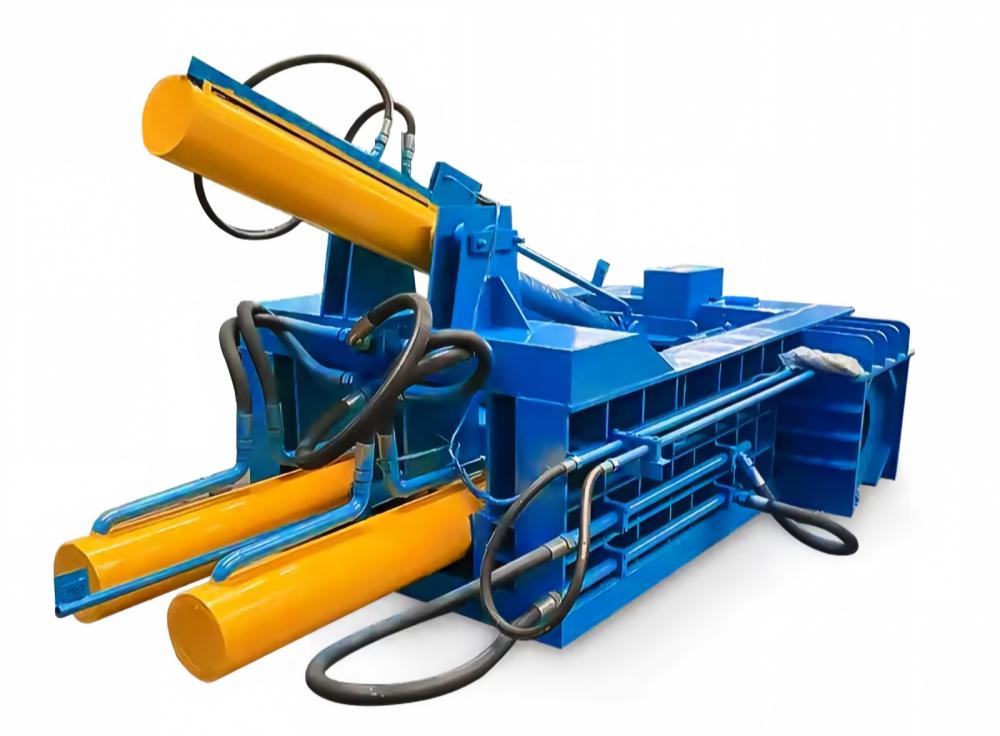
Electronic safety integration has evolved significantly. Modern balers utilize Programmable Logic Controllers (PLCs) that monitor every movement of the compression rams. If a sensor detects an anomaly—such as a door not being fully latched or a pressure spike that exceeds safety limits—the system immediately enters a ‘safe state.’ This technical overview serves as the foundation for understanding why specific controls and procedures are non-negotiable in industrial metal fabrication environments.
Furthermore, the environment surrounding the baler must be considered. Noise reduction technologies, vibration dampening mounts, and oil leak detection systems are all technical components of a safe installation. By understanding the mechanical limits and the electronic oversight of the machine, facility managers can better implement the procedural safety measures required for daily operation.
Essential Controls for Safe Operation
The control interface of a car body baler is the primary point of interaction between the human operator and the machine’s raw power. Essential controls start with the Emergency Stop (E-Stop) buttons. These must be strategically placed around the machine—not just on the main console, but also near the loading hopper and the bale discharge area. These buttons are typically ‘mushroom’ style, red on a yellow background, and must be hard-wired to a safety relay that bypasses the PLC to ensure immediate power disconnection to the hydraulic pumps.
Two-hand control systems are another critical safety feature, particularly for machines that require manual positioning of the scrap. By requiring the operator to use both hands to initiate a cycle, the risk of a hand being caught in the crushing chamber is virtually eliminated. Additionally, light curtains and infrared sensors can be installed around the perimeter of the baling chamber. If the light beam is broken during a cycle, the machine stops instantly, preventing accidental entry into the danger zone.
Pressure relief valves (PRVs) are the unsung heroes of hydraulic safety. These mechanical controls are set to a specific PSI (Pounds per Square Inch) to ensure that the hydraulic lines never exceed their rated capacity. If the baler encounters an incompressible object, the PRV opens, diverting oil back to the reservoir and preventing a hose burst. Modern HARSLE balers also feature digital pressure monitoring, providing real-time feedback to the operator via an HMI (Human Machine Interface) screen.
Finally, the ‘Hold-to-Run’ control is a vital safety logic. In many jurisdictions, the baler is programmed so that the operator must maintain constant pressure on the control lever or button for the ram to move. If the operator lets go, the ram stops. This prevents the machine from continuing a cycle if the operator becomes incapacitated or distracted. These essential controls form a multi-layered defense against mechanical and human error.
Lockout/Tagout (LOTO) Procedures for Maintenance
Lockout/Tagout (LOTO) is a critical safety procedure that ensures a car body baler is completely de-energized and cannot be started during maintenance or repair. Given the high amount of stored energy in hydraulic accumulators and heavy mechanical components, LOTO is the only way to guarantee technician safety. The process begins with preparation: identifying all energy sources, including electrical, hydraulic, and gravity-fed potential energy (such as a raised compression lid).
The first step in a formal LOTO procedure is the controlled shutdown of the machine using the standard stop sequence. Once the machine is off, the main electrical isolator must be turned to the ‘OFF’ position and secured with a personal padlock. Each technician working on the machine must apply their own lock. This ensures that the machine cannot be restarted until every single person has finished their task and removed their lock.
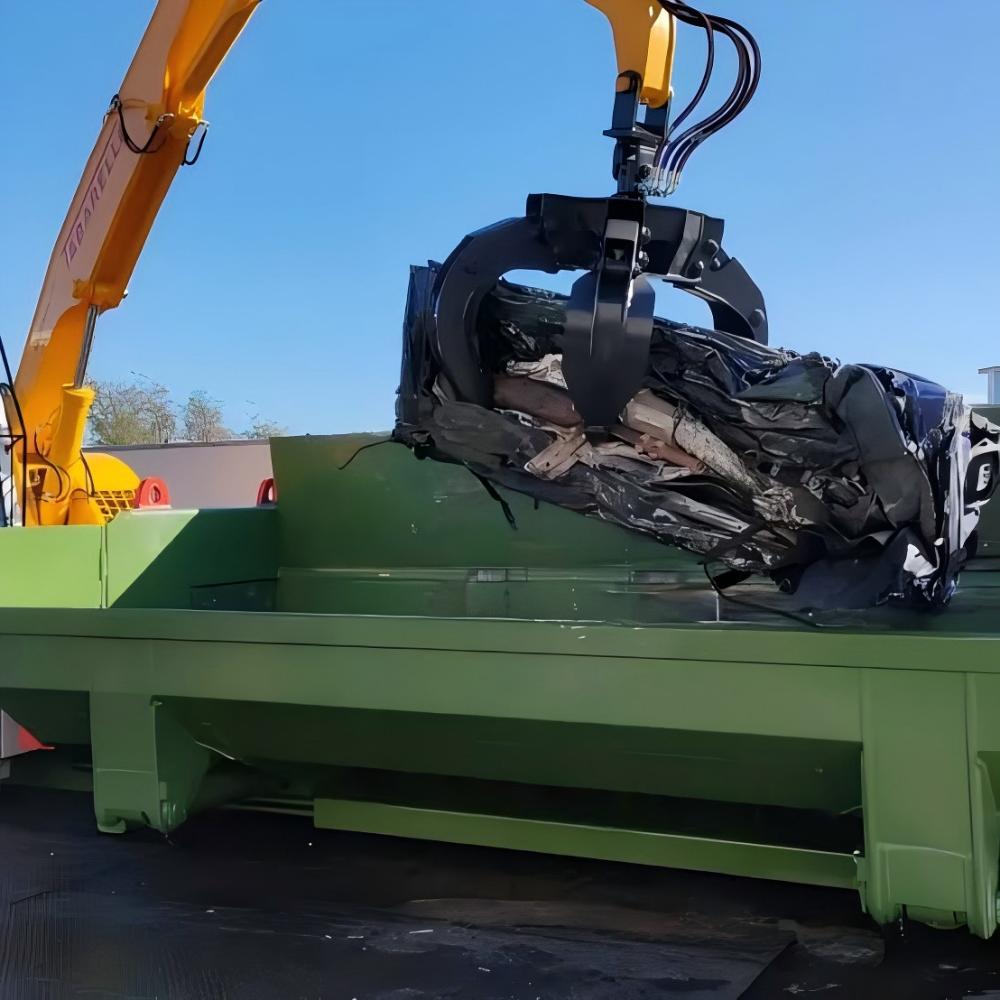
Hydraulic energy isolation is equally important. Even with the power off, hydraulic lines can hold thousands of pounds of pressure. Technicians must bleed the system using manual discharge valves or by cycling the controls after the pump is off to dissipate residual pressure. If the baler has a vertical lid or ram, mechanical blocks or ‘safety pins’ must be inserted to prevent the component from falling due to gravity if a hydraulic seal fails during maintenance.
The final and most crucial step of LOTO is verification. After all locks are applied and energy is dissipated, the technician must attempt to start the machine using the normal controls. If the machine does not move or power up, the isolation is verified. Only then is it safe to begin work. This rigorous ‘Car Body Baler Safety: Essential Controls, Lockout Procedures, and Operator Training’ protocol is what separates a professional recycling facility from a high-risk operation.
Operator Training and Certification
No amount of safety hardware can compensate for an untrained operator. Comprehensive training for car body balers should cover three main areas: machine mechanics, operational safety, and emergency response. New operators must be taught how to identify different types of scrap metal and understand which materials are ‘non-balable’ (such as sealed pressure vessels or heavy structural beams that exceed the machine’s capacity). Overloading the machine is a primary cause of structural failure and hydraulic leaks.
Training must also include a deep dive into the HMI and control logic. Operators need to understand what every alarm code means and how to respond correctly. For example, a ‘low oil level’ alarm shouldn’t just be cleared; the operator must be trained to inspect the machine for leaks before adding more fluid. Behavioral safety is also a key component—training operators to never bypass safety sensors or ‘cheat’ the two-hand controls with tape or weights.
Certification should not be a one-time event. Annual recertification ensures that operators remain sharp and are updated on any new safety regulations or machine software updates. During these sessions, emergency drills should be conducted. Does the operator know exactly where the nearest fire extinguisher is? Do they know how to manually release a bale if the power fails? These are the questions that a robust training program answers.
Finally, daily inspection logs are a part of the training curriculum. Before the first car is crushed each morning, the operator should perform a ‘walk-around’ inspection. This includes checking for loose bolts, frayed hydraulic hoses, and ensuring all E-stops are functional. By instilling a culture of ‘safety first’ through rigorous training, companies can significantly reduce the Total Recordable Incident Rate (TRIR) in their fabrication shops.
Core Parameters of Car Body Balers
Understanding the core parameters of a car body baler is essential for both safety and production efficiency. The primary parameter is the ‘Nominal Force,’ usually measured in Kilonewtons (kN) or Tons. This represents the maximum pressure the main ram can exert. For car bodies, this typically ranges from 125 to 400 tons. Operating a machine consistently at its maximum limit increases wear and tear, so selecting a machine with a buffer above your daily needs is a safety-conscious decision.
Cycle time is another critical parameter. This is the time it takes for the machine to complete one full compression and return to the starting position. A faster cycle time increases throughput but also increases the heat generated in the hydraulic oil. Therefore, the cooling system capacity must be matched to the cycle time. If the oil exceeds 60°C (140°F), seals can degrade, leading to leaks and potential fire hazards.
The dimensions of the baling chamber and the resulting bale size are also vital. For car bodies, the chamber must be large enough to accept a standard sedan without excessive pre-processing. If the chamber is too small, operators might be tempted to use the machine’s lid to ‘force’ the car in, which can lead to hinge damage or hydraulic cylinder side-loading. Matching the machine’s physical parameters to the material being processed is a fundamental engineering requirement.
Calculation Method for Compaction Force
To ensure the safety and efficiency of a car body baler, engineers must accurately calculate the compaction force. The basic formula for hydraulic force is:
F = P × A
Where:
– F is the Force (in Newtons or Pounds)
– P is the Hydraulic Pressure (in Pascals or PSI)
– A is the Effective Area of the cylinder piston (in square meters or square inches)
For a car body baler, we must also consider the ‘Specific Pressure’ on the material. This is calculated by dividing the total force by the surface area of the bale face. For example, if a baler exerts 200 tons of force on a bale face that is 600mm x 600mm, the specific pressure is approximately 5.5 MPa. High-density bales require higher specific pressure, but this also increases the stress on the chamber walls.
Another important calculation is the ‘Volumetric Reduction Ratio.’ This is the ratio of the volume of the loose car body to the volume of the finished bale. A typical car body might have a volume of 8 cubic meters, while the finished bale is 0.5 cubic meters, resulting in a 16:1 reduction. Understanding these calculations helps in selecting the right motor power (kW) to ensure the hydraulic pumps can deliver the required flow rate at the necessary pressure without overheating.
Car Body Baler Parameter Table
| Parameter Description | HARSLE Model HB-250 | HARSLE Model HB-400 | Unit |
|---|---|---|---|
| Nominal Compaction Force | 2500 (250 Tons) | 4000 (400 Tons) | kN |
| Bale Size (W x H) | 600 x 600 | 800 x 800 | mm |
| Chamber Dimensions (L x W x H) | 5000 x 2200 x 1200 | 6000 x 2400 x 1500 | mm |
| Main Motor Power | 45 x 2 | 75 x 2 | kW |
| Cycle Time (No Load) | 120 | 150 | Seconds |
| Hydraulic System Pressure | 25 | 28 | MPa |
| Machine Weight | 35,000 | 52,000 | kg |
Common Engineering Mistakes in Baler Design and Operation
One of the most common engineering mistakes in car body baler design is the use of undersized hydraulic reservoirs. A reservoir should ideally hold 3 to 5 times the pump’s flow per minute. If the tank is too small, the oil does not have enough time to shed heat or allow air bubbles to settle. This leads to cavitation in the pump and overheating, both of which are significant safety risks that can lead to sudden component failure.
Another mistake is poor sensor placement. If limit switches or proximity sensors are placed in areas where they can be easily struck by falling scrap or covered in debris, they will fail frequently. This often leads to operators ‘jumping’ or bypassing the sensors to keep production moving—a dangerous practice. Engineering for safety means protecting the safety components themselves with heavy-duty steel guards and using non-contact sensors where possible.
Inadequate structural reinforcement around the hinges of the compression lid is a frequent point of failure. The lid of a car body baler acts as a massive lever. If the pivot pins are not properly sized or if the lubrication channels are blocked, the friction can cause the metal to gall and eventually snap. Engineers must ensure that these high-stress points are easily accessible for maintenance and designed with a high safety factor (typically 3:1 or 5:1).
Finally, neglecting the ‘Human Factors’ in design is a mistake. If the control console is positioned in a way that the operator cannot see the entire chamber, they may inadvertently start a cycle while someone is near the machine. Visibility is a safety feature. Modern designs often include elevated operator cabins or integrated CCTV systems to provide a 360-degree view of the baling operation.
Selection Checklist for a Safe Car Body Baler
- Safety Certifications: Does the machine meet CE, ANSI, or local safety standards?
- Emergency Stop Accessibility: Are there at least three E-stop locations around the machine?
- Hydraulic Redundancy: Does the system include dual-channel safety valves?
- Structural Integrity: Is the chamber lined with replaceable wear plates (e.g., Hardox steel)?
- Control Logic: Does the PLC include a ‘Safe Torque Off’ (STO) function?
- Operator Visibility: Can the operator see the loading and discharge zones clearly from the console?
- Maintenance Access: Are LOTO points clearly labeled and easy to access?
- Fire Suppression: Is there an integrated or nearby fire suppression system for the hydraulic unit?
- Training Support: Does the manufacturer provide on-site training and a detailed safety manual?
- Cooling Capacity: Is the oil cooler rated for continuous operation in your local climate?
Frequently Asked Questions (FAQ)
1. How often should the hydraulic hoses be replaced?
Hydraulic hoses on a car body baler should be inspected daily for leaks or abrasions. As a general safety rule, they should be replaced every 2 to 3 years, regardless of their outward appearance, as the internal rubber degrades over time due to heat and pressure pulses.
2. Can I bale cars with the fuel tanks still attached?
Absolutely not. This is a major fire and explosion hazard. All fluids (gasoline, oil, coolant) and hazardous materials (batteries, mercury switches) must be removed before the car body enters the baler. This is a fundamental part of operator training.
3. What is the most common cause of baler accidents?
The most common cause is bypassing safety interlocks or failing to follow proper Lockout/Tagout procedures during maintenance. Human error, often driven by a desire to increase speed, is the leading factor in industrial machinery accidents.
4. Does HARSLE provide safety training for their machines?
Yes, HARSLE provides comprehensive technical documentation and can offer on-site commissioning and training to ensure that your team understands the ‘Car Body Baler Safety: Essential Controls, Lockout Procedures, and Operator Training’ protocols specific to our equipment.
5. Why is my baler making a high-pitched squealing noise?
This is often a sign of ‘cavitation’ in the hydraulic pump or a pressure relief valve that is stuck partially open. You should stop the machine immediately and check the oil level and the suction filters. Operating a machine with a cavitating pump is a safety risk and will lead to pump failure.