
How Hammer Shredders Handle Mixed Metal Scrap In Heavy-Duty Applications

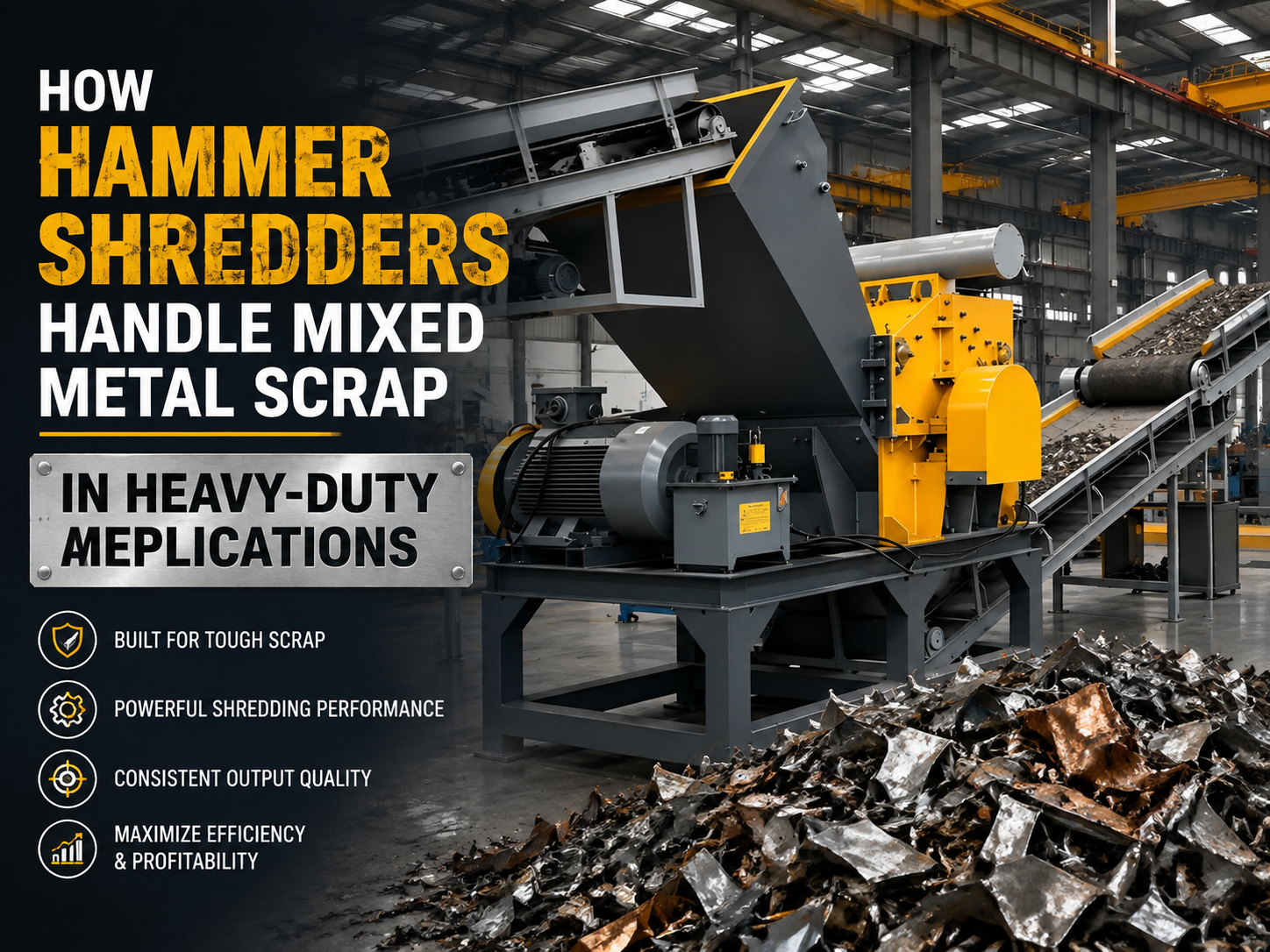
Technical Overview of Hammer Shredders in Metal Recycling
In the modern industrial landscape, the efficiency of recycling operations hinges on the ability to process diverse materials with minimal downtime. Understanding how hammer shredders handle mixed metal scrap in heavy-duty applications requires a deep dive into the mechanical principles of impact crushing. Unlike shear shredders that rely on high-torque cutting, hammer shredders utilize high-velocity kinetic energy to pulverize, tear, and densify metal scrap. This process is essential for transforming bulky items like end-of-life vehicles (ELVs), white goods, and industrial structural steel into high-density, high-purity ‘shredded’ scrap that is ready for the furnace.
The core of the hammer shredder is the rotor assembly, a massive rotating shaft equipped with heavy, free-swinging hammers. As the rotor spins at high speeds, typically between 400 and 700 RPM, the hammers extend due to centrifugal force. When mixed metal scrap is introduced into the shredding chamber, these hammers strike the material against a fixed anvil or breaker bar. This initial impact shatters brittle components and deforms ductile metals. The material is then dragged across a series of bottom grates, where it continues to be hammered until it is small enough to pass through the grate openings. This repetitive action not only reduces size but also ‘scrubs’ the metal, removing paint, rust, and non-metallic attachments.
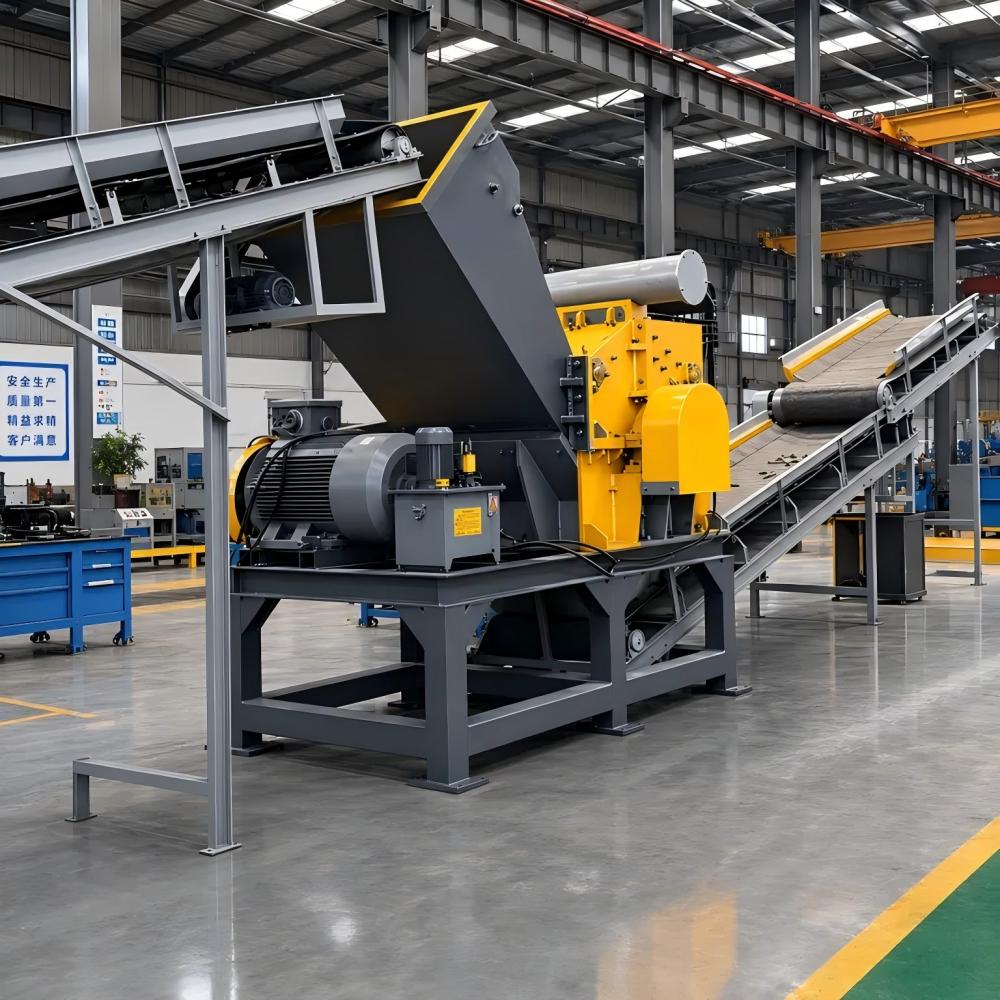
Handling mixed metal scrap presents a unique challenge because the feed material varies significantly in density, hardness, and geometry. A single batch might contain thin aluminum sheets, heavy steel beams, and cast iron engine blocks. To manage this, heavy-duty hammer shredders are designed with massive inertia. The rotor acts as a flywheel, storing energy that can be released instantaneously when a particularly tough piece of scrap enters the chamber. This prevents the motor from stalling and ensures a consistent throughput even when the material composition fluctuates wildly.
Furthermore, the ‘swinging’ nature of the hammers is a critical safety and durability feature. If a hammer strikes an un-shreddable object—such as a solid steel shaft or a large piece of manganese steel—it can retract or swing back into the rotor body. This prevents the catastrophic mechanical failure that would occur in a fixed-blade shredder. Modern HARSLE hammer shredders also incorporate hydraulic reject doors that allow these un-shreddable items to be ejected from the chamber automatically, protecting the internal liners and the rotor itself.
Core Parameters of Heavy-Duty Hammer Shredders
To optimize how hammer shredders handle mixed metal scrap in heavy-duty applications, engineers must balance several core parameters. The first and most critical is Motor Power. For heavy-duty applications, power ratings often range from 500 HP to over 5,000 HP. The power must be sufficient not only to maintain rotor speed under load but also to provide the torque necessary for the initial ‘bite’ on large scrap bundles. High-voltage squirrel-cage motors or wound-rotor motors are commonly used to provide the necessary starting torque and operational stability.
Rotor Tip Speed is another vital parameter. The kinetic energy of a hammer is proportional to the square of its velocity. Therefore, increasing the rotor speed significantly increases the shredding force. However, higher speeds also lead to accelerated wear on the hammers and liners. Engineers must find the ‘sweet spot’ where the impact force is sufficient to break the toughest scrap in the mix without causing excessive maintenance costs. For mixed scrap, a tip speed of 50 to 70 meters per second is generally considered optimal.
The Hammer Weight and Geometry are tailored to the specific scrap profile. In heavy-duty applications, individual hammers can weigh anywhere from 50kg to over 250kg. Heavier hammers provide more ‘punch’ for thick structural steel, while lighter, bell-shaped hammers might be used for lighter gauge materials to increase the number of impacts per revolution. The metallurgy of these hammers—usually high-manganese steel or specialized alloy steels—is engineered to work-harden, meaning the surface becomes harder as it strikes the metal scrap.
Finally, Grate Opening Size determines the final product density and size. Smaller openings result in a more uniform and denser product, which is preferred by steel mills, but they also reduce the overall throughput and increase the internal wear of the machine. In mixed metal applications, double-row grates or staggered grate patterns are often used to balance the need for high-quality output with the requirement for high-volume processing.
Calculation Method for Shredder Performance
Quantifying how hammer shredders handle mixed metal scrap in heavy-duty applications involves calculating the kinetic energy and the theoretical throughput. The kinetic energy ($E_k$) of the rotor assembly is the primary driver of the shredding process. It can be calculated using the formula:
E_k = 0.5 × I × ω²
Where I is the moment of inertia of the rotor (including hammers) and ω is the angular velocity in radians per second. In heavy-duty scrap processing, the goal is to ensure that the energy lost during a single impact (the ‘slowdown’) does not exceed 10-15% of the total stored energy, as this allows the motor to recover the speed before the next major impact.
Throughput ($T$) is more complex to calculate as it depends on the bulk density of the feed material ($ρ$), the volume of the shredding chamber ($V$), and the ‘efficiency factor’ ($η$) which accounts for the time the material spends recirculating before passing through the grates. A simplified estimation for hourly throughput is:
T = (V × ρ × RPM × k) / 60
Where k is a constant derived from the grate area and the material type. For mixed metal scrap, $k$ is typically lower than for homogenous scrap because the machine must work harder to process the varied densities. Engineers use these calculations to size the feeding systems, such as the hydraulic feed rollers, ensuring they do not overfeed the shredder and cause a ‘slug’ that could stall the rotor.
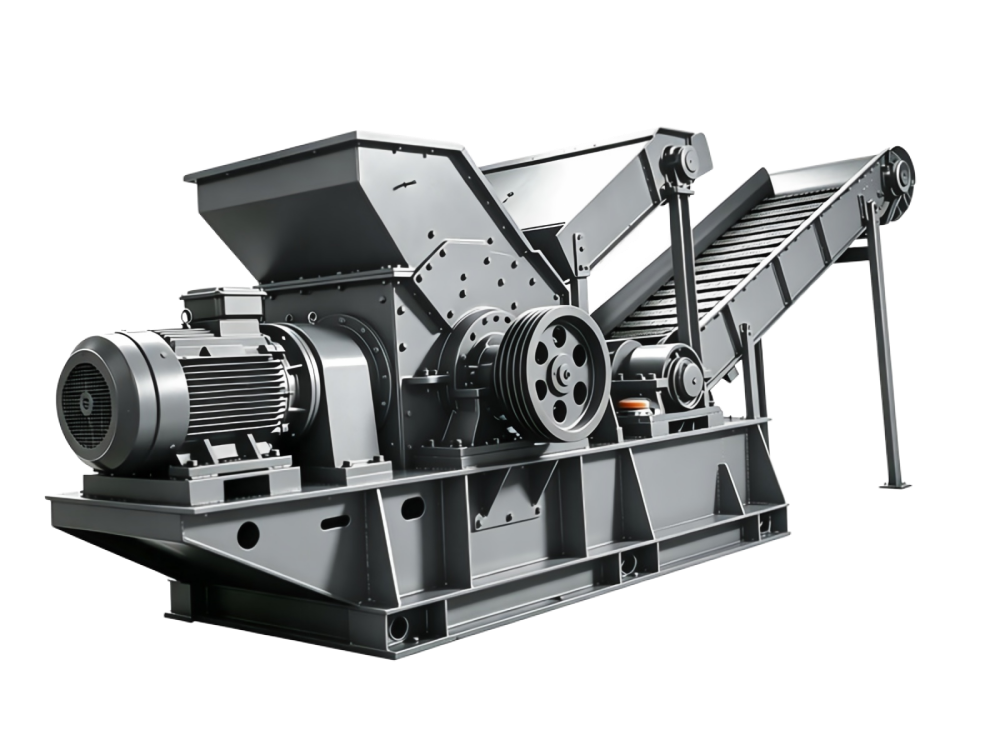
Parameter Table for Industrial Hammer Shredders
The following table outlines typical specifications for hammer shredders used in heavy-duty mixed metal scrap applications. These values represent the standard range for industrial-grade equipment.
| Model Category | Motor Power (kW) | Rotor Diameter (mm) | Hammer Weight (kg) | Throughput (Tons/Hr) | Typical Application |
|---|---|---|---|---|---|
| Light-Heavy | 400 – 800 | 1200 – 1600 | 50 – 80 | 10 – 25 | White goods, light iron, aluminum scrap |
| Medium-Heavy | 1000 – 2000 | 1800 – 2200 | 100 – 150 | 30 – 70 | ELVs, mixed demolition scrap, HMS #2 |
| Ultra-Heavy | 2500 – 5000+ | 2400 – 3000 | 180 – 300 | 80 – 150+ | Heavy structural steel, baled scrap, HMS #1 |
Common Engineering Mistakes in Shredder Operation
One of the most frequent mistakes in managing how hammer shredders handle mixed metal scrap in heavy-duty applications is undersizing the drive system. Operators often attempt to process heavy structural scrap with a motor designed for light-gauge materials. This leads to frequent ‘stalling’ events, which place immense thermal stress on the motor windings and mechanical stress on the couplings and bearings. It is always more cost-effective to have surplus power than to run a machine at its absolute limit.
Another common error is neglecting hammer rotation and replacement cycles. Because hammers work-harden, they maintain their edge for a period, but once the profile becomes too rounded, the shredder loses its ability to ‘grab’ and tear the scrap. Instead, the material simply bounces around the chamber, consuming energy and generating heat without being reduced in size. This ‘polishing’ effect significantly reduces throughput and increases the cost per ton. Implementing a strict maintenance schedule based on tonnage processed is essential.
Poor feed control is a third major issue. A hammer shredder is most efficient when the chamber is consistently filled to about 70-80% capacity. Overfeeding leads to ‘slugging,’ where the rotor speed drops significantly, while underfeeding leads to ‘windmilling,’ where the hammers strike the liners more often than the scrap, causing unnecessary wear. Advanced PLC-controlled feed rollers that adjust speed based on motor amperage are the best solution to this problem.
Finally, many facilities ignore the importance of vibration damping. A heavy-duty shredder generates massive harmonic vibrations. If the foundation is not properly engineered with vibration isolators or sufficient mass, these vibrations can lead to premature failure of nearby electronic components, hydraulic seals, and even the structural integrity of the building. Regular inspection of the foundation bolts and damping pads is a critical but often overlooked task.
Selection Checklist for Mixed Metal Hammer Shredders
When selecting a machine to ensure efficient handling of mixed metal scrap, consider the following checklist:
- Material Profile Analysis: What is the maximum thickness and yield strength of the toughest material in your mix? Ensure the rotor inertia and motor torque are rated for these ‘peak’ events.
- Rotor Design: For mixed scrap, a ‘disc’ rotor is often preferred over a ‘spider’ rotor as it provides more protection for the rotor shaft against wrapping wires and long strips of metal.
- Metallurgy Options: Does the manufacturer offer different hammer alloys? Manganese is great for high-impact steel, but chrome-moly alloys might be better for abrasive, lower-impact materials.
- Downstream Compatibility: Ensure the shredder’s output size matches your separation equipment (magnets, eddy currents, air classifiers).
- Maintenance Access: Look for hydraulic housing opening systems. In heavy-duty applications, you will be changing hammers and liners frequently; ease of access translates directly to lower OpEx.
- Safety Systems: Does the machine include an automated ‘un-shreddable’ ejection door? This is non-negotiable for mixed scrap where heavy solids are common.
- Cooling and Lubrication: Heavy-duty operation generates heat. Ensure the bearing lubrication system is filtered and cooled, and consider water injection for the shredding chamber to control dust and temperature.
Frequently Asked Questions (FAQ)
How often should hammers be replaced in a heavy-duty shredder?
The lifespan of hammers depends entirely on the abrasiveness and hardness of the scrap. In a typical mixed metal application, hammers might need to be flipped after 20-40 hours of operation and replaced entirely after 80-120 hours. Monitoring the ‘sharpness’ of the hammer profile and the density of the output is the best way to determine the replacement interval.
Can a hammer shredder handle stainless steel?
Yes, but with caution. Stainless steel is much tougher and work-hardens more rapidly than carbon steel. Processing large amounts of stainless steel will increase wear on the hammers and liners significantly. If your mix is high in stainless, you may need to upgrade to specialized high-alloy hammers and increase the motor power requirements.
What is the role of water injection in the shredding process?
Water injection serves three main purposes: it suppresses dust generated during the pulverization of non-metallics, it cools the hammers and liners to prevent them from losing their temper, and it helps to loosen and wash away dirt and non-metallic debris from the metal surface, resulting in a cleaner final product.
Why is my shredder vibrating excessively?
Excessive vibration is usually caused by an unbalanced rotor. This happens when hammers wear unevenly or when a hammer is lost or broken. If vibration increases suddenly, stop the machine immediately and inspect the hammer pins and the hammers themselves. Even a small weight discrepancy at high RPM can generate thousands of pounds of centrifugal force imbalance.
What is the difference between a hammer shredder and a ring mill?
While both use a rotor, a hammer shredder uses heavy, solid hammers that rely on pure impact. A ring mill uses heavy rings that can spin on their pins, providing a combination of impact and a ‘rolling/grinding’ action. Ring mills are often used for lighter scrap or when a very specific, rounded ‘nugget’ shape is required for the output, whereas hammer shredders are the workhorses for heavy, mixed structural scrap.


