
Hammer Shredder Performance Comparison: Fixed Hammer vs Swing Hammer Designs

Technical Overview of Hammer Shredder Designs
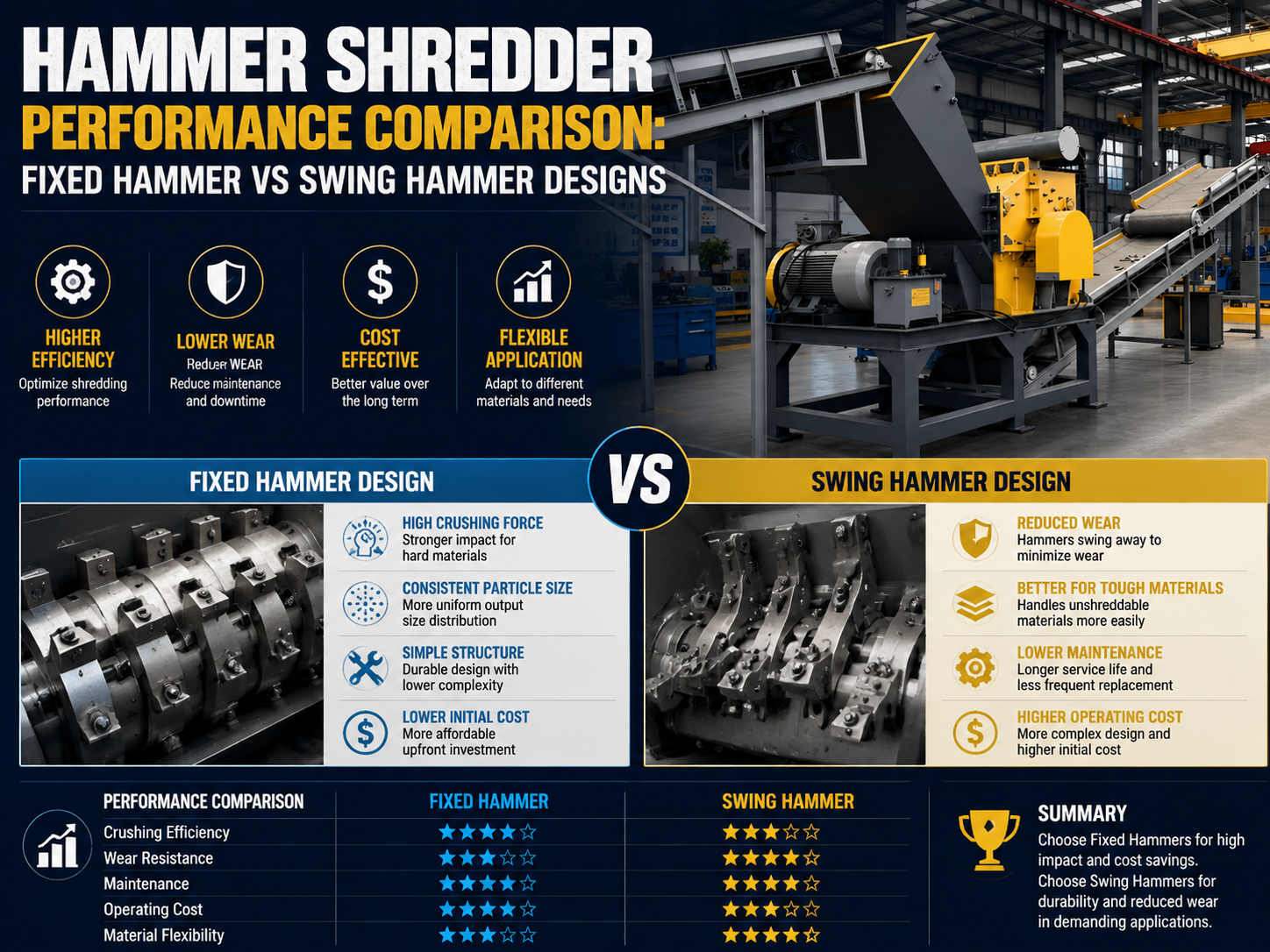
In the demanding world of industrial recycling and material processing, the hammer shredder stands as a cornerstone of efficiency. These machines are engineered to reduce the size of bulky materials—ranging from scrap metal and electronic waste to minerals and biomass—through high-velocity impact. However, the fundamental performance of these machines is dictated by the design of the crushing elements: the hammers. The industry primarily utilizes two distinct configurations: Fixed Hammer and Swing Hammer designs. Understanding the nuances between these two is critical for optimizing throughput, minimizing downtime, and ensuring the longevity of the equipment.
Fixed hammer shredders feature hammers that are rigidly attached to the rotor. This design ensures that the hammer maintains a constant orientation relative to the material being processed. Because the hammer cannot pivot, the entire mass of the rotor and the hammer acts as a single unit during impact. This results in a high-intensity shearing and crushing action, making fixed hammers ideal for processing materials that require precise sizing or for applications where the material is relatively uniform and free of uncrushable contaminants. The rigid nature of the fixed hammer allows for a tighter tolerance between the hammer tip and the anvil or grate, which is essential for achieving a fine, consistent output.
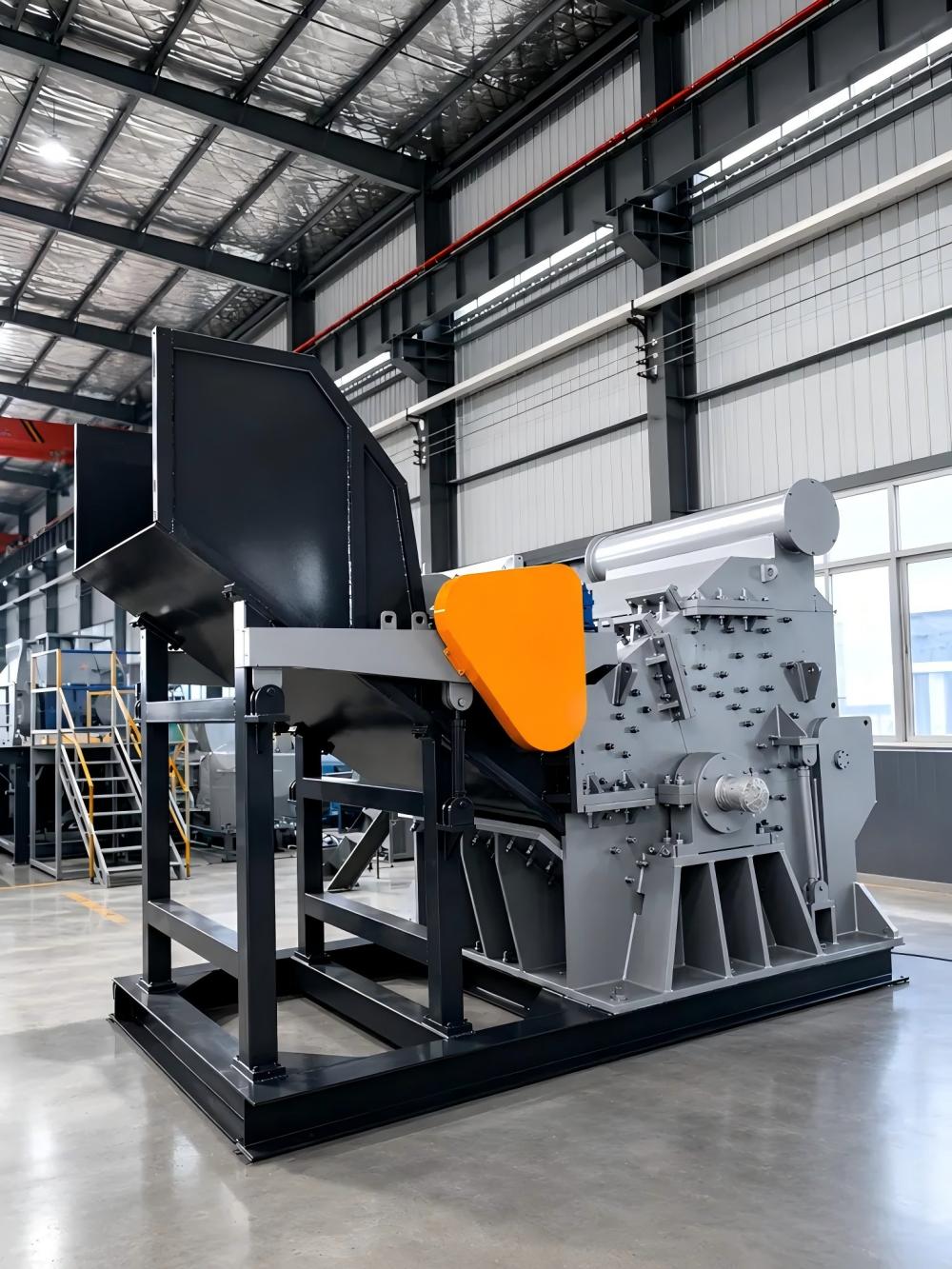
Conversely, swing hammer shredders utilize hammers that are mounted on pins or shafts, allowing them to pivot freely. As the rotor spins at high speeds, centrifugal force flings the hammers outward into their working position. When a swing hammer strikes a piece of material, it delivers a massive kinetic blow but has the unique ability to ‘give’ or retract if it encounters an object that is too hard to crush (such as a large piece of tramp metal). This pivoting action serves as a built-in safety mechanism, protecting the rotor, bearings, and motor from the catastrophic shock loads that would otherwise occur. This makes swing hammers the preferred choice for heavy-duty scrap metal recycling where the feed material is unpredictable.
From a mechanical engineering perspective, the choice between fixed and swing designs influences the entire machine’s architecture. Fixed hammer systems require more robust vibration dampening and precision-balanced rotors because any imbalance is magnified by the rigid structure. Swing hammer systems, while more forgiving of shock, require meticulous maintenance of the hammer pins and suspension points, as these areas are subject to significant frictional wear. HARSLE engineers emphasize that the selection must align with the specific physical properties of the input material and the desired final product characteristics.
Core Parameters Influencing Performance
When conducting a Hammer Shredder Performance Comparison: Fixed Hammer Vs Swing Hammer Designs, several core parameters must be analyzed to determine the suitability of each design for a specific application. The first and most critical parameter is Tip Speed. Tip speed is the linear velocity of the hammer’s outermost edge. In fixed hammer designs, tip speed is directly proportional to rotor RPM. In swing hammer designs, the effective tip speed can vary slightly as the hammer pivots back upon impact, though the nominal speed remains a function of centrifugal force. Higher tip speeds generally result in finer fragmentation but increase the rate of abrasive wear.
Kinetic Energy (KE) is the second vital parameter. The formula KE = 1/2 mv² dictates that the energy delivered is a product of the hammer’s mass (m) and the square of its velocity (v). Fixed hammers benefit from the combined inertia of the rotor assembly, providing a ‘stiffer’ impact. Swing hammers rely more on the individual mass of the hammer and the centrifugal force keeping it extended. For heavy scrap processing, swing hammers are often made significantly heavier to compensate for their ability to pivot, ensuring they have enough momentum to shatter tough alloys without retracting too easily.
Granulometry and Output Control are also heavily influenced by hammer design. Fixed hammers, due to their rigid positioning, allow for a very small ‘nip area’ or clearance between the hammer and the discharge grate. This results in a more uniform particle size distribution (PSD). Swing hammers, because they can deflect, often produce a wider range of particle sizes. If the application requires a strictly controlled 20mm output for downstream chemical processing, a fixed hammer design is often superior. If the goal is simply to densify scrap metal for furnace charging, the swing hammer’s versatility is more advantageous.
Finally, Metallurgy and Wear Life play a decisive role. Fixed hammers are often made from high-chrome alloys or tungsten carbide-tipped steel to maintain their sharp edges for shearing. Swing hammers are typically cast from manganese steel (Hadfield steel), which has the unique property of work-hardening. As the swing hammer repeatedly strikes hard material, its surface becomes harder and more wear-resistant, while the core remains tough and ductile to prevent fracturing. This makes swing hammers exceptionally durable in high-impact environments where fixed hammers might chip or crack.
Calculation Method for Shredder Efficiency
To accurately compare the performance of these two designs, engineers use specific mathematical models to predict throughput and energy consumption. The most common calculation involves determining the Specific Energy Consumption (SEC), measured in kilowatt-hours per ton (kWh/t). This value indicates how much electrical energy is required to reduce a ton of material to the target size. Fixed hammer shredders typically have a lower SEC for brittle materials because the rigid impact is more efficient at propagating cracks. However, for ductile materials like aluminum scrap, the SEC may rise as the material tends to smear rather than shatter.
Another critical calculation is the Centrifugal Force (Fc) for swing hammers, which determines the hammer’s resistance to deflection. The formula is Fc = m * r * ω², where ‘m’ is the hammer mass, ‘r’ is the radius from the center of the rotor to the hammer’s center of gravity, and ‘ω’ is the angular velocity. If the impact force of the material exceeds the centrifugal force, the hammer will pivot back. Engineers must calculate this to ensure the hammers stay extended during normal operation while still providing the ‘relief’ function for uncrushables.
The Reduction Ratio is also calculated as the ratio of the average feed size to the average product size. In fixed hammer designs, the reduction ratio is often higher in a single pass due to the precision of the shearing action. To calculate the theoretical throughput (T), the formula T = K * D * L * n * ρ is often used, where K is a constant based on material type, D is rotor diameter, L is rotor length, n is RPM, and ρ is the bulk density of the material. By adjusting these variables, HARSLE can customize shredder configurations to meet specific production targets.
Parameter Comparison Table
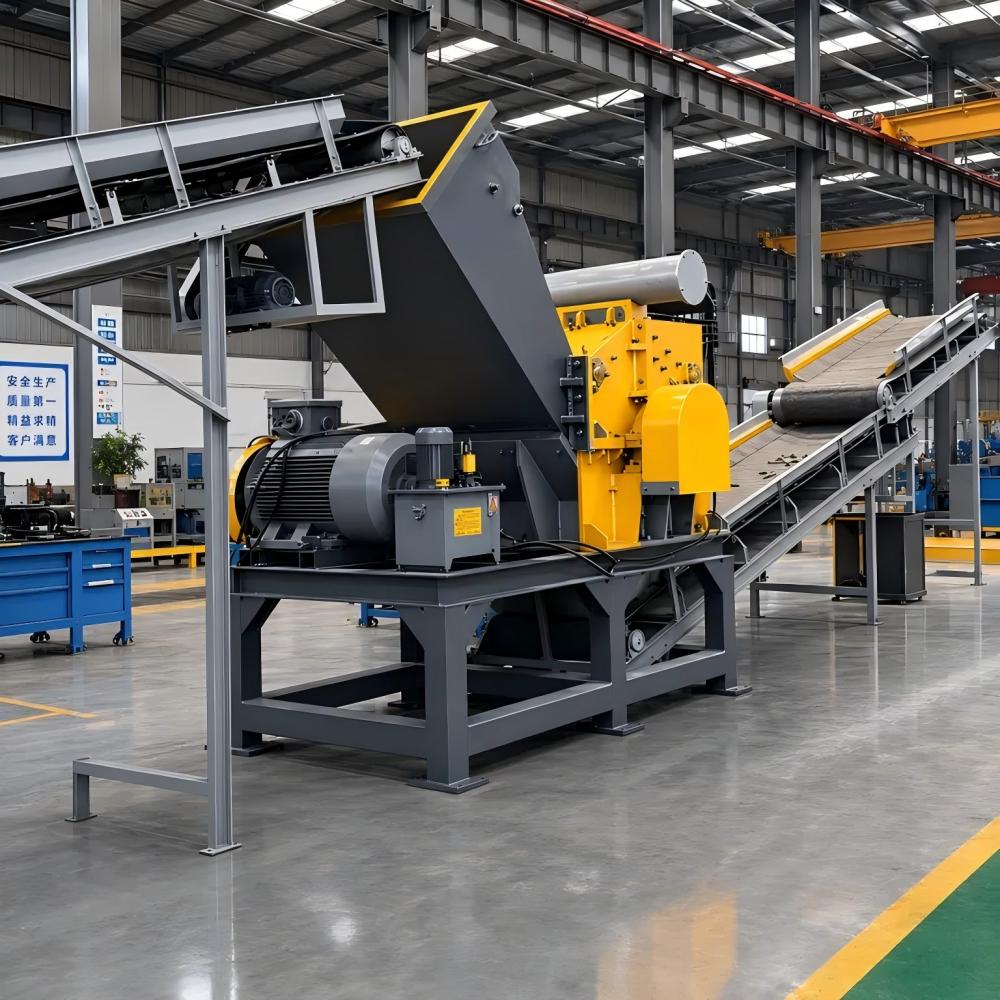
The following table provides a direct comparison of technical specifications and performance metrics between Fixed Hammer and Swing Hammer designs based on standard industrial benchmarks.
| Feature / Parameter | Fixed Hammer Design | Swing Hammer Design |
|---|---|---|
| Primary Impact Mechanism | Rigid Shearing & Crushing | Centrifugal Impact & Shattering |
| Uncrushable Material Handling | Poor (Requires Shear Pins/Clutches) | Excellent (Hammers Pivot/Retract) |
| Output Size Consistency | High (Very Uniform) | Moderate (Variable) |
| Typical Tip Speed | 30 – 50 m/s | 50 – 90 m/s |
| Hammer Material | High-Chrome / Tool Steel | Manganese Steel (Work-Hardening) |
| Maintenance Frequency | Moderate (Edge Sharpening) | High (Pin & Bushing Inspection) |
| Vibration Levels | High (Requires Heavy Foundation) | Moderate (Self-Dampening) |
| Ideal Feed Material | Uniform, Brittle, Pre-Sorted | Mixed Scrap, Bulky Waste, Ores |
| Energy Efficiency (SEC) | Higher for Brittle Materials | Higher for Tough/Ductile Materials |
| Initial Capital Cost | Lower to Moderate | Higher (Complex Rotor Design) |
Common Engineering Mistakes in Shredder Selection
One of the most frequent mistakes in the industry is underestimating the impact of ‘Tramp Metal’ in fixed hammer systems. Many operators choose fixed hammers for their precision but fail to implement adequate magnetic separation or pre-sorting. When a piece of uncrushable steel enters a fixed hammer shredder, it can cause catastrophic failure of the rotor shaft or the main bearings. In contrast, while swing hammers handle tramp metal better, a common mistake is neglecting pin wear. If the pins that hold the swing hammers are not regularly lubricated and inspected, they can ovalize the holes in the rotor discs, leading to an unbalanced rotor and eventual structural failure.
Another error involves mismatched rotor speeds. Operators often believe that increasing the RPM will always increase production. However, for fixed hammers, excessive speed can lead to ‘glazing’ of the material or excessive heat generation, which can melt certain plastics or soften metals, leading to chamber clogging. For swing hammers, if the speed is too high, the centrifugal force becomes so great that the hammers act as if they are fixed, losing their protective pivoting ability and increasing the risk of damage from uncrushables.
Furthermore, ignoring the ‘Moisture Factor’ is a significant engineering oversight. Fixed hammer shredders are particularly susceptible to clogging when processing wet or sticky materials because the tight clearances between the hammers and the grates do not allow for easy material flow. Swing hammers, with their more open design and aggressive ‘beating’ action, are generally better at handling moisture, but even they require specific grate configurations to prevent ‘pancaking’ of the material against the screen.
Selection Checklist for Industrial Hammer Shredders
Choosing the right shredder requires a systematic approach. Use the following checklist to guide your decision-making process:
- Material Analysis: Is the feed material brittle (fixed hammer) or ductile and tough (swing hammer)?
- Contamination Level: Is there a high probability of uncrushable items (tramp metal) in the feed? If yes, swing hammers are mandatory.
- Output Requirements: Do you need a specific, uniform grain size for a downstream process, or is volume reduction the primary goal?
- Throughput Volume: Calculate the required tons per hour. Swing hammers generally offer higher throughput for large-scale scrap operations.
- Maintenance Capability: Does your facility have the tools to balance a fixed rotor or the staff to regularly change swing hammer pins and bushings?
- Power Constraints: Ensure your electrical grid can handle the high startup torque required by heavy swing-hammer rotors.
- Safety Features: Does the machine include an ‘ejection gate’ for uncrushables? This is vital for both designs but critical for fixed hammers.
- Environmental Factors: Consider noise and dust generation. Fixed hammers tend to be slightly quieter due to lower tip speeds but produce more fine dust.
Frequently Asked Questions (FAQ)
1. Which design has a longer hammer life?
Generally, swing hammers made of manganese steel have a longer operational life in high-impact environments because they work-harden. Fixed hammers, while made of harder materials initially, can be prone to chipping if the material is not perfectly consistent. However, in abrasive but low-impact applications (like glass recycling), fixed hammers with carbide inserts often last longer.
2. Can I convert a fixed hammer shredder to a swing hammer design?
It is rarely feasible to convert the design. The rotor architecture, the housing strength, and the motor torque characteristics are fundamentally different. A swing hammer rotor requires much larger pin-support structures and a different balance profile than a fixed hammer rotor.
3. How often should I rotate the hammers?
For swing hammers, rotation (flipping the hammer to use the other leading edge) should occur when the leading corner has worn down by about 20-30% of its original profile. Fixed hammers usually require sharpening or replacement once the clearance between the tip and the anvil exceeds the manufacturer’s specification, typically every 40-100 hours of operation depending on the material.
4. Why is my swing hammer shredder vibrating excessively?
Excessive vibration in swing hammer shredders is usually caused by uneven wear. If one hammer loses more mass than the one opposite it, the rotor becomes unbalanced. Another common cause is a ‘stuck’ hammer that has pivoted back and become wedged by debris, preventing it from extending fully under centrifugal force.
5. Is a fixed hammer shredder better for electronic waste (E-waste)?
Yes, fixed hammer shredders are often preferred for E-waste because they provide the precise shearing action needed to liberate precious metals from circuit boards and plastic housings without over-pulverizing the components, which makes downstream separation easier.
6. What is the role of the ‘Anvil’ in these designs?
The anvil is the stationary wear part that the hammers strike against. In fixed hammer designs, the anvil is precision-aligned to create a shearing gap. In swing hammer designs, the anvil acts more as a primary impact wall to shatter the material before it reaches the discharge grates.
Conclusion
The Hammer Shredder Performance Comparison: Fixed Hammer Vs Swing Hammer Designs reveals that there is no ‘one-size-fits-all’ solution in the recycling industry. Fixed hammers offer precision and efficiency for controlled environments, while swing hammers provide the ruggedness and safety required for unpredictable, high-volume scrap processing. By carefully analyzing material properties, production goals, and maintenance capabilities, industrial operators can select the HARSLE shredder configuration that maximizes their return on investment and ensures long-term operational success.


