
How to Evaluate Hammer Shredder Blade and Hammer Wear in Daily Production

Technical Overview of Hammer Shredder Wear Mechanisms
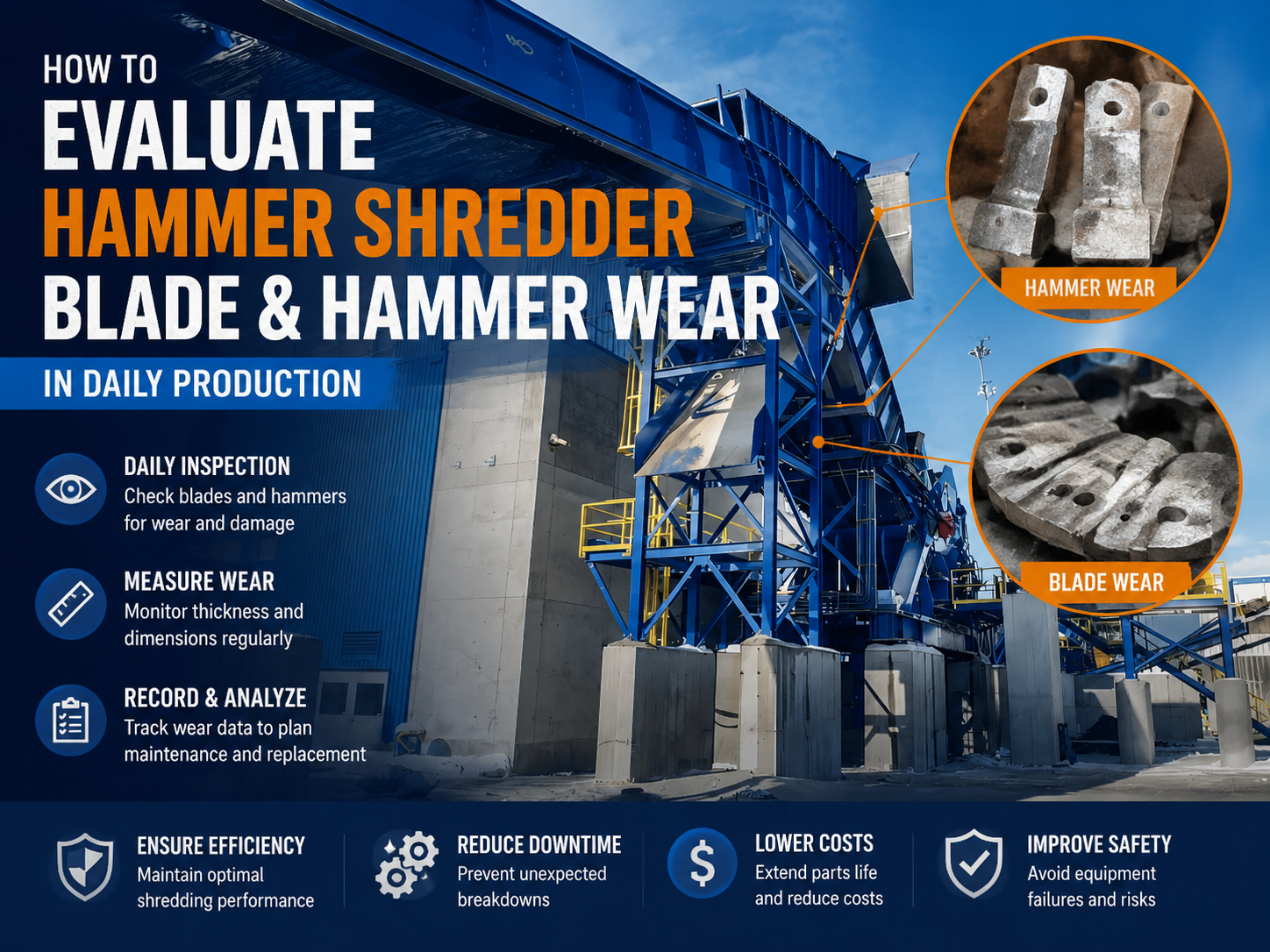
In the heavy-duty world of metal recycling and industrial waste processing, the hammer shredder is a workhorse designed to reduce bulky materials into manageable, high-density fragments. The core of this operation lies in the rotor assembly, where high-speed hammers strike the incoming material with immense kinetic energy. To Evaluate Hammer Shredder Blade Hammer Wear In Daily Production, one must first understand that wear is not merely an inevitable byproduct of operation; it is a complex interaction of impact, abrasion, and thermal stress. The efficiency of the entire shredding line is directly proportional to the sharpness and mass of these hammers.
Hammer wear typically manifests in three stages: the initial rounding of the leading edge, the loss of mass across the striking face, and finally, the structural deformation of the hammer eye or the pin hole. In daily production, the goal is to identify the transition from the first to the second stage. When a hammer loses its sharp profile, it no longer shears the metal effectively. Instead, it begins to consume more energy by pushing the material against the grate bars, leading to increased heat generation and potential damage to the rotor shaft. HARSLE equipment is engineered to withstand these stresses, but consistent evaluation is the only way to ensure long-term ROI.
The physics of the shredding process relies on the formula for kinetic energy: E = ½mv². As a hammer wears down, its mass (m) decreases. Even a 10% reduction in mass significantly reduces the impact energy delivered to the scrap metal. This forces the motor to work harder to achieve the same throughput, leading to a spike in kilowatt-hours per ton processed. Therefore, evaluating wear is not just about the physical state of the blade; it is about the economic efficiency of the entire fabrication facility.
Furthermore, the type of material being processed—whether it is light HMS (Heavy Melting Steel), aluminum scrap, or electronic waste—drastically alters the wear profile. Abrasive materials like glass-contaminated scrap will cause rapid surface erosion, while heavy structural steel will cause more impact-related fracturing or “spalling” on the hammer surface. Understanding these nuances is the first step in a professional evaluation protocol.
Core Parameters Influencing Hammer Longevity
When you Evaluate Hammer Shredder Blade Hammer Wear In Daily Production, you must look beyond visual inspection and focus on specific technical parameters. The first and most critical parameter is Material Hardness (HRC). Most industrial hammers are manufactured from high-manganese steel (Hadfield steel) or high-chromium alloy steel. Manganese steel is unique because it “work-hardens” under impact. The more it is struck, the harder its surface becomes, while the core remains ductile to prevent snapping. If the surface hardness does not reach the expected levels (typically HRC 45-55 after work-hardening), the hammer will wear prematurely.
The second parameter is Toughness and Impact Value. While hardness prevents abrasion, toughness prevents the hammer from shattering when it hits an un-shreddable object, such as a solid steel shaft or a heavy engine block. Evaluation involves checking for micro-cracks around the pin hole. If the hammer shows signs of elongation at the mounting point, it indicates that the material’s yield strength has been exceeded, and the hammer is at risk of catastrophic failure.
Thirdly, the Clearance Gap between the hammer tip and the grate bars (or anvil) is a vital operational parameter. As the hammer wears, this gap increases. A larger gap means the material stays in the shredding chamber longer, being “rubbed” rather than “cut.” This leads to a phenomenon known as “re-shredding,” where the machine wastes energy on material that is already small enough to pass through the grates but cannot because the worn hammers cannot sweep it through. Monitoring this gap daily provides a clear metric for when to flip or replace the blades.
Finally, Weight Balance is a parameter that cannot be ignored. Hammers must be replaced or rotated in balanced sets. Evaluating wear on a single hammer is insufficient; one must evaluate the wear distribution across the entire rotor. An unbalanced rotor caused by uneven hammer wear will lead to vibration, which destroys bearings and compromises the structural integrity of the HARSLE shredder frame.
Calculation Method for Wear Rate and Life Expectancy
To move from subjective observation to objective data, industrial operators use specific calculation methods. The most effective way to Evaluate Hammer Shredder Blade Hammer Wear In Daily Production is to calculate the Specific Wear Rate (SWR). This is expressed as the weight of metal lost from the hammers per ton of material processed (grams/ton).
The formula is: SWR = (W_initial – W_current) / T_processed. By weighing a sample hammer during weekly maintenance shutdowns, operators can plot a wear curve. For example, if a 50kg hammer weighs 48kg after processing 500 tons of scrap, the wear rate is 4 grams per ton. If the wear rate suddenly jumps to 8 grams per ton, it indicates a change in the feed material quality or a failure in the hammer’s heat treatment layer.
Another critical calculation is the Remaining Useful Life (RUL). Most manufacturers specify a “discard weight” for hammers, usually around 60-70% of the original weight. Once the hammer reaches this threshold, the risk of the hammer “flipping” over the pin or breaking increases exponentially. By using the SWR, you can predict exactly how many more shifts the machine can run before a change-out is required, allowing for scheduled downtime rather than emergency repairs.
Furthermore, operators should calculate the Energy Efficiency Ratio (EER). By tracking the Amperage draw of the shredder motor relative to the throughput, you can correlate energy spikes with hammer wear. A worn hammer set can increase energy consumption by up to 30%. In many cases, the cost of the electricity wasted by running worn hammers is higher than the cost of a new set of hammers, making early replacement the more profitable choice.
Technical Parameter Table for Hammer Materials
Choosing the right material is essential for minimizing wear. The following table compares common materials used in HARSLE hammer shredders and their performance metrics during daily production.
| Material Type | Initial Hardness (HB/HRC) | Work-Hardened Hardness | Impact Toughness (J/cm²) | Best Application |
|---|---|---|---|---|
| High Manganese (Mn13) | 200-220 HB | 45-52 HRC | 150-200 | High-impact scrap, large auto bodies |
| Ultra-High Manganese (Mn18Cr2) | 220-250 HB | 50-55 HRC | 120-160 | Abrasive scrap, mixed metals |
| Alloy Steel (Cr-Mo) | 40-45 HRC | 40-45 HRC | 60-80 | Consistent, light-gauge aluminum |
| Bimetallic Composite | 60-65 HRC (Face) | N/A | 30-50 (Core) | Highly abrasive, low-impact waste |
Common Engineering Mistakes in Hammer Maintenance
One of the most frequent mistakes when trying to Evaluate Hammer Shredder Blade Hammer Wear In Daily Production is the “Visual Deception” error. Operators often look at the hammer from the inspection door and assume that because the hammer still has “meat” on it, it is performing well. However, if the leading edge has rounded to a radius larger than 20mm, the shredder is no longer cutting; it is grinding. This grinding action generates excessive heat, which can actually de-temper the hammer material, making it softer and accelerating wear even further.
Another common mistake is Inconsistent Rotation Cycles. Hammers should be flipped (front-to-back) and moved (outside-to-inside) to ensure even wear. The hammers at the ends of the rotor typically wear faster because they interact with the side liners. If an operator fails to rotate these to the center of the rotor, the outer hammers will reach their discard weight while the inner hammers are still at 90% capacity. This leads to inefficient material processing and premature replacement of the entire set.
Ignoring the Pin and Bushing Condition is a critical engineering oversight. The hammer and the pin work as a system. If the pin is worn or grooved, the hammer will not swing freely. A “frozen” or restricted hammer cannot retract when it hits an un-shreddable object, leading to broken hammers or, worse, a bent rotor shaft. Daily evaluation must include a check of the hammer’s ability to swing 360 degrees without resistance.
Finally, many facilities make the mistake of Welding Hard-Facing on Manganese Hammers without proper pre-heating or material compatibility checks. Manganese steel is sensitive to heat. Improper welding can create “heat-affected zones” (HAZ) that are brittle. These zones act as stress concentrators where the hammer will eventually snap during operation, potentially causing catastrophic internal damage to the HARSLE shredder housing.
Selection Checklist for High-Performance Shredder Hammers
To ensure you are using the best components for your HARSLE machinery, use this checklist during your procurement and evaluation process:
- Material Certification: Does the supplier provide a chemical analysis report? Ensure the Manganese-to-Carbon ratio is optimal (usually 10:1).
- Heat Treatment Verification: Ask for the quenching and tempering logs. Uniform hardness throughout the casting is vital for consistent wear.
- Geometric Precision: Check the pin hole diameter and the distance from the hole to the striking face. Variations here cause rotor imbalance.
- Weight Matching: Ensure the hammers in a single set are within +/- 1.5% of each other’s weight.
- Surface Integrity: Inspect for casting defects, blowholes, or inclusions on the striking face, as these are starting points for rapid wear.
- Application Matching: Are you using high-manganese for high-impact? Using the wrong alloy for the specific scrap type is the leading cause of “unexpected” wear.
- Supplier Track Record: Does the manufacturer understand the specific tolerances of HARSLE equipment?
Frequently Asked Questions (FAQ)
1. How often should I inspect the hammers in my shredder?
For high-volume daily production, a visual inspection should be performed at the end of every shift. A detailed measurement of the hammer profile and weight should be conducted weekly. If you notice a sudden drop in throughput or an increase in vibration, stop the machine immediately for an unscheduled inspection.
2. When is the best time to flip the hammers?
Hammers should generally be flipped when the leading edge has rounded off significantly, usually when the radius of the wear exceeds 15-25mm depending on the hammer size. Flipping them allows the sharp trailing edge to become the new striking face, effectively doubling the life of the component before a full replacement is needed.
3. Can I mix different brands of hammers on the same rotor?
It is strongly discouraged. Different manufacturers use different alloy compositions and casting densities. Even if they look identical, their wear rates and weights will differ, leading to a rotor imbalance within a few days of operation. Always replace hammers in full, matched sets from a trusted provider like HARSLE.
4. Why are my hammers wearing faster on one side of the shredder?
This is usually due to uneven feeding. If the infeed conveyor is not centered, material will pile up on one side of the shredding chamber. This causes the hammers on that side to do more work and wear faster. Ensure your feed chute is designed to distribute material evenly across the full width of the rotor.
5. What is the danger of running hammers past their discard weight?
The primary danger is structural failure. As the hammer loses mass, the area around the pin hole becomes the weakest point. A worn hammer is more likely to break and be ejected through the grate bars or, worse, become lodged between the rotor and the anvil, causing a catastrophic “slugging” event that can twist the rotor shaft or destroy the motor coupling.


