Four-Shaft Shredder Screening and Discharge System: How to Control Particle Size

Technical Overview of Four-Shaft Shredder Screening and Discharge Systems
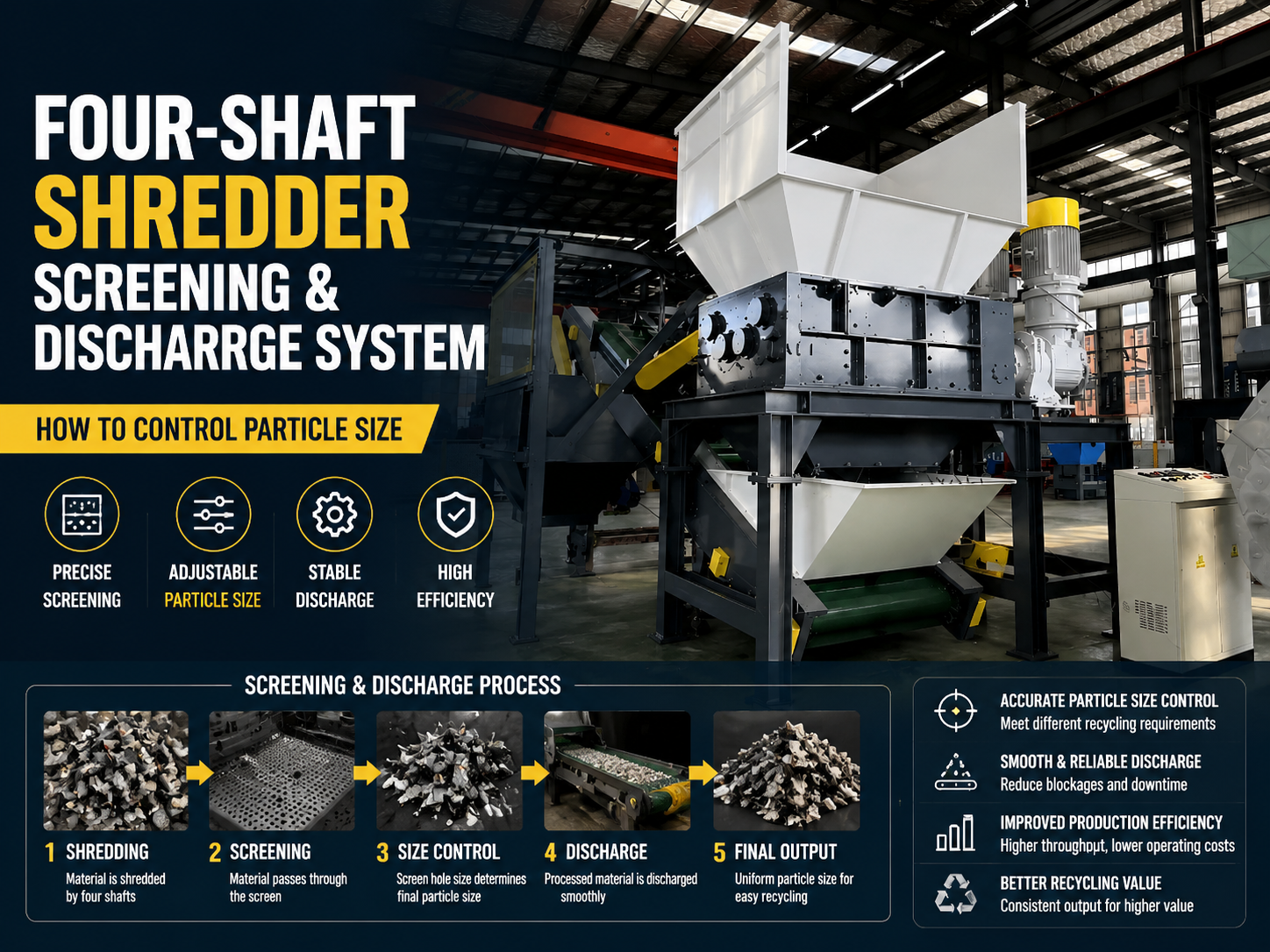
In the realm of industrial recycling and size reduction, the four-shaft shredder stands as a pinnacle of versatility and precision. Unlike two-shaft shredders, which primarily focus on volume reduction, the four-shaft design is engineered for specific output requirements. The Four-Shaft Shredder Screening Discharge System: Control Particle Size mechanism is the heart of this process, ensuring that material only leaves the cutting chamber once it has reached the desired dimensions. This system integrates mechanical shearing, tearing, and sieving into a continuous loop, making it ideal for processing electronic waste, plastics, tires, and complex metal scraps.
The fundamental architecture of a four-shaft shredder consists of two main cutting shafts and two auxiliary shafts. The auxiliary shafts, often positioned above the main cutters, serve to grab the material and force it down into the primary cutting zone. This positive feeding action prevents material from ‘bouncing’ on top of the blades, a common issue in dual-shaft systems. However, the true differentiator is the screen basket located beneath the shafts. This screen acts as a gatekeeper; material that is larger than the screen apertures is caught by the hooks of the cutting shafts and pulled back up for another round of shredding. This internal recirculation is what guarantees a uniform particle size.
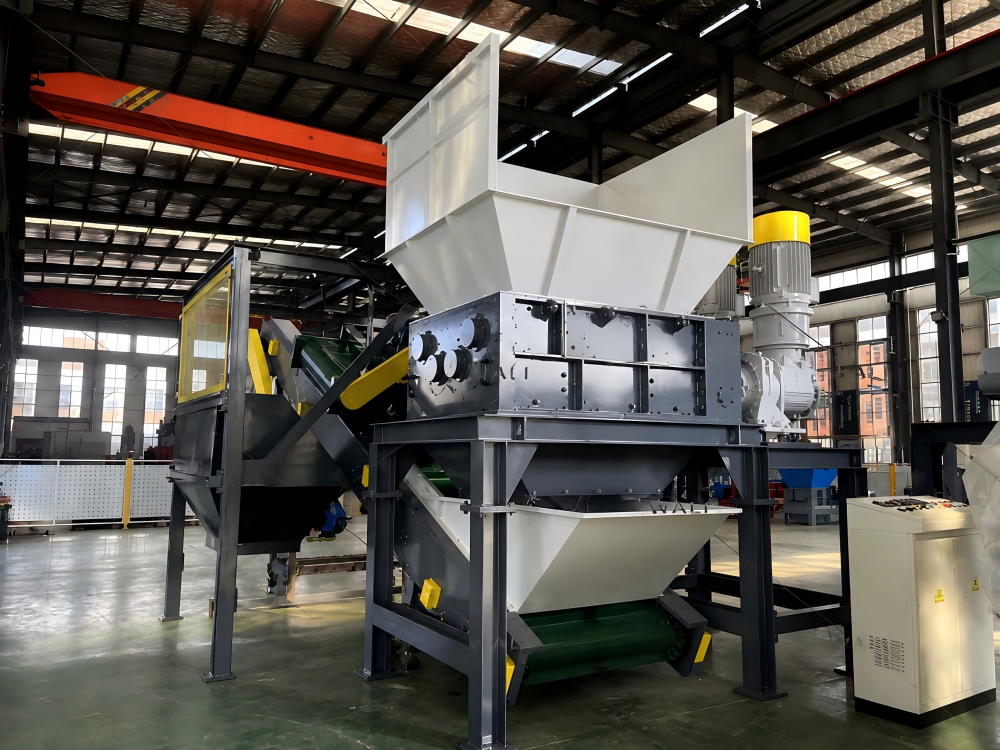
The discharge system is not merely a passive grate. In advanced HARSLE models, the screening system is designed to handle high-torque impacts while maintaining structural integrity. The interaction between the blade geometry and the screen clearance determines the efficiency of the discharge. If the clearance is too wide, thin materials like plastic films might bypass the cutting action. If it is too tight, friction increases, leading to heat buildup and potential screen blinding. Understanding this balance is critical for operators looking to optimize their Four-Shaft Shredder Screening Discharge System: Control Particle Size capabilities.
Core Parameters Influencing Particle Size
Controlling the output of a four-shaft shredder requires a deep dive into several interconnected parameters. The most obvious is the screen mesh size, but it is far from the only factor. The thickness of the blades, the number of hooks per blade, and the rotational speed of the shafts all play synergistic roles in defining the final product. For instance, a 40mm screen will not necessarily produce 40mm cubes; the output will be a distribution of sizes where 40mm is the maximum dimension in at least one axis.
Blade Thickness and Hook Geometry
The width of the individual cutters (blades) dictates one dimension of the shredded particle. If you are using 30mm thick blades, the resulting material will generally have a width corresponding to that measurement. The ‘hooks’ or ‘teeth’ on the blades determine the length of the cut. A blade with four hooks will produce smaller longitudinal pieces than a blade with two hooks, assuming the same shaft speed. For precise particle size control, engineers must match the blade profile to the material’s fracture characteristics.
Shaft Speed and Torque Distribution
Four-shaft shredders typically operate at relatively low speeds (15-35 RPM) but with extremely high torque. The speed differential between the primary and secondary shafts creates a shearing effect. By adjusting the VFD (Variable Frequency Drive) settings, operators can influence how long the material stays in the chamber. Slower speeds often result in cleaner cuts for tough materials like rubber, while higher speeds can increase throughput for brittle materials like hard plastics, provided the screening system can keep up with the discharge volume.
Screen Open Area and Geometry
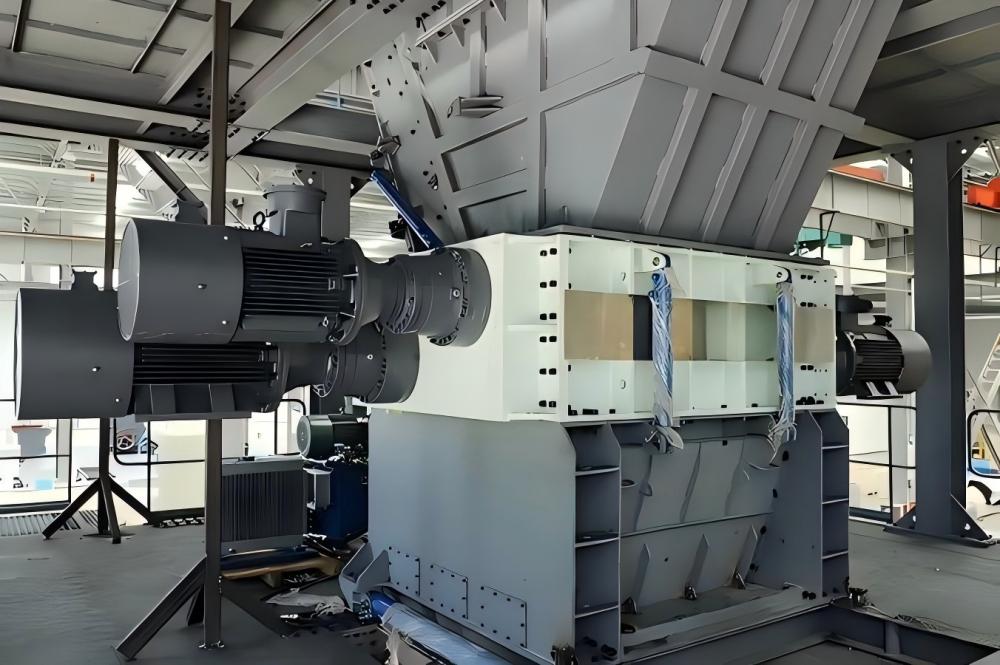
The ‘open area’ ratio of the screen—the total area of the holes versus the total area of the screen plate—directly affects throughput. Hexagonal or circular holes are common, but for specific materials like long fibers or wires, elongated slots might be used to prevent ‘bridging’ (where material clogs the holes). The Four-Shaft Shredder Screening Discharge System: Control Particle Size efficiency is highly dependent on the screen’s ability to allow sized particles to exit quickly to avoid unnecessary over-shredding, which wastes energy and creates excessive fines.
Calculation Method for Throughput and Particle Distribution
To accurately predict the performance of a Four-Shaft Shredder Screening Discharge System: Control Particle Size, engineers use a combination of empirical data and mathematical modeling. The theoretical throughput ($Q$) can be estimated by considering the volume of material displaced by the blade hooks per revolution, multiplied by the shaft speed and the bulk density of the material. However, the ‘Screening Efficiency Factor’ ($E$) must be applied to account for the recirculation of oversized material.
The formula is often expressed as: $Q_{actual} = (V_{chamber} \times RPM \times \rho \times K) / R$, where $V$ is the displacement volume, $\rho$ is density, $K$ is the filling coefficient, and $R$ is the recirculation ratio. The recirculation ratio is determined by the ratio of the screen aperture size to the average ‘bite’ size of the blades. If the blades are cutting pieces significantly larger than the screen holes, $R$ increases, throughput drops, and energy consumption per ton rises.
Another critical calculation involves the ‘Screen Passing Probability.’ This is a statistical approach that considers the angle of approach of a particle to the screen hole. In a four-shaft shredder, the centrifugal force is low, so gravity and the mechanical pushing of the blades are the primary drivers for discharge. Calculating the optimal clearance between the blade outer diameter and the screen inner diameter is essential to prevent ‘smearing’ of soft materials, which can be modeled using fluid dynamics for polymers or granular mechanics for minerals.
Parameter Table for Common Materials
The following table provides a general guideline for configuring the Four-Shaft Shredder Screening Discharge System: Control Particle Size based on different input materials. These values are based on standard HARSLE industrial configurations.
| Material Type | Recommended Screen Size (mm) | Blade Thickness (mm) | Hook Count | Target Particle Size |
|---|---|---|---|---|
| Electronic Waste (WEEE) | 20 – 40 | 20 – 30 | 4 – 6 | < 30mm |
| Car Tires (Pre-shredded) | 50 – 80 | 40 – 50 | 2 – 3 | < 60mm |
| Hard Plastics (HDPE/PP) | 15 – 30 | 15 – 25 | 6 – 8 | < 20mm |
| Aluminum Scrap | 30 – 50 | 30 – 40 | 3 – 5 | < 40mm |
| Paper and Cardboard | 40 – 100 | 30 – 50 | 2 – 4 | Variable |
| Medical Waste | 25 – 40 | 20 – 30 | 5 – 7 | < 35mm |
Common Engineering Mistakes in Discharge Management
One of the most frequent errors in operating a Four-Shaft Shredder Screening Discharge System: Control Particle Size is the mismatch between blade geometry and screen aperture. Operators often attempt to produce very small particles (e.g., 15mm) using thick blades (e.g., 50mm). This results in a massive recirculation load, as the blades cannot physically cut the material small enough to pass through the screen in a single pass. This leads to excessive heat, which can melt plastics or temper the steel of the blades, reducing their lifespan.
Another common mistake is neglecting the ‘Screen Blinding’ phenomenon. This occurs when damp or sticky materials (like organic waste or adhesive-backed plastics) coat the screen, effectively closing the holes. When the discharge system is blinded, the material continues to circulate, increasing the pressure within the chamber. Without a pressure-sensing auto-reverse safety mechanism, this can lead to catastrophic shaft failure or motor burnout. Regular cleaning and the use of anti-blind coatings or specialized screen geometries can mitigate this.
Furthermore, many facilities fail to account for the ‘Fines’ generation. While the goal is a specific particle size, the mechanical action of shredding inevitably produces dust and micro-particles. If the discharge system is not integrated with a proper dust extraction or secondary fine-screening system, these fines can contaminate the final product or create an explosive atmosphere in the case of aluminum or certain plastics. Proper engineering requires a holistic view of the discharge flow, not just the screen itself.
Selection Checklist for a Four-Shaft Shredder System
When selecting a shredder to optimize your Four-Shaft Shredder Screening Discharge System: Control Particle Size, use the following checklist to ensure the equipment meets your technical requirements:
- Material Compatibility: Does the blade metallurgy (e.g., D2, SKD-11, or Hardox) match the abrasiveness of your input?
- Screen Accessibility: Can the screen basket be easily removed for cleaning or size changes? HARSLE designs often feature hydraulic screen cradles for rapid maintenance.
- Drive System: Is the motor equipped with a VFD to allow for fine-tuning of shaft speeds for different discharge requirements?
- Blade Configuration: Are the blades individual or integrated? Individual blades allow for cheaper replacement and customization of the cutting sequence.
- Cooling Systems: For heat-sensitive materials, does the shredder include water-cooling for the shafts or air-cooling for the chamber?
- Safety Features: Does the system include an automatic reverse function when the screen is blocked or when an un-shreddable object is detected?
- Throughput Requirements: Does the calculated discharge rate meet your downstream processing needs (e.g., granulators or optical sorters)?
Frequently Asked Questions (FAQ)
How often should I replace the screen in my four-shaft shredder?
Screen longevity depends entirely on the abrasiveness of the material. For clean plastics, a screen may last several thousand hours. For glass-filled polymers or contaminated metals, it may need inspection every 500 hours. Replace the screen when the hole edges become rounded, as this significantly decreases screening efficiency and increases recirculation.
Can I run the shredder without a screen?
Yes, four-shaft shredders can be operated without a screen if you only require primary volume reduction and do not need a specific particle size. This will significantly increase throughput and reduce energy consumption, but the output will be inconsistent in size.
What is the relationship between screen size and energy consumption?
There is an inverse relationship. As the screen aperture size decreases, the energy consumption per ton of material increases. This is due to the higher recirculation rate and the increased friction of processing the material multiple times until it is small enough to pass.
Why is my particle size inconsistent despite having a screen?
Inconsistent particle size usually points to worn blades or excessive clearance between the blades and the screen. If the blades are rounded, they ‘tear’ rather than ‘cut,’ creating long, thin strips that might ‘snake’ through the screen holes even if they are technically longer than the hole diameter.
How do I prevent ‘bridging’ over the screen holes?
Bridging is common with fibrous materials. To prevent this, ensure the auxiliary shafts are effectively pushing material down and consider using a screen with staggered holes or a vibrating discharge chute to keep the material moving once it passes through the screen.