Hammer Shredder Technical Guide: Working Principle, Key Components, and Industrial Applications

Technical Overview of Hammer Shredder Systems
The hammer shredder, often referred to as a hammer mill in specific industrial contexts, represents a cornerstone of modern material size reduction technology. At its core, the hammer shredder is a high-speed, high-torque machine designed to fragment bulky materials into smaller, more manageable pieces through the application of kinetic energy. Unlike shear shredders that rely on slow-speed cutting, the hammer shredder utilizes the momentum of heavy, rotating masses to shatter materials upon impact. This makes it exceptionally effective for brittle materials, scrap metal, and various forms of industrial waste where high throughput and density are required.
In the realm of metal fabrication and recycling, the Hammer Shredder Technical : Working Principle, Key Components, Industrial Applications are critical factors that determine the efficiency of a processing line. HARSLE has engineered these machines to withstand the extreme stresses of continuous operation, integrating advanced metallurgy with precision mechanical engineering. The technical evolution of these machines has moved from simple crushing devices to sophisticated systems capable of separating ferrous and non-ferrous metals while simultaneously cleaning the material of contaminants like paint, plastic, and dirt.
The fundamental physics behind a hammer shredder involves the conversion of electrical energy into rotational kinetic energy. As the motor drives the central rotor, the attached hammers reach peripheral speeds that can exceed 60 meters per second. When material enters the crushing chamber, it is struck by these hammers, causing immediate fracture. The material is then further reduced as it is forced against breaker plates and eventually passed through a discharge grate. This multi-stage reduction process ensures a consistent output size, which is vital for downstream processes such as smelting or secondary sorting.
Understanding the technical nuances of these machines is essential for plant managers and engineers. The choice of a shredder impacts not only the immediate production goals but also long-term operational costs, including energy consumption and wear-part replacement cycles. As global demand for recycled materials increases, the hammer shredder remains the primary tool for converting low-value scrap into high-value, furnace-ready commodities.
Core Components of a Hammer Shredder
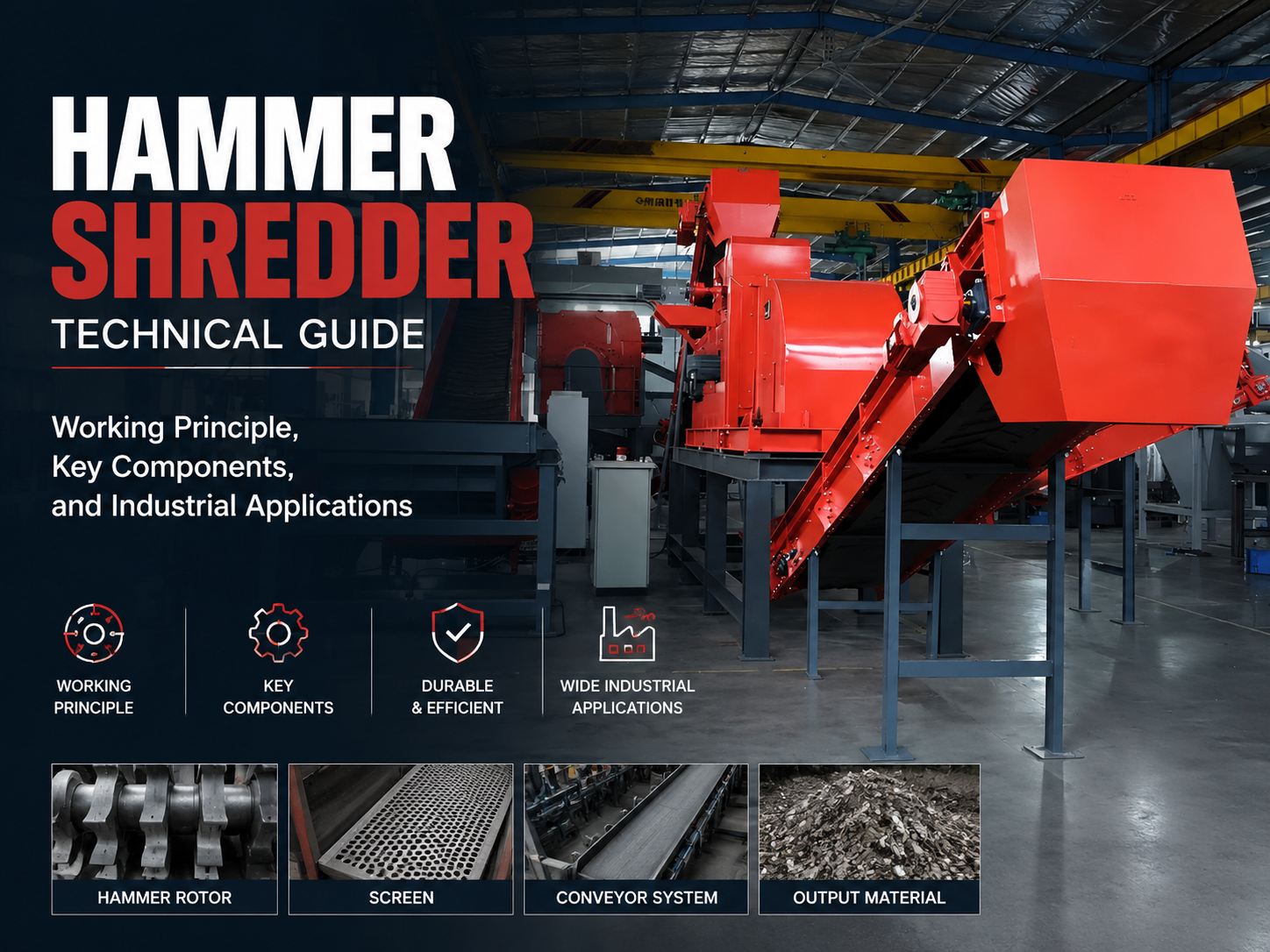
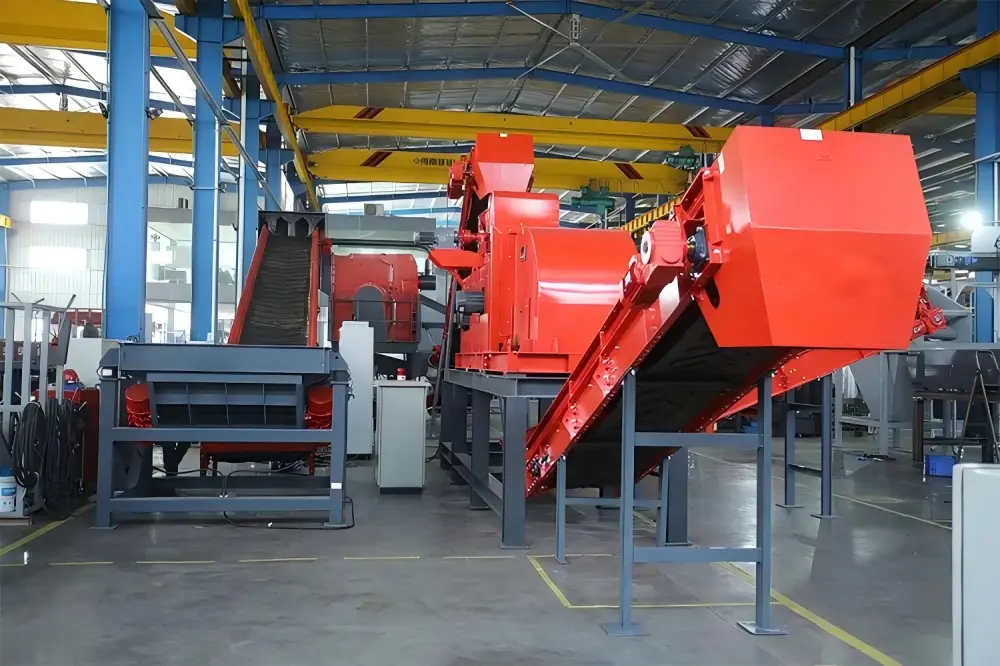
The efficiency and longevity of a hammer shredder are dictated by the quality and design of its internal components. The most critical component is the Rotor Assembly. This is the heart of the machine, consisting of a heavy-duty shaft, rotor disks, and hammer pins. The rotor must be dynamically balanced to prevent vibrations that could lead to catastrophic structural failure. In high-end HARSLE models, the rotor is designed with high inertia to maintain speed even when encountering large, dense objects.
Hammers (Beaters): These are the primary wear parts. Hammers are typically cast from manganese steel or specialized alloy steels that work-harden during use. There are two main types: fixed hammers and swing hammers. Swing hammers are more common in industrial shredders because they can retract if they hit an un-shreddable object, protecting the rotor from damage. The geometry of the hammer—whether it is a bell shape, a T-shape, or a rectangular block—is optimized based on the specific material being processed.
Breaker Plates and Liners: The interior of the shredding chamber is lined with replaceable wear plates. The breaker plate is the first point of contact after the initial hammer strike. It is designed to reflect the material back into the path of the hammers for secondary impact. These liners are usually made from high-chrome iron or manganese to resist both abrasive and impact wear. The clearance between the hammers and the breaker plate is a key adjustment parameter for controlling the fineness of the output.
Discharge Grates (Screens): Located at the bottom of the chamber, the grates determine the final size of the shredded material. Only material that has been reduced to a size smaller than the grate openings can exit the machine. The design of these grates—whether they are staggered, straight, or circular—affects the throughput and the amount of recirculating load within the shredder. Heavy-duty grates are essential for metal shredding to prevent deformation under the weight of the material.
Working Principle: The Mechanics of Impact
The Hammer Shredder Technical : Working Principle, Key Components, Industrial Applications begins with the feeding mechanism. Material is introduced into the shredding chamber, often via a vibrating feeder or a conveyor belt. As the material enters the “circle of destruction” created by the rotating hammers, it undergoes three distinct stages of reduction: impact, attrition, and shear.
Stage 1: Primary Impact. The high-velocity hammers strike the incoming material. Because the hammers are moving much faster than the falling material, the kinetic energy transfer is massive. For brittle materials, this initial strike is often enough to shatter the object into several fragments. For ductile materials like aluminum or mild steel, the impact begins to deform and tear the metal.
Stage 2: Secondary Impact and Attrition. The fragments are accelerated by the hammers and flung against the breaker plates. This collision further breaks the material. As the material bounces back into the hammer path, it is struck again. Furthermore, the material particles rub against each other and the chamber walls (attrition), which helps in removing surface coatings and rounding off sharp edges, increasing the bulk density of the final product.
Stage 3: Discharge and Sizing. The material continues to circulate in the chamber until it is small enough to pass through the discharge grate. If a piece of material is too large, it is carried back up for another cycle. This “closed-loop” within the chamber ensures that the output is uniform. In advanced systems, a “reject door” or “tramp metal trap” is included to allow un-shreddable items (like heavy engine blocks or solid steel shafts) to be ejected safely without damaging the rotor.
Core Parameters and Technical Specifications
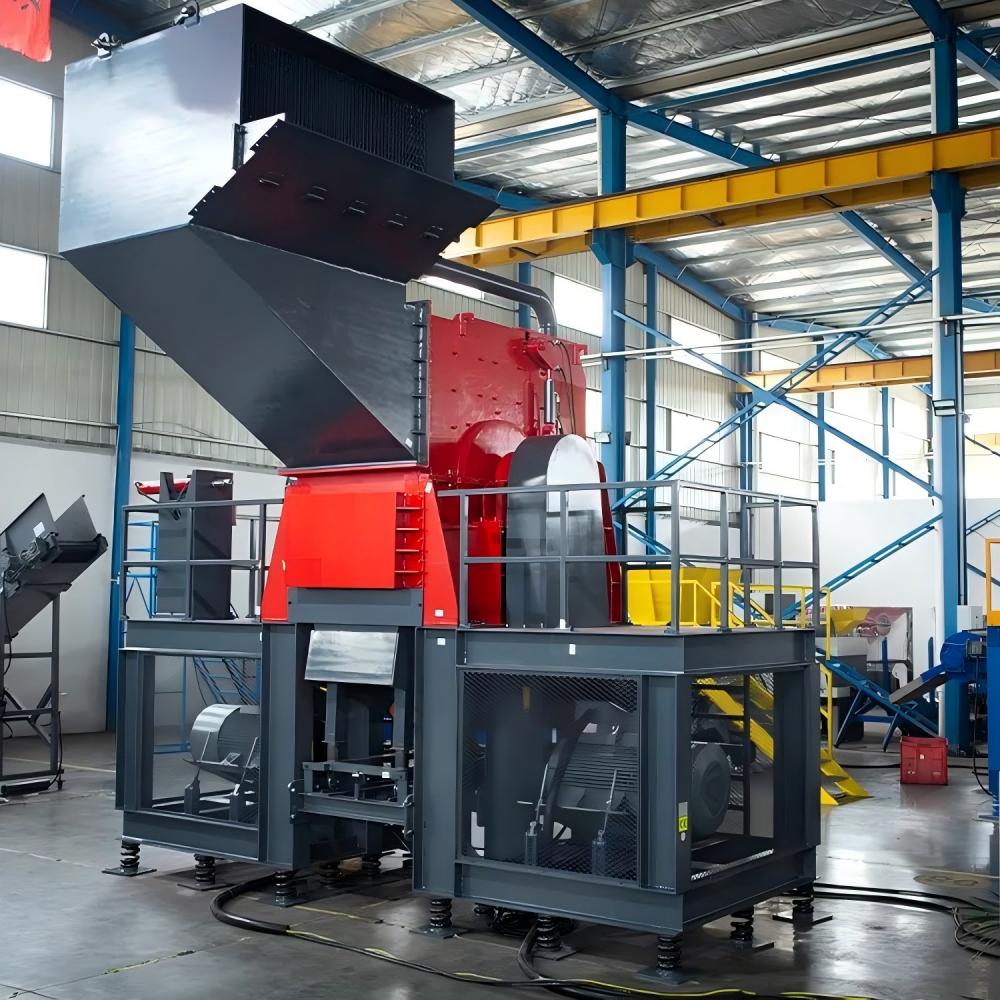
When evaluating a hammer shredder, several core parameters must be analyzed to ensure the machine meets the application requirements. The most prominent is Rotor Diameter and Width. The physical dimensions of the rotor define the volume of the crushing chamber and the maximum size of the feed material. A larger diameter rotor provides higher tip speeds and greater kinetic energy for a given RPM.
Motor Power (kW/HP): The power requirement is directly proportional to the desired throughput and the hardness of the material. For scrap metal recycling, power ratings often range from 200kW to over 2000kW. The motor must provide enough torque to start the heavy rotor and maintain speed under load. HARSLE utilizes high-efficiency motors coupled with fluid couplings or V-belt drives to dampen shock loads and protect the motor windings.
Rotor Speed (RPM): The speed of the rotor determines the impact velocity. While higher speeds result in finer fragmentation, they also increase the rate of wear on the hammers and liners. Finding the “sweet spot” for RPM is critical for balancing output quality with operational costs. Typically, industrial hammer shredders operate between 500 and 1200 RPM depending on the rotor size.
Calculation Method for Shredder Performance
To accurately size a hammer shredder, engineers use specific formulas to estimate kinetic energy and throughput. The kinetic energy ($E$) of a single hammer can be calculated using the formula:
E = ½mv²
Where:
– m is the mass of the hammer (kg).
– v is the peripheral velocity (tip speed) of the hammer (m/s).
The tip speed ($v$) is calculated as:
v = (π × D × n) / 60
Where D is the rotor diameter (meters) and n is the rotational speed (RPM).
Throughput capacity ($Q$) is more complex to calculate as it depends on material density, feed rate, and grate size. A simplified engineering estimate for capacity is:
Q = K × D² × L × n
Where K is a material-specific constant, L is the rotor length, and n is the RPM. For scrap metal, the constant $K$ is significantly lower than for limestone or wood, reflecting the higher energy required for fragmentation.
Parameter Table: HARSLE Hammer Shredder Series
| Model Series | Rotor Diameter (mm) | Motor Power (kW) | Throughput (Tons/Hr) | Typical Application |
|---|---|---|---|---|
| HS-1000 | 1000 | 110 – 160 | 5 – 10 | E-waste, Aluminum Cans |
| HS-1250 | 1250 | 200 – 315 | 10 – 20 | Light Scrap, White Goods |
| HS-1600 | 1600 | 450 – 800 | 25 – 45 | ELV (End-of-Life Vehicles) |
| HS-2000 | 2000 | 1000 – 2000 | 50 – 100 | Heavy Industrial Scrap |
Industrial Applications of Hammer Shredders
The versatility of the hammer shredder allows it to serve a wide array of industries. In Metal Recycling, it is the primary tool for processing ELVs (End-of-Life Vehicles). The shredder breaks the car body into fist-sized pieces, allowing for the easy separation of steel from non-ferrous metals (like aluminum and copper) and “fluff” (plastics, foam, and glass). This process significantly increases the value of the scrap by creating a clean, dense product known as “fragmentized scrap.”
In the Waste-to-Energy (WtE) sector, hammer shredders are used to process Municipal Solid Waste (MSW) and Refuse-Derived Fuel (RDF). By shredding the waste to a uniform size, the combustion efficiency in incinerators is greatly improved. Similarly, in Biomass Processing, these machines grind wood waste, agricultural residues, and forestry byproducts into fuel for biomass boilers.
The Mining and Quarrying industry utilizes heavy-duty hammer mills for primary and secondary crushing of medium-hard rocks like limestone, gypsum, and phosphate. The ability of the hammer shredder to handle wet or sticky materials better than jaw or cone crushers makes it a preferred choice in certain geological conditions. Additionally, Electronic Waste (E-waste) recycling relies on specialized hammer shredders to liberate precious metals from circuit boards and plastic housings without generating excessive heat that could melt the plastics.
Common Engineering Mistakes in Shredder Operation
One of the most frequent mistakes in hammer shredder operation is Improper Hammer Selection. Using a hammer that is too light for the material will result in poor fragmentation and excessive “bounce back,” while a hammer that is too heavy can overload the motor and cause premature bearing failure. Operators must match the hammer metallurgy and weight to the specific Mohs hardness and density of the feed material.
Another common error is Neglecting Rotor Balance. As hammers wear down unevenly, the rotor can become unbalanced. Operating an unbalanced rotor leads to high-frequency vibrations that can crack the machine housing and destroy the main bearings. Regular weighing of hammers and replacing them in balanced sets (opposing pairs) is a mandatory maintenance task that is often overlooked in fast-paced production environments.
Inadequate Feeding Control also plagues many operations. Overfeeding the shredder can lead to “slugging,” where the motor stalls because the chamber is packed too tightly for the hammers to rotate. Conversely, underfeeding leads to inefficient energy use and increased wear per ton of material processed. Implementing an automated feed control system that adjusts the conveyor speed based on the motor’s current draw is the best way to mitigate this issue.
Selection Checklist for Industrial Hammer Shredders
- Material Characterization: Define the maximum feed size, moisture content, and material hardness (brittle vs. ductile).
- Desired Output: Specify the required particle size distribution and bulk density of the finished product.
- Capacity Requirements: Determine the required tons per hour (TPH) and the number of shifts the machine will operate.
- Power Availability: Ensure the facility’s electrical infrastructure can handle the high startup current and continuous load of the shredder motor.
- Maintenance Access: Check for hydraulic housing opening systems that allow for easy hammer and liner replacement.
- Wear Part Longevity: Evaluate the metallurgy of the hammers and liners; ask for expected life cycles based on similar material processing.
- Safety Features: Ensure the presence of vibration sensors, emergency stops, and tramp metal ejection doors.
- Environmental Compliance: Consider dust suppression systems (water sprays) and noise reduction enclosures if the site is near residential areas.
Frequently Asked Questions (FAQ)
1. How often should hammers be replaced?
The lifespan of hammers depends entirely on the abrasiveness of the material. For clean aluminum, hammers may last hundreds of hours. For contaminated scrap steel, they may need to be rotated or replaced every 40 to 80 hours of operation. Regular inspection is key.
2. Can a hammer shredder process stainless steel?
While it can, stainless steel is significantly harder and more work-hardening than mild steel. This will lead to much faster wear on the hammers and liners. Specialized high-alloy hammers are recommended for consistent stainless steel processing.
3. What is the difference between a hammer shredder and a ring granulator?
A hammer shredder uses swinging hammers that strike the material, while a ring granulator uses heavy rings that crush the material through a combination of impact and rolling pressure. Ring granulators are typically used for coal and less abrasive materials.
4. How do I prevent dust explosions in a hammer shredder?
When shredding materials like aluminum or certain plastics, fine dust can become explosive. Using water injection systems within the chamber and maintaining proper ventilation/dust collection systems are standard safety protocols to prevent ignition.
5. Why is my shredder vibrating excessively?
Excessive vibration is usually caused by an unbalanced rotor (uneven hammer wear), a bent shaft, or failing bearings. It can also be caused by a loose foundation bolt. The machine should be stopped immediately and a vibration analysis performed.