
Four-Shaft Shredder Technical Parameters Explained for Buyers and Engineers

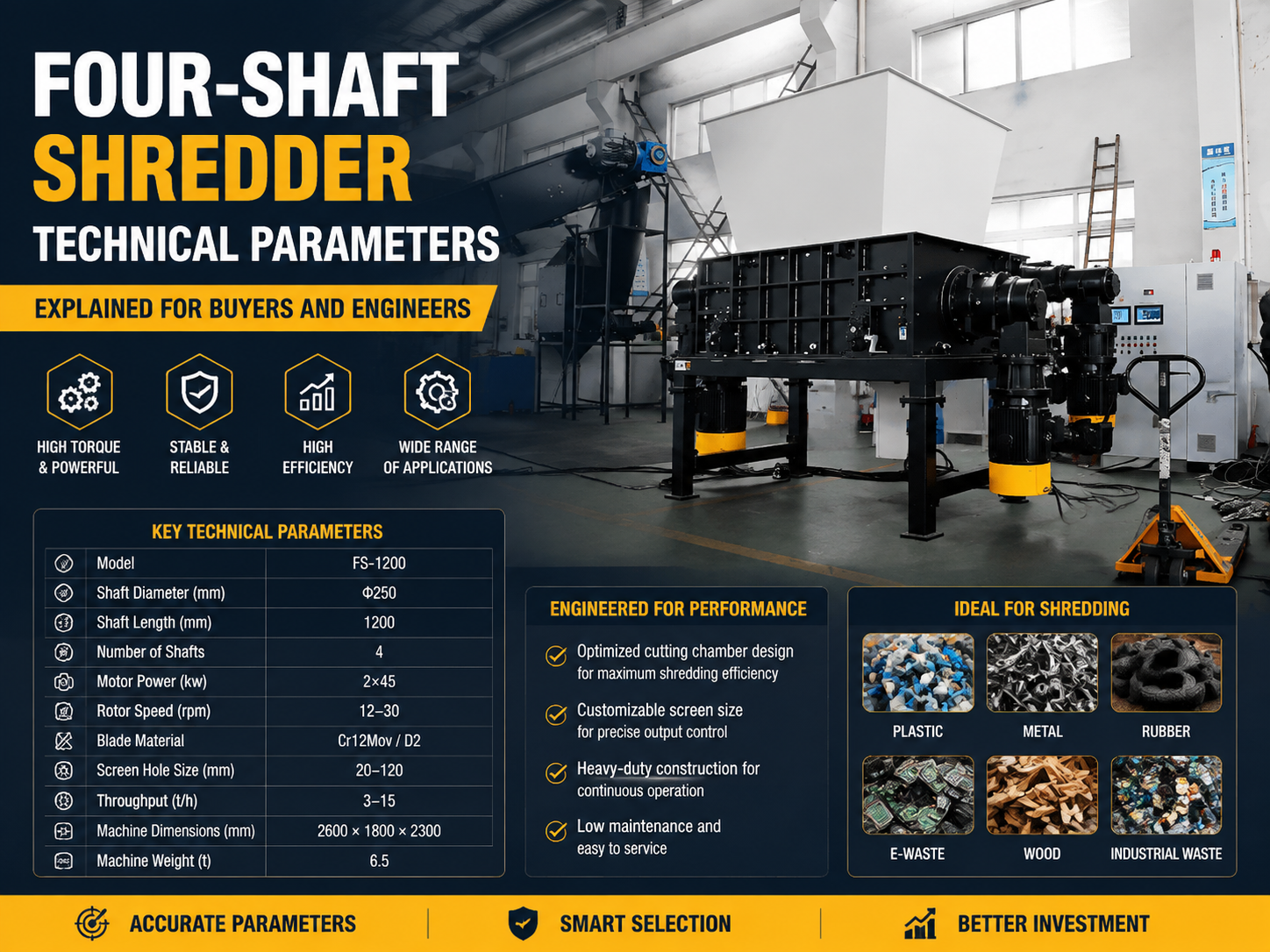
Technical Overview of Four-Shaft Shredder Systems
The four-shaft shredder represents the pinnacle of size reduction technology for complex, high-volume waste streams. Unlike single or double-shaft variants, the four-shaft design utilizes two main drive shafts and two auxiliary shafts. This configuration is specifically engineered to provide superior material grabbing capabilities and a controlled output size through the integration of a screen. For engineers and procurement specialists, understanding the Four-Shaft Shredder Technical Parameters Explained Buyers Engineers is critical to ensuring the machine aligns with operational requirements and long-term ROI.
At its core, the four-shaft shredder operates on a principle of high torque and low speed. The two outer shafts act as feeders, pulling material into the center where the two inner shafts perform the primary cutting and shearing. This redundant cutting action ensures that even bulky or resilient materials, such as electronic waste, tires, or heavy plastics, are processed efficiently. The inclusion of a screen beneath the shafts ensures that only material reduced to the desired dimensions can exit the chamber, while larger pieces are recirculated back to the cutting zone.
From a mechanical engineering perspective, the four-shaft shredder offers a unique advantage in terms of ‘active’ feeding. In many shredding applications, material tends to ‘bridge’ or float above the cutters. The secondary shafts in a four-shaft system actively break down these bridges, forcing material into the primary cutters. This leads to a more consistent throughput and prevents the machine from idling while material sits unprocessed in the hopper. For buyers, this translates to higher efficiency and lower energy consumption per ton of processed material.
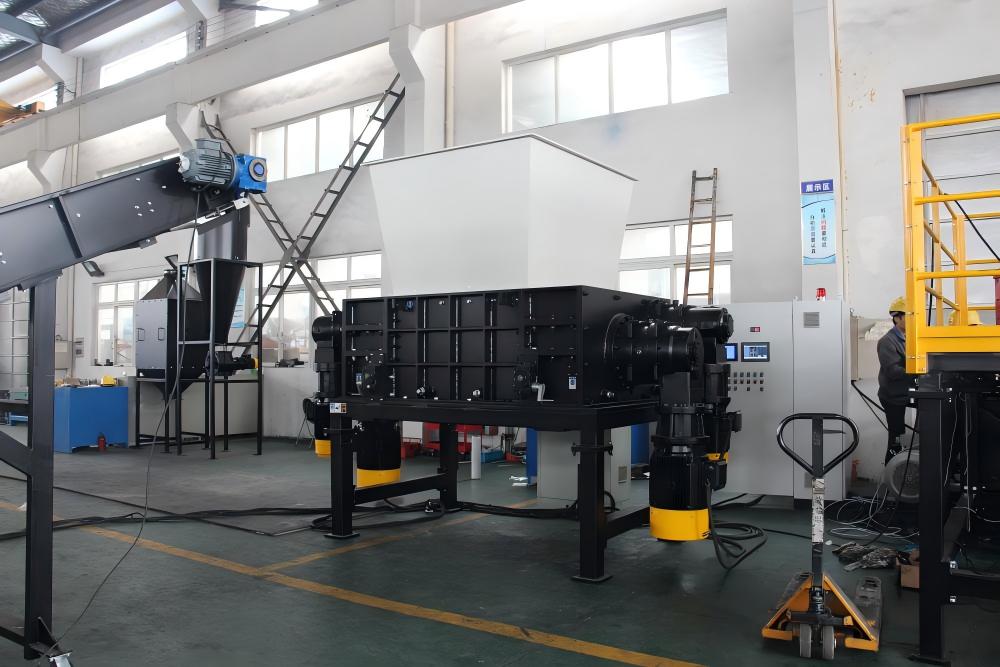
Core Technical Parameters: Power, Torque, and Speed
When evaluating a four-shaft shredder, the relationship between motor power (kW), torque (Nm), and shaft speed (RPM) is the most vital technical consideration. Motor power is the total energy available to the system, but torque is the actual force applied to the material. In heavy-duty recycling, torque is the parameter that determines whether a machine can shear through a steel-reinforced tire or a thick plastic purge. High-torque, low-speed machines are generally preferred for tough materials because they minimize heat generation and dust while maximizing cutting force.
Shaft speed is typically measured in RPM (revolutions per minute). In a four-shaft system, the shafts often operate at differential speeds. For example, the outer shafts might rotate faster to facilitate feeding, while the inner shafts rotate slower to maximize shearing force. Engineers must look for the ‘gearbox ratio’ which dictates this relationship. A higher ratio usually means more torque but lower speed. If your application involves brittle materials like glass or certain hard plastics, a slightly higher speed might be acceptable. However, for metals and tough polymers, low speed (typically 10-25 RPM) is the industry standard for durability.
Another critical parameter is the ‘Starting Torque.’ Industrial shredders often face ‘jam’ scenarios where the machine must restart while the chamber is full of material. A high-quality four-shaft shredder, such as those manufactured by HARSLE, utilizes advanced frequency drives (VFDs) or hydraulic motors to provide maximum torque from a standstill. This prevents motor burnout and reduces mechanical stress on the drive train during startup cycles.
Blade Geometry and Metallurgy
The blades (or cutters) are the primary wear components of any shredder. When analyzing Four-Shaft Shredder Technical Parameters Explained Buyers Engineers, one must look closely at blade thickness, diameter, and the number of hooks. Blade thickness determines the width of the shredded output. For instance, if you require a 20mm output, your blades should be designed to match that specification in conjunction with the screen size. The number of hooks on each blade influences the ‘grab’ frequency; more hooks generally mean a more aggressive feed but may require more power.
Metallurgy is where many buyers make mistakes. Standard alloy steels may be sufficient for paper or soft plastics, but for industrial waste, specialized heat-treated alloys like D2, DC53, or Hardox are required. The hardness of the blade (measured on the Rockwell C scale, HRC) must be balanced with toughness. A blade that is too hard will be brittle and chip when it hits a non-shreddable object (like a stray steel bolt), while a blade that is too soft will dull quickly. Engineers should specify a hardness range, typically between 55-60 HRC, depending on the application.
Furthermore, the arrangement of the blades on the shaft—whether they are staggered or aligned—affects the vibration levels and the smoothness of the shredding process. Staggered blades ensure that the cutting force is distributed over time, preventing massive torque spikes that can damage the gearbox. This is a subtle but essential technical detail that distinguishes high-end engineering from budget-tier machinery.
Calculation Method for Throughput and Capacity
Estimating the actual throughput of a four-shaft shredder is more complex than simply looking at a spec sheet. The theoretical capacity is often calculated using the formula: Throughput (kg/h) = Chamber Volume × Material Bulk Density × Filling Efficiency × Shaft Speed × Discharge Factor. However, for practical engineering purposes, a more simplified approach is often used based on the screen size and the material type.
The screen mesh size is the ultimate gatekeeper of throughput. A smaller mesh size (e.g., 20mm) will significantly reduce the hourly capacity compared to a larger mesh (e.g., 50mm) because the material must stay in the chamber longer to be reduced to the smaller size. Engineers should calculate the ‘recirculation rate’—the percentage of material that fails to pass through the screen on the first pass. For tough materials, this can be as high as 60-70%, meaning the machine is effectively processing the same material multiple times.
To calculate the required motor power for a specific throughput, engineers use the ‘Specific Energy Consumption’ (SEC) value, which is expressed in kWh/ton. For example, shredding mixed plastic waste typically requires 15-25 kWh/ton. If you need to process 2 tons per hour, you would need a minimum of 30-50 kW of total motor power. Always include a 20% safety margin to account for material variations and blade dulling over time.
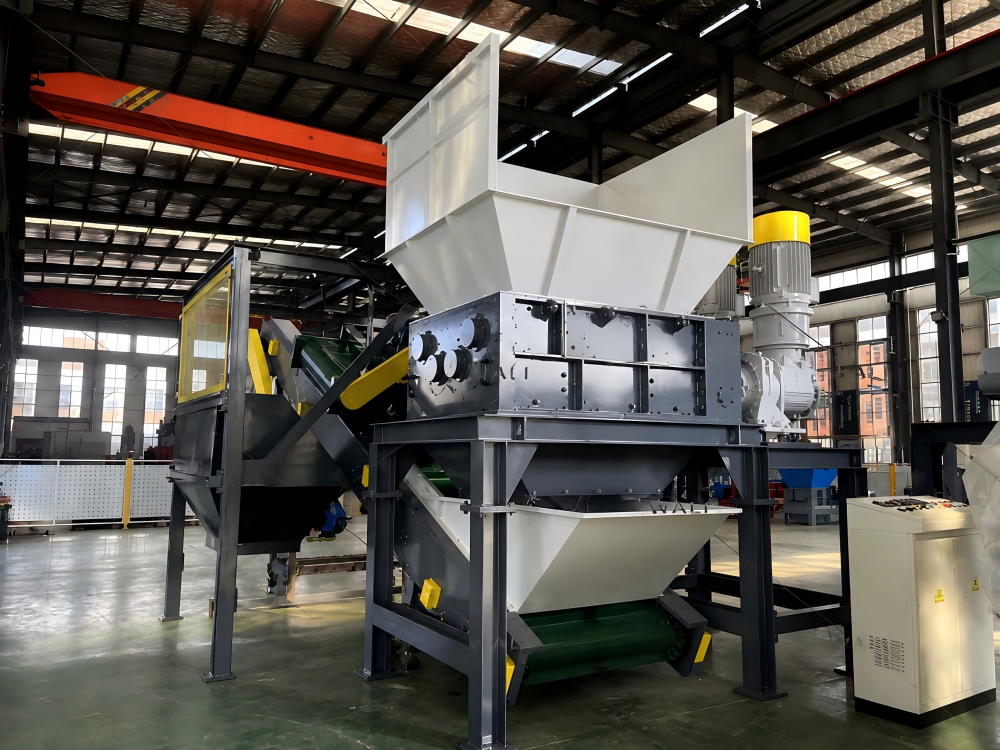
Technical Parameter Table for HARSLE Four-Shaft Shredders
The following table provides a standardized look at the technical specifications for various classes of four-shaft shredders. These values are representative of industrial-grade equipment designed for heavy-duty applications.
| Parameter | Light-Duty (FS-600) | Medium-Duty (FS-1000) | Heavy-Duty (FS-1500) |
|---|---|---|---|
| Motor Power (kW) | 15 + 15 | 30 + 30 | 55 + 55 |
| Cutting Chamber (mm) | 600 x 500 | 1000 x 800 | 1500 x 1200 |
| Shaft Speed (RPM) | 15 / 25 | 12 / 20 | 10 / 18 |
| Blade Diameter (mm) | 300 | 450 | 600 |
| Blade Thickness (mm) | 20 – 40 | 30 – 60 | 50 – 100 |
| Screen Mesh (mm) | 20 – 50 | 30 – 80 | 40 – 150 |
| Throughput (kg/h) | 500 – 800 | 1500 – 2500 | 4000 – 7000 |
| Weight (kg) | 3,500 | 7,500 | 14,000 |
Common Engineering Mistakes in Shredder Selection
One of the most frequent mistakes engineers make is over-specifying the motor power while under-specifying the gearbox torque. A 100kW motor is useless if the gearbox cannot handle the resulting torque or if the shaft diameter is too small to resist twisting. Always verify the ‘Service Factor’ of the gearbox; for shredding applications, a service factor of 2.0 or higher is recommended to handle the constant shock loads and reversals.
Another common error is ignoring the cooling system for the hydraulic fluid or the gearbox oil. Four-shaft shredders generate significant heat due to the friction of shearing and the high-pressure environment of the cutting chamber. In continuous 24/7 operations, without an adequate oil cooling system, the lubricant viscosity will drop, leading to premature gear failure and seal leaks. Buyers should always ask if an air or water-cooled heat exchanger is included in the technical package.
Lastly, many buyers fail to consider the ‘Ease of Maintenance’ as a technical parameter. How long does it take to change the blades? Can the screen be swapped out by a single operator, or does it require a crane? A machine with slightly lower throughput but a 50% faster blade changeover time will often have a higher ‘Net Annual Production’ than a faster machine that is difficult to service. Look for ‘swing-out’ screen cradles and split-bearing housings as key engineering features.
Selection Checklist for Buyers and Engineers
- Material Characterization: Define the maximum hardness, density, and dimensions of the input material.
- Output Requirements: Specify the exact particle size needed for downstream processes (e.g., granulation or pyrolysis).
- Drive Type: Choose between Electric (VFD) for energy efficiency or Hydraulic for maximum shock absorption and variable speed control.
- Blade Material: Ensure the HRC hardness and alloy type match the abrasiveness of your waste stream.
- Safety Features: Verify the presence of auto-reverse logic (to clear jams), emergency stops, and hopper interlocks.
- Control System: Look for PLC-based controls (e.g., Siemens or Schneider) that allow for remote monitoring and data logging.
- Total Cost of Ownership (TCO): Calculate the cost of wear parts (blades, spacers, scrapers) over a 2,000-hour operating window.
Frequently Asked Questions (FAQ)
What is the main advantage of a four-shaft shredder over a two-shaft shredder?
The primary advantage is the integrated screen and the auxiliary shafts. A two-shaft shredder produces ‘strips’ of material, whereas a four-shaft shredder produces a uniform, sized particle. The auxiliary shafts also prevent material from ‘riding’ on top of the cutters, ensuring better throughput for bulky items.
How often do the blades need to be sharpened or replaced?
This depends entirely on the material. For clean plastics, blades may last 2,000+ hours. For abrasive materials like glass-filled polymers or contaminated electronic waste, they may need attention every 500-800 hours. Many HARSLE blades are designed to be rotatable or weld-repaired to extend their lifespan.
Can a four-shaft shredder handle metal?
Yes, but with caveats. It is excellent for light metals (aluminum extrusions, copper wire, thin-walled steel containers). It is not intended for heavy structural steel or thick engine blocks, which require a specialized metal crusher or a much larger heavy-duty shredder.
What is the role of the PLC in a four-shaft shredder?
The PLC (Programmable Logic Controller) monitors the motor current. If the current spikes (indicating a jam), the PLC automatically stops the shafts and reverses them to reposition the material before attempting to shred again. This ‘auto-reverse’ function is critical for preventing mechanical failure.
Is noise a significant factor with these machines?
Because four-shaft shredders operate at low speeds, they are significantly quieter than high-speed granulators or hammer mills. However, the ‘cracking’ of hard materials still generates noise. Most units operate between 75-85 dB, and acoustic enclosures can be added if necessary.


