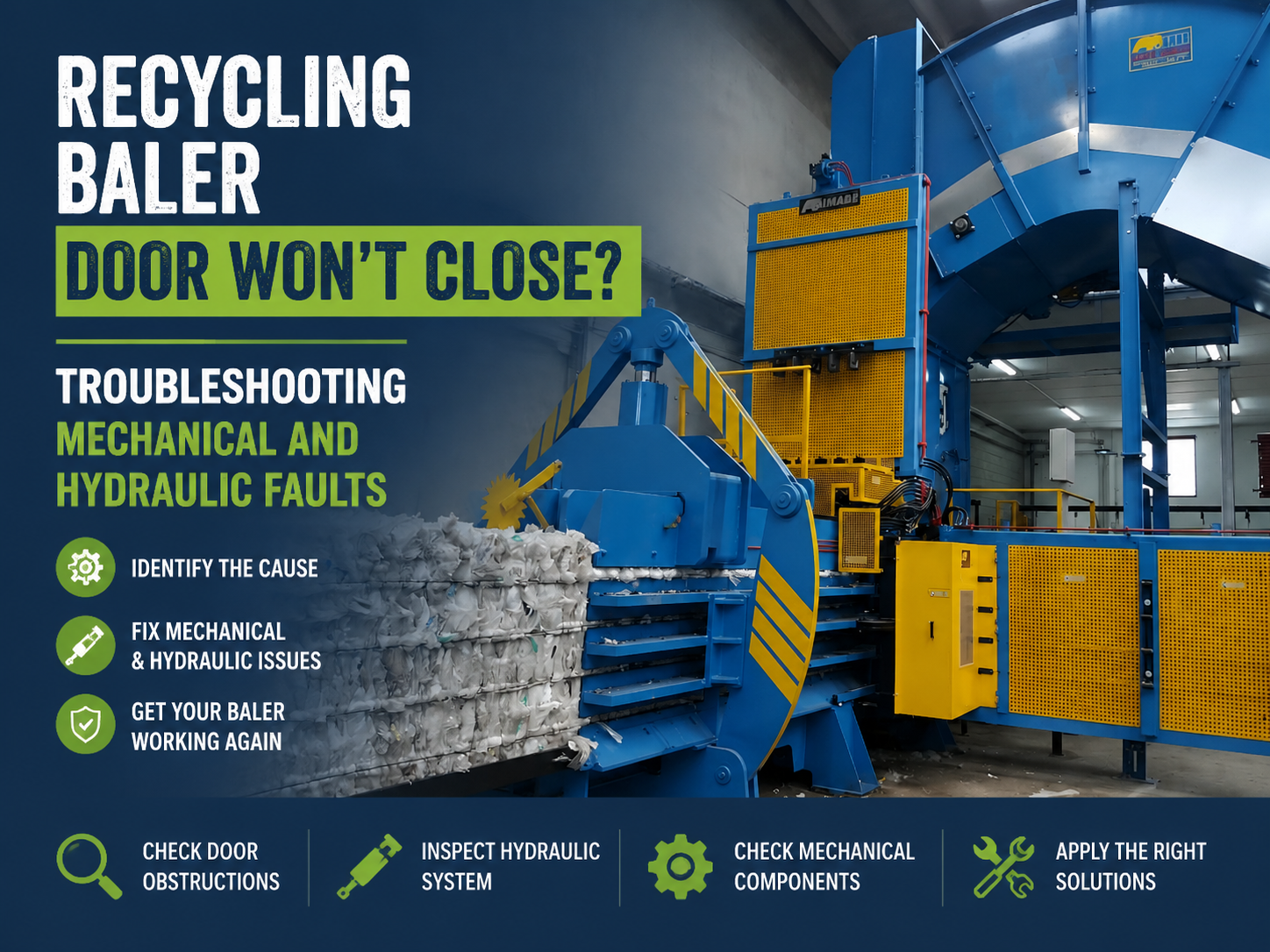
Recycling Baler Door Won’t Close? Troubleshooting Mechanical and Hydraulic Faults

Introduction to Recycling Baler Door Operational Challenges
In the high-intensity environment of a recycling facility or a metal fabrication shop, the recycling baler is the workhorse that ensures waste materials—ranging from cardboard and plastics to scrap metal—are compressed into manageable, transportable units. However, even the most robust machinery from industry leaders like HARSLE can encounter operational hiccups. One of the most common and frustrating issues operators face is when the recycling baler door won’t close. This problem is not merely a minor inconvenience; it is a critical safety and productivity issue. A door that fails to secure properly prevents the machine from initiating its compression cycle, leading to significant downtime and potential safety hazards for the floor staff.
Understanding why a recycling baler door won’t close requires a multi-faceted approach. The issue typically stems from one of two primary areas: mechanical obstructions or hydraulic system failures. Because these machines operate under immense pressure, every component—from the heavy-duty hinges to the precision-engineered hydraulic cylinders—must function in perfect harmony. When this harmony is disrupted, the machine’s safety interlocks will naturally prevent operation, leaving the operator to diagnose whether the fault is a simple physical blockage or a complex internal hydraulic leak. In this comprehensive guide, we will explore the systematic troubleshooting steps necessary to identify and resolve these faults, ensuring your recycling operations return to peak efficiency.
For facility managers and maintenance technicians, mastering the nuances of baler door mechanics is essential. Whether you are dealing with a vertical baler or a large-scale horizontal system, the principles of force, alignment, and fluid dynamics remain constant. By the end of this article, you will have a clear roadmap for troubleshooting “Recycling Baler Door Won’t Close? Troubleshooting Mechanical Hydraulic Faults,” allowing you to minimize repair costs and maximize the lifespan of your equipment.
Key Considerations Before Troubleshooting
Before diving into the technical specifics of valves and hinges, it is imperative to establish a safety-first protocol. Industrial balers exert forces measured in tons, and attempting to troubleshoot a door mechanism while the machine is energized can lead to catastrophic injury. The first and most important step is to implement a strict Lockout/Tagout (LOTO) procedure. Ensure that all power sources—both electrical and hydraulic—are disconnected and that any residual pressure in the hydraulic lines has been safely bled off. Never place your hands or tools near the door’s pinch points unless the machine is fully de-energized and secured.
Another key consideration is the environment in which the baler operates. Recycling facilities are notoriously dusty and prone to debris accumulation. Often, the reason a recycling baler door won’t close is as simple as a piece of stray metal or a buildup of compacted material in the door track or hinge area. Before assuming a mechanical or hydraulic failure, perform a thorough visual inspection. Clean the area around the door frame, the locking lugs, and the floor track. Small obstructions can often mimic the symptoms of much larger mechanical failures by preventing the door from reaching its final closed position, which in turn fails to trigger the safety limit switches.
Finally, consider the age and maintenance history of the machine. A baler that has been consistently lubricated and serviced is less likely to suffer from catastrophic mechanical failure. Conversely, a neglected machine may have multiple overlapping issues, such as worn bushings combined with a leaking hydraulic seal. Keeping a detailed maintenance log helps in identifying patterns—for instance, if the door has been closing progressively slower over the past month, the issue is more likely hydraulic (fluid degradation or pump wear) rather than a sudden mechanical break.
Technical Details: Mechanical Faults and Structural Integrity
1. Hinge Misalignment and Wear
The hinges of a recycling baler are subjected to extreme stress every time a bale is ejected. Over time, the heavy weight of the door, combined with the outward pressure of the compressed material, can cause the hinge pins to bend or the bushings to wear down. When this happens, the door may sag. A sagging door will not align correctly with the locking mechanism or the frame, preventing it from closing fully. To troubleshoot this, check for visible gaps or unevenness when the door is pulled toward the closed position. If the door requires manual lifting to close, the hinges likely need replacement or professional realignment.
2. Frame Distortion and Metal Fatigue
In heavy-duty metal fabrication environments, balers are often pushed to their limits. If a baler is consistently overloaded or if the material is not distributed evenly within the chamber, the frame itself can undergo “racking” or slight twisting. Even a few millimeters of frame distortion can prevent the door from seating properly. Inspect the frame for signs of cracked welds or paint flaking, which often indicates areas of high stress. Structural integrity is paramount; if the frame is warped, the door will never close correctly regardless of how much you adjust the latch.
3. Locking Lug and Latch Obstructions
The locking mechanism is the final point of contact. On many HARSLE balers, this involves a heavy-duty latch or a series of lugs that rotate into place. These components can become caked with grease, dirt, and fine metal particles, creating a paste that hardens over time. This buildup can prevent the latch from fully engaging. Furthermore, the latch itself can become burred or mushroomed from repeated impact. Filing down these burrs and ensuring the locking path is clear is a standard mechanical fix for a door that won’t stay shut.
Technical Details: Hydraulic System Failures
1. Hydraulic Cylinder Internal Leaks
Many modern recycling balers use hydraulic cylinders to open and close the door, especially on horizontal models. If the internal seals of the door cylinder are worn, fluid can bypass the piston, leading to a loss of “holding power.” In this scenario, the door might move toward the closed position but fail to exert enough force to compress the seal or engage the latch. You might notice the door “drifting” open after you attempt to close it. This is a classic sign of internal bypass, requiring a cylinder rebuild or seal replacement.
2. Directional Control Valve Malfunctions
The directional control valve (DCV) is the brain of the hydraulic circuit, directing oil to either the cap end or the rod end of the cylinder. If the valve spool is sticking due to contaminated oil or a weak solenoid, the door may not receive the full flow of oil required to close. Troubleshooting this involves checking the voltage to the solenoid and manually overriding the valve (if safe and equipped) to see if the door responds. If the door closes under manual override but not via the control panel, the issue is likely electrical or related to the solenoid coil.
3. Pressure Relief Settings and Pump Efficiency
If the entire hydraulic system is underperforming, the door is often the first component to show symptoms because it requires a specific pressure threshold to lock. Check the system pressure gauge while attempting to close the door. If the pressure doesn’t reach the manufacturer’s specified PSI, the pressure relief valve might be set too low or may be stuck open, allowing oil to return to the tank prematurely. Additionally, a worn hydraulic pump may not be able to generate the necessary flow rate, causing the door to move sluggishly or stop entirely when it encounters the slight resistance of the door seals.
Selection Advice: Choosing a Baler with a Reliable Door Design
When purchasing a new recycling baler, the door design should be a top priority in your selection criteria. Not all doors are created equal. For high-volume operations, look for balers that feature “heavy-duty” or “reinforced” door frames. HARSLE, for example, utilizes high-tensile steel and precision-machined hinges to ensure that the door remains aligned even after years of heavy use. A door that feels flimsy or light is likely to warp under the pressure of dense metal bales, leading to the very troubleshooting issues discussed here.
Consider the type of locking mechanism as well. Hydraulic locking pins are generally more reliable and require less physical effort from the operator than manual ratcheting latches. However, they do add complexity to the hydraulic circuit. If your facility has limited maintenance staff, a robust manual locking system might be preferable for its simplicity. Conversely, for maximum safety and throughput, an automated hydraulic door with integrated safety sensors is the industry standard. Ensure the sensors are high-quality, non-contact proximity switches, which are less prone to damage than mechanical limit switches.
Finally, evaluate the ease of maintenance. Are the grease points for the hinges easily accessible? Can the hydraulic cylinder be removed without dismantling the entire frame? A well-designed baler like those in the HARSLE lineup considers the “serviceability index,” ensuring that when a door won’t close, the fix is fast and straightforward. Always ask for a detailed hydraulic schematic and a mechanical parts breakdown before finalizing your purchase to ensure your team can handle future repairs.
Maintenance Checklist for Baler Door Systems
| Frequency | Task | Component |
|---|---|---|
| Daily | Clear debris from door tracks and locking lugs. | Mechanical Path |
| Weekly | Lubricate door hinges and latch pivot points. | Hinges/Latches |
| Monthly | Inspect hydraulic hoses for leaks or abrasions. | Hydraulic Lines |
| Quarterly | Check alignment of limit switches and proximity sensors. | Electrical/Safety |
| Annually | Test hydraulic oil quality and replace filters. | Hydraulic System |
Frequently Asked Questions (FAQ)
Q1: Why does my baler door close but the machine won’t start the cycle?
A: This is usually a safety interlock issue. Even if the door looks closed, the safety sensor (limit switch or proximity sensor) may not be triggered. Check if the sensor is misaligned, dirty, or if the actuator arm is bent. The machine’s PLC (Programmable Logic Controller) requires a “closed and locked” signal before it will allow the ram to move.
Q2: Can I bypass the door sensor to finish a bale?
A: Absolutely not. Bypassing safety sensors is a violation of OSHA regulations and poses a severe risk of injury or death. If the sensor is faulty, it must be replaced by a qualified technician before the machine is put back into service.
Q3: The door closes very slowly. Is the pump failing?
A: It could be the pump, but first check the hydraulic fluid level and the suction filter. Low fluid or a clogged filter will starve the pump, causing slow operation. Also, check for air in the lines, which can cause “spongy” or slow movement. Bleeding the hydraulic system may resolve the issue.
Q4: How do I know if my hinges are bent?
A: Open the door halfway and try to wiggle it up and down. If there is significant play, the bushings are worn. To check for a bent hinge, use a straightedge or a plumb line against the hinge pin. Any deviation from vertical indicates a bend that will prevent proper door seating.
Q5: What is the best lubricant for baler doors?
A: Use a heavy-duty, extreme-pressure (EP) grease, preferably one with molybdenum disulfide (moly). This type of grease stays in place under high loads and resists being washed away by moisture or pushed out by the heavy weight of the door.
Conclusion
A recycling baler door that won’t close is a significant hurdle, but with a systematic approach to troubleshooting mechanical and hydraulic faults, it is a manageable one. By distinguishing between simple physical obstructions and deeper hydraulic failures, operators and maintenance teams can drastically reduce downtime. Remember that the key to longevity for any HARSLE machine lies in preventative maintenance—regular lubrication, cleaning, and fluid checks will prevent the majority of door-related issues before they start.
Investing time in understanding the mechanical alignment and hydraulic pressures of your baler not only ensures a safer workplace but also protects your capital investment. Whether you are processing cardboard or heavy scrap metal, a functional, secure door is the gateway to a productive recycling operation. If troubleshooting steps do not resolve the issue, always consult with a professional technician to ensure the structural and hydraulic integrity of your equipment remains uncompromised.