
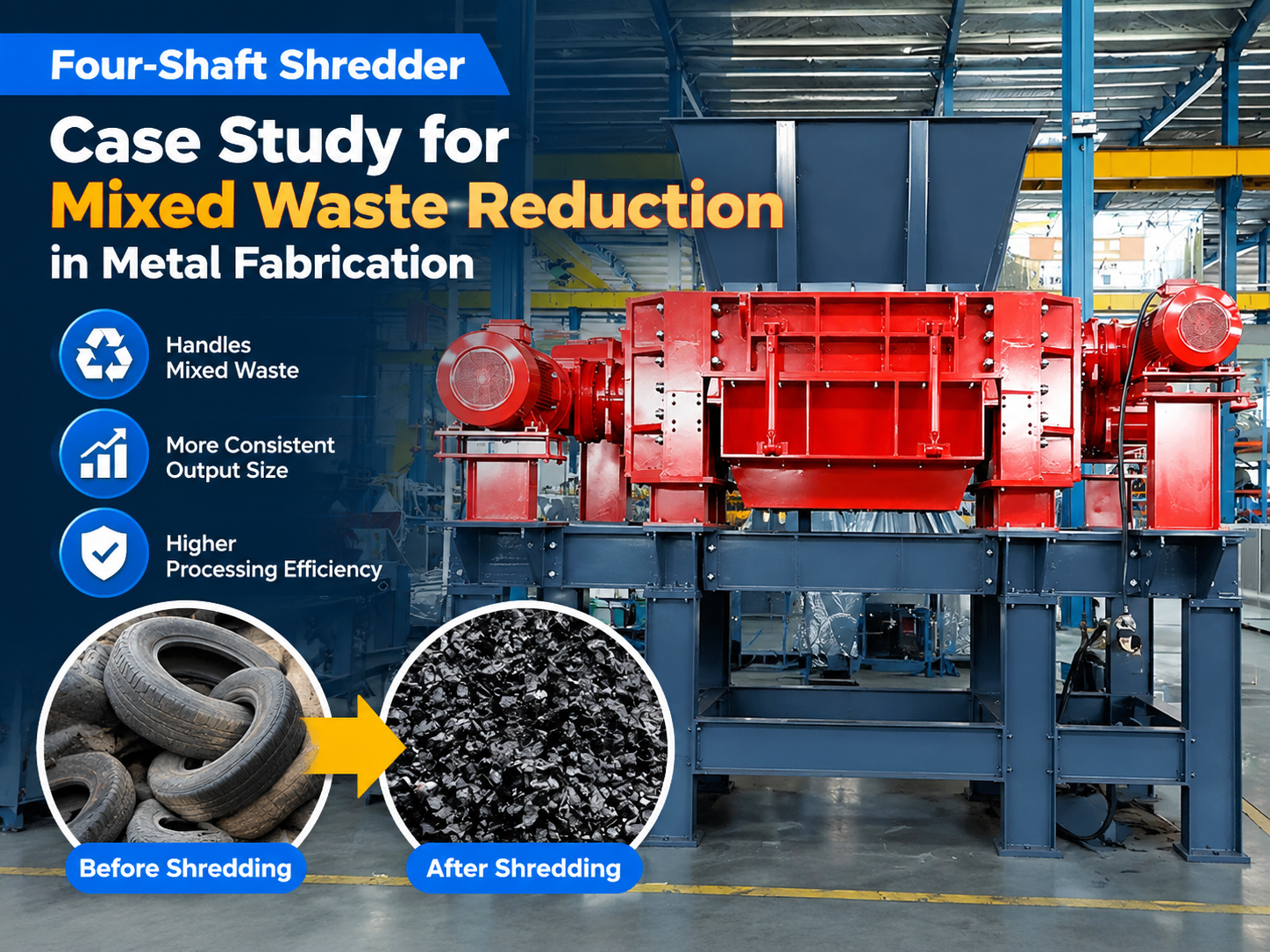
Four-Shaft Shredder Case Study: Revolutionizing Mixed Waste Reduction in Metal Fabrication

Introduction: The Challenge of Mixed Waste in Metal Fabrication
In the modern metal fabrication landscape, efficiency is not merely about how fast a press brake can bend a sheet or how accurately a laser cutter can profile a part. It is increasingly defined by how a facility manages its byproduct. Metal fabrication plants generate a complex stream of mixed waste, ranging from heavy steel offcuts and aluminum skeletons to tangled swarf, plastic packaging, and contaminated shop rags. Managing this waste stream is a significant logistical and financial burden for plant managers worldwide.
The implementation of a Four-Shaft Shredder Case Study Mixed Waste Reduction In Metal Fabrication reveals that traditional disposal methods—such as hauling bulky, uncompressed scrap—are no longer economically viable. As landfill costs rise and environmental regulations tighten, fabricators are turning to advanced mechanical shredding solutions. HARSLE has been at the forefront of this transition, providing robust machinery designed to handle the high-torque demands of industrial metal processing.
This article explores the transformative impact of integrating a four-shaft shredder into a fabrication workflow. By reducing the volume of mixed waste, companies can significantly lower transportation costs, improve material recovery rates, and create a safer, more organized shop floor. We will examine the technical mechanics, the strategic advantages, and the long-term ROI associated with this critical piece of industrial machinery.

Key Considerations for Waste Management in Fabrication
When evaluating waste management strategies, fabricators must first understand the composition of their waste. Mixed waste in a fabrication shop is rarely uniform. It often contains high-tensile steel, ductile aluminum, and various non-metallic contaminants. A standard two-shaft shredder may struggle with the density and variety of these materials, leading to frequent jams, excessive wear on blades, and downtime that halts production.
The primary consideration for any facility manager is the ‘volume-to-value’ ratio. Bulky scrap occupies significant floor space and requires frequent container swaps, which adds labor costs. By utilizing a four-shaft shredder, the material is reduced to a uniform, manageable size. This densification allows for more efficient loading of transport vehicles, effectively turning a waste disposal cost into a streamlined logistics process.
Safety is another critical factor. Manual handling of sharp, jagged metal offcuts poses a constant risk of injury to shop floor personnel. Automated shredding systems minimize the need for manual sorting and handling. By integrating a shredder into the scrap collection line, the facility creates a closed-loop system where waste is processed at the source, reducing the risk of accidents and improving overall workplace hygiene.
Environmental compliance and sustainability goals are also driving the adoption of shredding technology. Many metal fabricators are now required to report on their waste diversion rates. Shredding mixed waste allows for better separation of ferrous and non-ferrous metals using downstream magnetic separators or eddy current separators. This increases the purity of the scrap, which in turn commands a higher price from recycling facilities, directly impacting the bottom line.
Technical Details: How Four-Shaft Shredders Work
The core advantage of a four-shaft shredder lies in its unique mechanical architecture. Unlike two-shaft systems, which rely on a simple shearing action, the four-shaft design incorporates two primary cutting shafts and two secondary screen shafts. This configuration ensures that material is not only shredded but also sized to a specific output dimension before it is allowed to exit the cutting chamber.
The primary shafts are equipped with high-strength, wear-resistant blades that intermesh to tear and cut through tough metal components. The secondary shafts act as a sizing mechanism, pulling the material through a screen. If a piece of metal is too large, it is recirculated back into the cutting zone. This ‘positive displacement’ action is what makes the four-shaft shredder superior for mixed waste, as it prevents long, stringy pieces of metal from clogging the system.

HARSLE shredders are engineered with high-torque, low-speed gearboxes. This is essential for metal fabrication, where the material is often dense and hard. High torque allows the machine to ‘bite’ through thick steel plates without stalling, while the low speed reduces the heat generated during the process, preserving the hardness and integrity of the cutting blades. This balance is crucial for longevity and reducing maintenance intervals.
Furthermore, the control systems integrated into modern shredders provide real-time diagnostics. Sensors monitor the load on the motors, automatically reversing the shafts if a non-shreddable object (such as a large hardened tool steel block) is detected. This ‘auto-reverse’ feature protects the drivetrain from catastrophic failure and ensures that the machine can operate autonomously for extended periods, requiring minimal operator intervention.
Selection Advice: Choosing the Right Equipment
Selecting the correct four-shaft shredder requires a thorough analysis of your facility’s daily throughput. You must calculate the volume of waste generated in cubic meters per day and the peak load during high-production shifts. Choosing a machine that is undersized will lead to bottlenecks, while an oversized machine represents unnecessary capital expenditure. HARSLE provides consultation services to help fabricators match their specific waste profile to the appropriate shredder capacity.
Consider the material hardness and the presence of contaminants. If your facility processes high-strength alloys or hardened steel, you will require blades made from specialized tool steel with specific heat treatments. If your waste stream includes significant amounts of plastic or wood, the blade geometry should be optimized to prevent wrapping and binding. It is always recommended to perform a material test with a sample of your waste to ensure the shredder can achieve the desired output size.
Maintenance accessibility is another vital selection criterion. A shredder is a heavy-duty machine that will eventually require blade sharpening or replacement. Look for designs that offer easy access to the cutting chamber and modular blade sets. HARSLE designs its equipment with maintenance in mind, ensuring that downtime is kept to an absolute minimum through quick-change blade cartridges and accessible lubrication points.
Finally, consider the integration capabilities. Does the shredder need to be fed by a conveyor belt? Will it discharge directly into a compactor or a bin? The layout of your facility will dictate the footprint of the shredder. A compact, vertical design may be necessary for shops with limited floor space, while a horizontal, high-throughput system might be better suited for large-scale production environments. Always prioritize a system that fits seamlessly into your existing material handling workflow.
FAQ: Common Questions About Four-Shaft Shredders
- What is the main difference between a two-shaft and a four-shaft shredder? A four-shaft shredder includes two additional sizing shafts that ensure a uniform output size, making it far more efficient for mixed waste that requires consistent particle size for recycling.
- Can a four-shaft shredder handle hardened steel? Yes, HARSLE four-shaft shredders are designed with high-torque gearboxes and specialized blade materials capable of processing hardened steel offcuts and industrial scrap.
- How often do the blades need to be sharpened? Blade life depends on the abrasiveness and hardness of the material being shredded. Regular maintenance and proper lubrication significantly extend the interval between sharpenings.
- Does the shredder require a specialized operator? While the machines are highly automated, operators should be trained in basic safety protocols, routine inspection, and how to respond to the control panel alerts.
- How does a shredder improve my recycling revenue? By shredding and separating mixed waste, you can achieve higher purity levels for your scrap metal, which allows you to sell it at a premium price compared to unsorted, bulky mixed scrap.
Conclusion: Investing in Future-Proof Fabrication
The Four-Shaft Shredder Case Study Mixed Waste Reduction In Metal Fabrication highlights a clear trend: the most successful metal fabrication companies are those that treat waste as a manageable resource rather than a disposal problem. By investing in robust, high-torque shredding technology, fabricators can reclaim valuable floor space, reduce logistics costs, and improve the purity of their recyclable materials. HARSLE remains committed to providing the industrial machinery necessary to navigate these challenges, ensuring that your fabrication shop remains competitive, efficient, and environmentally responsible.
As we look toward the future of metal fabrication, the integration of smart, automated waste processing will become standard. The ability to process mixed waste on-site is not just an operational convenience; it is a strategic advantage that allows for a leaner, more profitable production cycle. Whether you are a small job shop or a large-scale manufacturing plant, the principles of volume reduction and material recovery are universal. By choosing the right four-shaft shredder, you are not just buying a machine—you are investing in the long-term sustainability and efficiency of your entire fabrication operation.












